
 •
Rating:
•
Rating:
THE REVIEW
Several years ago, I happened to spend a bit of time in the dressing room of Premiata Forneria Marconi before one of their concerts: a group of my friends was set to "open" for them that evening, and their guitarist had seized the opportunity to approach the virtuoso Franco Mussida to get some musical "tips"...
While we were there, around the two warming up with their acoustic guitars, someone asked Mussida who his favorite guitarist was. "At the moment, Rory Gallagher!" he replied dryly.
I was taken aback, expecting a Robert Fripp... or Steve Howe given their shared classical background, and instead, he named this Irishman full of feeling and immediacy, the opposite of his musical approach. So, I said on the fly: "But you play so differently, much more difficult!"... and he replied, "I don’t even try to do what he does! He’s from another planet! I had to study everything, while he just arrives there like that (and he snaps his fingers in front of my nose)... doing incredible things!"
If America gave us Stevie Ray Vaughan, Europe gave us Rory Gallagher: both donning a heavily used Fender Stratocaster, always the same one, both in a rock-blues trio making the guitar (magnificent) and voice (rough but "true", sincere) take center stage, both left us too soon, with Rory not making it after his liver, devastated by cirrhosis, was transplanted. When he gave up ten years ago, all of Ireland halted; it was a national mourning for what might be the world's most "musical" land, a great nation.
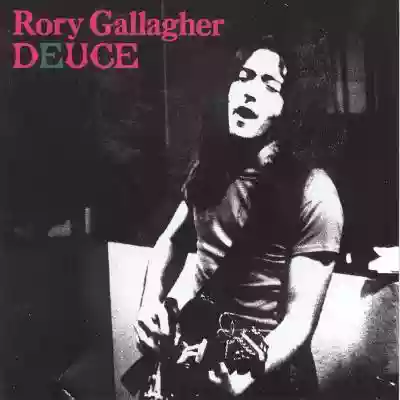
"Deuce" lets us hear him at the start of his career, in 1971. It’s his second work under his name, after two or three albums as Taste that rooted in the late sixties. A studio recording but the approach is totally and deliberately "live", and to fully achieve this, the "bases" of the tracks were recorded by rushing to the studio immediately after concerts, in the dead of night. The production is furthermore kept to a minimum, execution errors and imperfections are not corrected, and when the "vibe" was right, all well and good, onto the next. You can tell the songs emerge from inspired jam sessions (with him the loyal Gerry McAvoy on bass and Wilgar Campbell on drums) the group is extremely cohesive, the interaction among the musicians is spontaneous and vivid. Some overdubbing of solos, Rory’s gritty voice shot straight at you, and nothing else.
The album starts with "I’m Not Awake Yet", it’s semi-acoustic, very Irish due to a light Celtic jig rhythm, Rory starts by drawing inspiration from his land before referring to his American loves, using the electric only for a linear and quiet accompaniment, reserving embellishments and solos for the acoustic. Then comes "Used To Be" and it feels like a different record: imperial riff, magnificent, syncopated rhythm with his "rough" voice filling the pauses and the Stratocaster contrasting with its inimitable clean tone that leaves no escape, you can hear everything, the quality of each pick stroke, the micro uncertainties of intonation, and almost even the speaker cone working and the air it moves...
In "Don’t Know Where I’m Going" that follows, Gallagher is alone, voice, acoustic guitar, and harmonica, it feels like listening to a more bluesy Bob Dylan... who knows where to put his hands on the instrument. "Maybe I Will" smells of the sixties with its beat aftertaste and here too the guitarist performs an uncompromisingly clean solo, without safety net, alive and kicking, while in the next track "Whole Lot Of People", his first slide solo (a metal slide worn on the pinky and slid along the strings, without pressing them on the frets) is appreciated. Rory lingers there amidst continuous stop&go and intricate arpeggios.
The atmosphere rises to white heat with the next "In Your Town", a heart-stopping slide performance on a hypnotic and expand-at-will boogie rhythm (indeed, it was a classic in his concerts), then it partially calms in the dragging Muddy Waters-style blues "Should’ve Learnt My Lesson". With "There’s A Light", the musical landscape expands with very esoteric and sophisticated jazzy chords, offbeat drumming, and a melancholic melody, the kind Sting could successfully sing (listen to believe!). In contrast, the subsequent track "Out Of My Mind" is again acoustic and distinctly American-influenced, Rory plays and sings in Nashville folk style with tight virtuoso arpeggios and a “southern” vocal style.
"Crest Of A Wave" placed in conclusion is the most beautiful song on the album: highly lyrical and dominated by a long slide solo capable of bringing down saints. The guitarist lingers on a single chord stretching the emotional bow, and then, backed by the rhythm, he slides into a harmonic progression dispelling all possible doubts: it’s realized one is enjoying great music, the slide's work in this masterpiece generates something primordial, wild and free, ancestral and definitive, intense and nourishing feeling.
If you like rock guitar and in a store your gaze falls on CDs with a guy invariably wearing a checkered shirt and a battered Stratocaster on the cover, make sure to grab at least one. It’s him, it’s Rory Gallagher.
Loading comments slowly
Summary by Bot
This review highlights Rory Gallagher's 1971 album Deuce as a raw and live-feeling blues-rock work that showcases his guitar mastery and soulful voice. The spontaneous studio approach captures lively, imperfect performances that emphasize emotional expression. Songs blend Irish roots and American blues influences with potent slide guitar and acoustic textures. The album is hailed as essential listening for rock and blues guitar fans.Tracklist Lyrics Videos
Rory Gallagher
Rory Gallagher (also known as William Rory Gallagher) was an Irish guitarist, singer-songwriter and multi-instrumentalist associated with blues-rock and hard rock. He played in the band Taste before launching a solo career in the early 1970s and became especially celebrated for powerful live performances and a stripped-down, effects-light electric guitar approach.16 Reviews
Other reviews
By March Horses
Rory Gallagher, in his devotion to the old word with the wonders of modern amplification, was perhaps the greatest blues-rock musician of all time.
Splendidly and exquisitely imperfect.
