
 •
Rating:
•
Rating:
THE REVIEW
Irish Rory Gallagher has been one of the best rock-blues guitarists of all time.
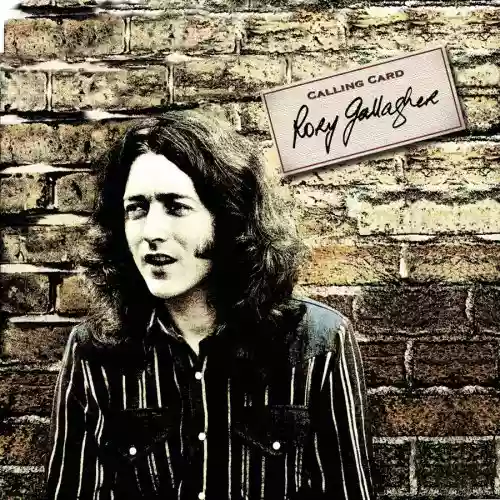
His art shone in all its glory, especially in fiery live performances. Not surprisingly, his most famous, and perhaps most beautiful, album is the live recording Irish Tour. However, in my opinion, it would be somewhat dismissive to categorize him simply as a great live performer because Rory produced quite a few studio albums, many of which are excellent. Among these, one of the most successful is undoubtedly Calling Card, an album from 1976, co-produced by Rory along with, at the time, former Deep Purple bassist, Roger Glover. Accompanying the guitarist were Gerry McAvoy (bass), Lou Martin (keyboards), Rod de'Ath (drums), the same band since 1973.
Calling Card is an excellent album, open to various genres, perhaps Rory's album where you can find the greatest diversity. It ranges from hard rock, to which the guitarist had heavily leaned already from the previous album, to ballads, from folk to jazz forays, but without descending into the banality and fragmentariness of rather conventional episodes, and without ever betraying the blues roots. Anyone unfamiliar with this album, or in general with Rory Gallagher, might think it's the classic album with the usual guitar acrobatics, and little else, music nice to play, musician's stuff, but not very interesting for the average listener. But no, these pieces are primarily beautiful songs, Rory had a great songwriting ability, and in this, he was superior to many other colleagues. In short, Calling Card, before being a brilliant example of genius guitar art, is a great rock album.
What strikes you from the first listen is the excellent production, nothing seems to be left to chance, and in this, the contribution of Roger Glover was fundamental. Roger and Rory had met years before when the Irishman opened some American concerts for Deep Purple. In some pieces, in fact, the influence of the Deep Purple sound is quite evident, among them "Moonchild", where a typically hard rock rhythmic structure supports a typically melancholic vocal and melodic line. - A little curiosity, when I first heard Moonchild, "Le vent nous portera" a famous single by the French Noir Desir immediately came to mind. But I don't want to accuse Noir Desir of plagiarism, I don't think at all that there are grounds to talk about plagiarism, I just note that in some passages the chords are quite identical, then maybe it's just coincidences -.
The album features other hard episodes, like the opening "Do You Read Me", an excellent mid-tempo hard blues, but especially "Secret Agent", the hardest piece on the album, which almost seems like it came out of an ZZ Top record, especially for the riff. Counterbalancing these are fine acoustic pieces like the excellent ballad "I'll Admit You're Gone" and the fun "Barley And Grape Rag", halfway between Irish folk and Dixieland. The title track is instead a successful fusion of blues and jazz, in which Lou Martin's piano splendidly duets with Rory's guitar, that Stratocaster worn out from frenetic use, and with which he brought out a splendid sound, perfectly balanced, able to jump between different genres and styles without ever losing its identity; what I like the most in this piece is the guitarist's "touch", something unique, hard to describe in words, impossible to imitate; no doubt about it, a masterclass display of great class.
But my favorite track remains "Edged In Blue", pure magic. Starting from the splendid initial solo, it's a chill down your spine that grabs you and doesn’t let go. And here, the musician's great compositional capability comes out; being a six-string ace is not enough to compose such a piece, you need to have the music in your blood, in your heart, not just in your fingers. The other tracks only serve to confirm the great form of Gallagher and the strong camaraderie among the band members, and it's perhaps the album in which a band sound comes out the most; the guitar remains prominent, but the other instruments are far from being mere extras. An album without weak points, even the two bonus tracks added on the CD version, "Rue The Day" and "Public Enemy" (here in the original version, slightly different from the one that would later appear on Top Priority), are episodes not to be underestimated.
In conclusion, I think it can be said without hesitation that this is a great album where Rory Gallagher has perfectly succeeded in his intent to experiment with new avenues, without losing touch with traditional rock-blues. Surely Rory Gallagher's brilliant guitar skills are more evident listening to his live performances, but on the other hand, such wonderfully crafted studio albums cannot be ignored. Sometimes, when talking about Rory Gallagher, the emphasis is on the fact that he is underrated. I don't know if he's underrated or not underrated, but what is certain is that he is less known compared to illustrious colleagues like Eric Clapton and Stevie Ray Vaughan, and the more I listen to him, the more I wonder why.
Goodbye and enjoy listening, to all, good, bad, beautiful, and ugly.
Loading comments slowly
Summary by Bot
Calling Card showcases Rory Gallagher's brilliance beyond live performances, offering a rich blend of blues, hard rock, folk, and jazz. Co-produced by Roger Glover, the album features strong songwriting, diverse tracks, and tight band interplay. Highlights include the soulful 'Edged In Blue' and the dynamic title track. This work reinforces Gallagher's underrated status among guitar legends.
Rory Gallagher
Rory Gallagher (also known as William Rory Gallagher) was an Irish guitarist, singer-songwriter and multi-instrumentalist associated with blues-rock and hard rock. He played in the band Taste before launching a solo career in the early 1970s and became especially celebrated for powerful live performances and a stripped-down, effects-light electric guitar approach.16 Reviews
