
 •
Rating:
•
Rating:
THE REVIEW
Dreaming helps us live our lives better.
Traveling too is an activity that can help us live our lives better.
Ronald Theodor Kirk clung to these two “lifelines” from a very young age to withstand his mocking fate.
Born on August 7, 1935, in Columbus, Ohio, he came to know darkness when, at the age of two, he became blind as a result of an incorrect dose of an ophthalmic eye drop.
Living in darkness, he loved to dream. In the dark, much more powerfully than in the light, the dreamlike finds a way to break into daily life. When he was very young, it was precisely on the inspiration of a dream that he decided to change his name to Roland, and later, again thanks to a dream he had in the early ’70s, he finally chose to add Rahsaan (the one who travels), perhaps to continue the journey of his all too brief but intense existence in his immense art of sound.
Kirk often said that, since he couldn’t read music, many of his musical insights came to him directly in his dreams. It wasn’t just a vague inspiration: he liked to repeat that while he slept, he heard complete compositions, including arrangements and instrumental parts with well-defined sound structures. One of the most cited pieces in this regard was “Serenade to a Cuckoo.” Roland affirmed, in fact, that he “received” it in a dream, almost as if it were already ready, so that on waking he had nothing to do but reproduce it with his instruments and record it. As easy as dreaming, don’t you think?
Starting at sixteen, when he dreamed of playing several wind instruments at the same time, he set himself the goal of achieving this. From that moment on, he began the incredible construction of a technique that was unprecedented. He studied until he became a blind black man who wore flashy clothes, with three saxophones (a tenor, a stritch, and a manzello found in a musical antiques store), a flute, a clarinet, various whistles and sirens all hanging from his body, so that he looked more like a street performer than a jazz soloist. But stopping at this image meant underestimating Kirk, who was anything but a special effect: he was a living musical archive, a system of sonic knowledge manifesting itself in real time.
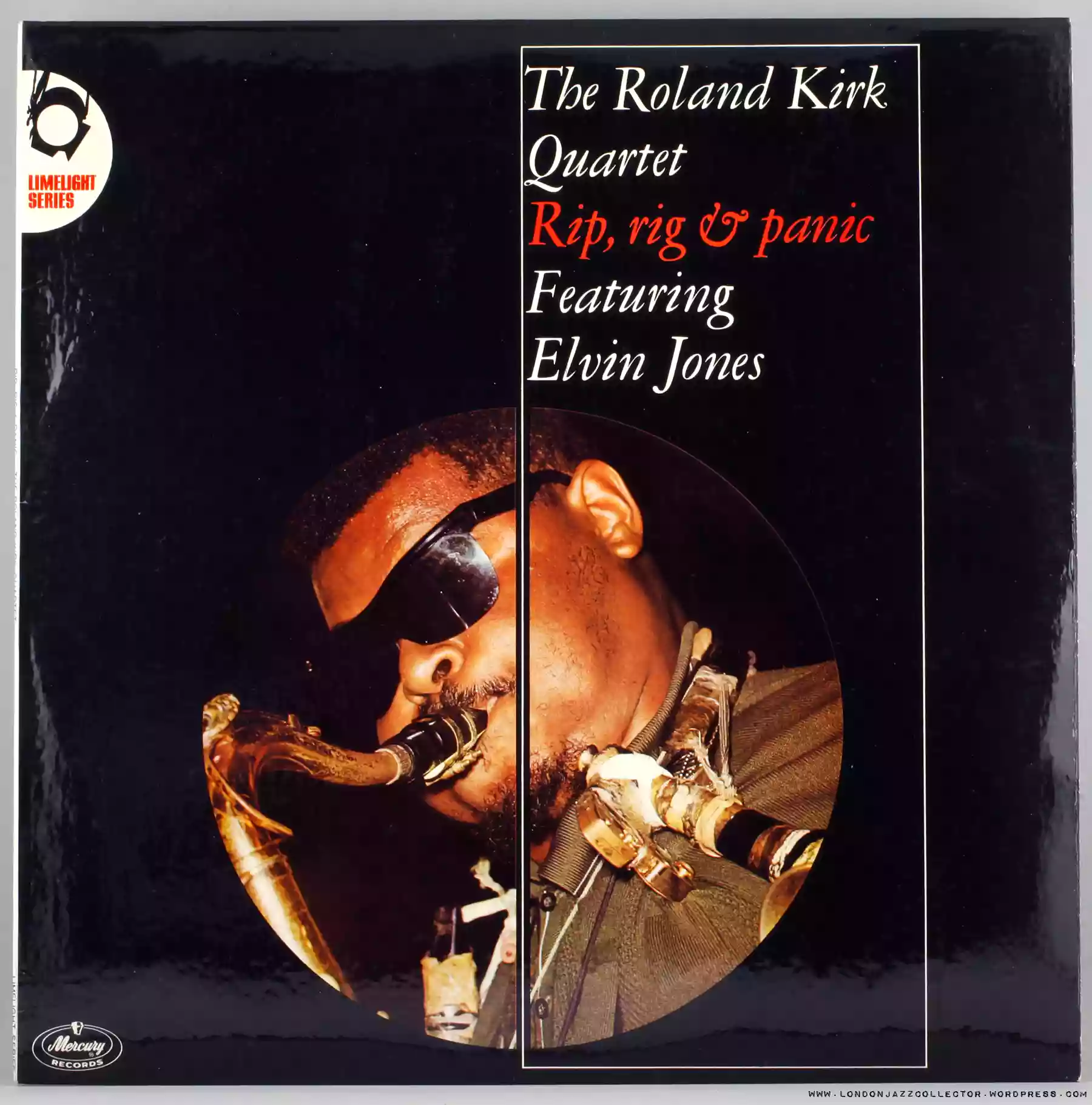
“Rip Rig & Panic” (SLML4015), released in 1965 by Limelight Records (a Mercury Records satellite label), by “Rahsaan” Roland Kirk is one of those records that cannot be described without beginning a journey into the mind and dreams of its author. It is a jazz album that has become a visionary manifesto in which tradition, experimentation, and theatricality coexist in a state of grace suspended in a state of permanent alertness, just as its title suggests.
Kirk himself explained the title of his masterpiece as if it were a kind of parable: Rip corresponds to sleep (“… To die, to sleep. To sleep, perchance to dream …”), Rig to mental rigidity (rigor mortis?!), finally Panic to the reaction one might have when someone suddenly breaks the mold.
In general, the entire album has a nocturnal concept: themes emerge, dissolve, return transformed. This idea runs through the whole record: it is music that wants to awaken consciousness from the torpor of everyday life.
It begins with “No Tonic Pres.” A lightning-fast opening, constructed as a tribute to Lester Young. It’s a fast, nervous piece. Kirk starts with a swing language, deforming it from within, inserting rhythmic fractures and sudden timbral shifts with the fine support of Jaki Byard on piano, and it’s already Panic.
“Once in a While” is an apparently more traditional ballad, inspired by Clifford Brown.
Here the lyrical side emerges: the tenor sax sound is warm, almost nostalgic, but is continuously traversed by cracks supported by the pulsing bass lines of Richard Davis. It resembles a wavering memory that cannot remain stable in the mind.
“From Bechet, Byas and Fats” is a triple homage to the art of Sidney Bechet, Don Byas, and Fats Waller. Kirk stages the history of jazz, structuring it as a simultaneous collage: not a philological citation, but a deformed reincarnation. The past becomes living, unstable matter.
“Mystical Dream” is the emblem of the album. Roland plays all his winds together, creating an almost hallucinatory effect. In particular, the flute part recalls Herbie Mann, who shares with him the credit of having fully introduced this instrument into jazz. The track floats, like a dream that shifts scene without warning. It is one of the moments in which technique and imagination coincide perfectly. It is explicitly born from a dream and seems constructed as a dreamlike flow: fragmentary, simultaneous, without hierarchies.
The title track “Rip, Rig & Panic” is the work’s manifesto. It starts from a relatively recognizable structure and then destroys it. Changes in dynamics, sudden explosions, tightly woven dialogues with Elvin Jones on drums, in a state of grace. Here the Panic is real: the listener loses all points of reference.
“Black Diamond” is a composition by Milt Sealey, more linear but no less intense.
It works almost as a relative pause: the group shows how conventional it could sound if it only wished to. However, even here Kirk inserts subtle deviations that prevent any easy adaptation to the mainstream.
“Slippery, Hippery, Flippery,” as the title anticipates, is an ironic ending (the ambulance siren) and slippery. It’s a continuous rhythmic game, almost dance-like, but always on the verge of slipping away. The record ends without a real conclusion: consistent with its character as an irregular and unpredictable flow.
The beating heart of this “musical experience” is Kirk’s technique: that of humming or “spoken sound,” and that of circular breathing or “supersoffio,” later a source of inspiration for many other musicians. The “supersoffio” is not a display of virtuosity. It is the means by which the musician breaks through the torpor (Rip), shakes us from rigidity (Rig), and provokes our awakening (Panic). In this sense, “Rip, Rig & Panic” is a perceptual experience that asks the listener to escape their own mental inertia, exactly as its creator intended.
This album is considered both one of Roland Kirk’s most important and a milestone in jazz, even though the jazzman was never favored by the critics of his time. They saw him as a freak, a sideshow phenomenon. His technical ability always seemed bizarre regardless of the music he was able to produce.
About Bird, Charles Mingus once said: "Look at those critics who keep talking to each other. They don't hear anything". The music critics were all white, and to please them, you had to play music they could understand, that they could fit into the established schemes of the mainstream: this can be done, that can’t, this is jazz, that is just pop. In other words, academic culture formats any phenomenon, transforming it into a trend, appropriating it and crystallizing its market rules. For the people of the ghetto, the music of that period was not a stylistic choice. It was rather a way of putting together lunch and dinner. If you get paid, you can play and sing anything, and if your skin is black, white people expect you to play only “black” music, even if you love Antonín Dvořák.
Despite this, his influence on music never ceased. Not just in jazz. Jimi Hendrix considered him his favorite musician. Ian Anderson found in him the key to bringing the flute into rock. Trombonist Steve Turre recounted how Kirk made him listen to records in the dark, to force all his attention exclusively on the sound. It wasn’t a theoretical lesson; it was a true sonic experience.
Roland Rashaan Kirk was also one of the most openly militant musicians of modern jazz. With the Jazz and People’s Movement, he “burst” into several television talk shows to denounce the systematic absence of black musicians from the mainstream media. He did not seek consensus; quite the opposite—he sought conflict as a means of visibility. Legendary was his performance on the Ed Sullivan Show, when in a gesture of defiance he switched the planned execution of “My Cherie Amour” with “Haitian Fight Song” by Mingus. His music became an act of public rebellion. It was precisely his sound, considered by purists as coarse, dissonant, even out of tune, that became representative of the variety of ferment running through the African American communities and art of the ’70s. The Black Muslim movement, Free Jazz, the blues, the civil rights struggles. His music identified him, just as the choice of the name Rahsaan did, aligning him with the rejection of the surnames imposed by the “white masters,” the same rejection that made Malcolm Little become Malcolm X.
His resilience is equally legendary. When, in 1975, he suffered his first stroke, he was left semi-paralyzed and had to have all his instruments modified so he could play them with just one hand. In a concert held at the Ronnie Scott's Club in London, he again managed to play two saxophones simultaneously in a masterful way. A second stroke took him away in 1977, at only 42 years old. He had just finished a concert at the Bluebird in Bloomington, Indiana.
His groove, after so many decades, is still untamed and strikingly current. It continues to touch the listener’s heart with its energy and resolve. It remains the “circular breath” that refuses to stop, the note that refuses to end. Rahsaan Roland Kirk didn’t play jazz, he played life itself, with all its disordered beauty, its necessary brutality, and its irreducible search for freedom.
"It's the trick they use, our masters. They make us famous and give us names: the King of this, the Count of that, the Duke of that. We'll die without a penny anyway. Sometimes I think I'd rather die than face this world of white people.": cit. Charles Mingus.
Loading comments slowly
Summary by Bot
This review awards Roland Kirk's 'Rip, Rig & Panic' a perfect score, highlighting its significance in jazz history. The reviewer emphasizes the album's powerful impact and Kirk's artistry. 'Rip, Rig & Panic' is depicted as a must-listen for jazz fans, esteemed for its innovation. The review is both enthusiastic and insightful. A recommended read for anyone interested in influential jazz recordings.
Roland Kirk
American jazz multi-instrumentalist (tenor sax, stritch, manzello, flute) famed for playing multiple horns at once, circular breathing, and a fiercely original style. Born August 7, 1935 in Columbus, Ohio; blind from age two; added “Rahsaan” to his name in the early 1970s. Active from the 1950s until his death in 1977.02 Reviews
