
 •
Rating:
•
Rating:
THE REVIEW
Via Urbana, little church of San Lorenzo, cold and semi-deserted. Yesterday I went to confess for the umpteenth time and promptly placed my left knee on the protruding nail poorly planted on the confessional step. I cannot move to the right, or I would slip out of Father Hugo's line of sight, which would be disrespectful. The nail torments me, and this is penance even before absolution. I deserve it in the end. I am a student. Impure acts, callused hands stuff. Will HE make me pay? And the Father: Yesterday a certain Rodrigo came, a Spanish mercenary with some Guarani Indians on his conscience. He killed his brother in a duel over trivial reasons, similar to yours. Woman contested. What should HE do to him?
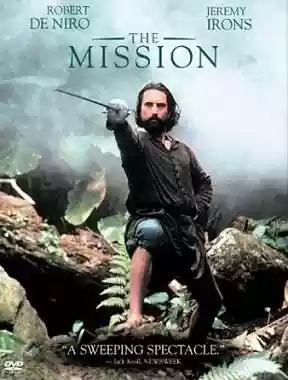
Corroded by remorse and devoted to idleness, Rodrigo (Robert De Niro) is persuaded by Father Gabriel (Jeremy Irons), a Jesuit, who invites him to repent and follow him to what in 1750 is the garden of Eden, even if surrounded by Spanish and Portuguese demons. Rodrigo’s burden is heavy, very much so, and the effort to carry it up among slippery slopes and wonderful waterfalls is a great deal. Upon reaching the objective, Rodrigo converts, and so do many Indians who were considered animals shortly before. Thus he discovers that Eden really exists, and with it, painted angels who live on the simplest tricks.
Unfortunately, sometimes HE gets distracted or at most, is distracted by the misleading voices of the exploitative and enslaving governor of the place, one Capeza (de cazo), and his entourage of henchmen, firmly convinced of the overflowing and savage insignificance of these Indians, incapable of participating in the Mission, hence invited (with coercive measure, of course) to abandon what is their earthly paradise. Perhaps there remains a small flame to be kindled, and by interposed pontiff, Cardinal Altamirano (Ray McAnally) is sent to ascertain the potential of the Indians, though tempted to desist by Cabeza (Chuck Low). The cardinal will find himself facing an absolutely splendid spectacle. Perhaps Eden really exists; the Guarani are converting to Christianity, becoming angels in their own right.
Unfortunately, the devil wins, and Altamirano is not entirely convinced. An attempt at mediation is made, a compromise, but it's all in vain. Better exploitation and economic interest, anything but HIM. In fact, HE wants it to be this way. The Indians are not worthy of Eden and must succumb to the Iberian invader. But sometimes a forgotten burden manages to bring forth something that has left a mark in the past, has engraved a destiny. Rodrigo remembers having been a mercenary, a skilled swordsman, a fighter, even a murderer and realizes that it's time not to yield to the devil, even with the use of that violence that had distinguished him before conversion. Father Gabriel, on the other hand, turns the other cheek and decides to carry on the Mission, amidst flaming arrows and rudimentary cannon shots until death on a cross. The Indians will be exterminated, but some children, hidden in the jungle, will have the courage to navigate towards a new life.
A beautiful work by Roland Joffé, with the contribution of an absolutely perfect cinematography by Chris Menges, skillfully blending the natural cold colors of the vegetation and monumental waterfalls with the warm ones of the rocks, the mud, and the Indians, in addition to carefully crafting perspectives that give the viewer the ability to imagine a limit in the shots. The soundtrack by our Morricone is exciting, rendered even more impactful by its use in contrast to the soul of the scenes. Therefore: in the canoe battle sequence, a dramatic scene that would require a disturbing, sinister comment, one of the most beautiful choirs ever interpreted is inserted, intense, pressing, poignant. A method, in my opinion, successful, used, as far as I remember, by Kubrick in "A Clockwork Orange," experimenting with a lively Rossini crescendo to depict the violent beatings of the Droogs, and by Herzog in "Stroszek", which uses a sparkling blues between the highs and harmonica of Sonny Terry, while a pick-up catches fire, Bruno S. flees by cable car and lobotomized pets entertain the spectators for the price of a token.
Mentionable is the metaphor of "Hope is the last to die," when an excellent De Niro, mortally hit by a shotgun bullet, delays dying, almost on command, hoping that Father Gabriel will succeed where he has failed, and while trying to hold on to the elusive life, barely manages to perceive, with a fading gaze, that even hope will unfortunately fall under the enemy musket shots. Father Gabriel, in a scene reminiscent of the poignant advance of Timos in Dovzhenko's "Arsenal," dies, but someone will pick up that crucifix destined, over time, to win. Formidable film.
Loading comments slowly
Summary by Bot
This detailed review praises Roland Joffé's The Mission as a deeply moving film about faith, sacrifice, and colonial injustice. The cinematography by Chris Menges vividly captures the natural beauty and harsh realities faced by the Guarani Indians. The score by Ennio Morricone enriches the emotional impact, carefully contrasting scenes with striking musical choices. The powerful performances by Robert De Niro and Jeremy Irons highlight themes of repentance and resistance. Ultimately, the film is hailed as a formidable and unforgettable work of art.
Roland Joffé
Roland Joffé is a British film director best known for The Mission (1986). His films often engage historical themes and notable collaborations include composer Ennio Morricone and cinematographer Chris Menges.02 Reviews
Other reviews
By mauro60
This film is among the best I’ve ever seen, a combination of components at the highest level.
"A god does not exist or, if he exists, he doesn’t care about us."
