
 •
Rating:
•
Rating:
THE REVIEW
When this morning, half-dazed by the flu and depressed by the grayness and rain, I got up and opened DeBaser, I unexpectedly smiled. Not that this site depresses me, mind you, it's magnificent and you all are magnificent. But a "no" day is a "no" day, and facing a review of a vintage Rod, moreover written so well, well, it hardly leaves you indifferent. Also because if the album in question, "Never a Dull Moment" superbly reviewed by Supersoul, I haven't listened to it yet, it at least reminded me of an lp that I listen to quite often (and not yet on DeBaser! And if I don't review it now, when?!), along with all the memories related to its purchase.
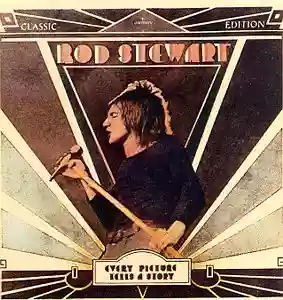
That autumn day three years ago there fortunately weren't any youngsters in the shop looking for Coldplay. Instead, there was a guy rummaging in the "bargain vinyl" corner, that is, all the reject economic editions of the '80s on offer. It so happens that the guy in question was yours truly, who while rummaging came across this very "Every Picture Tells a Story". Now, I didn't know much about Rod Stewart; actually, the little I knew were his more or less recent yells in the "singing in the shower" style that had indelibly marked the adolescences of my older cousins in the '80s. Which, as you might imagine, initially sparked repulsion toward the aforementioned album in my hands. But then I told myself: hey, calm down a bit. But didn't that record your brother bought, that "Beck Ola" from the Jeff Beck Group, have Rod Stewart as the singer? Yes, actually yes. I turned the cover over and took a look at the year. 1971. And come to think of it, I asked myself, where did I read that his very first records weren't bad at all? So, doing some math, given the negligible price, I decided to take a risk. And here comes the second problem. Because when you're used to spending at least one afternoon a week in THAT record store (a habit lost unfortunately, or fortunately for my wallet), to talking with a half-crazy shop owner who doesn't have too many problems (imagine especially when you have a bit of familiarity, as in my case) telling you to your face what they think of what you're buying, you get a bit scared. I approached the counter trembling, already imagining the string of imminent insults (and even hypothesizing fleeing without paying, maybe leaving the money outside the door at night with the shutters down, you know, just not to be infamous), and submitted it to his judicious yet unbalanced gaze. Well, his exact words were: "However... when this guy still knew how to work as God commands, unlike that ***** of Sailing". Now, I have nothing to say about "Sailing", if only because I've never heard it; I simply report the shop owner's opinion. So it was that I left the shop visibly satisfied to have escaped the wrath of his boss, and I was even more visibly satisfied when this vinyl edition that survived the digital advent, remained secluded for over two decades in its cover, kept away from any sharp object called a turntable needle, had the chance to melt, to free itself in my stereo speakers, while an entire building trembled...
Well yes, I'll tell you right away, this record makes the walls shake. Not that it's its fault, but this is a record that, as they used to say, is made to be played at full volume. Don't expect some masterpiece, but an LP of pure blood, sweat, tears, those of Rod and his fellow bacchanals, fights and plays by Ron Wood (at the time in Faces, not yet in the rolling gang), Ian McLagan (also a Faces companion) Mick Waller (old acquaintance, like Wood for that matter, dating from the Jeff Beck Group), as well as unsuspecting much calmer companies, like folk guitarist Martin Quittenton, violinist Dick Powell and Lindisfarne's mandolin player Ray Jackson. Music that may not be anything original, but rough and dirty like that of any great English rock record of 1971, be it the Rolling Stones, the Who or Led Zeppelin. The title track indeed starts with a vaguely Townshendian riff (even though played and co-composed by Ron Wood) and a shaking drum that can't help but remind you of Keith Moon, and ends with an incandescent duet with Maggie Bell (a great forgotten voice of '70s English r'n'b).
The first side then pleasantly passes through a ballad with soul and gospel tones ("Seems Like a Long Time") and a medley composed of the old rock'n'roll classic "That's All Right" and a rendition of the folk traditional "Amazing Grace", to end with a Bob Dylan cover. But the second side spares no one. After a round of acoustic guitar from friend Quittenton, it starts with "Maggie May", the song that on the "no" days lifts you irrepressibly, followed by another original, "Mandolin Wind", a folk rock ballad that feels a lot like Led Zeppelin III and IV, poignant as needed. But watch out, because if the Mandolin Song has sweetened you, you've irreparably let your guard down for the next "(I Know) I'm Losing You", a cover of an old Temptations piece of Motown memory, which between Waller's wilder and more possessed than ever drums, and Wood's lethal guitar riff (I like to think that a few years later Keith Richards remembered this song, before choosing Ronnie) finds its cornerstones. There's nothing to do, you've authentically torn your clothes dancing, you couldn't resist it and now you're back on the couch exhausted. To balance the accounts and quiet you, there's one last cover, this time by Tim Hardin (another famous '60s folksinger), "Reason to Believe", which brings back a bit of old and healthy melancholy.
The record ends, the turntable arm goes back to rest and you too, with your feet in slippers, certain that another day has passed, perhaps a difficult day, but that a good vintage Rod has straightened you up, as always.
Loading comments slowly
Summary by Bot
This heartfelt review recounts the discovery and lasting impact of Rod Stewart's 1971 album 'Every Picture Tells a Story.' The album is praised for its raw, authentic rock sound, memorable collaborations, and a selection of influential tracks that blend rock, folk, and soul elements. The reviewer shares personal anecdotes of purchasing the vinyl and highlights the album's ability to uplift and move listeners even on difficult days.Tracklist Lyrics Videos
