
 •
Rating:
•
Rating:
THE REVIEW
Thank heavens in our career as listeners we have not missed encounters with moody and irregular musicians, people capable of bringing out the best in themselves while walking the fine red line between the recording studio and the psychiatric ward. Like Mad Hatters who stumbled into a Hieronymus Bosch painting, amongst strange half-human, half-animal figures, to show the trailing visitors their wonders enclosed in a piece of black vinyl. Thus, the best works of Skip Spence, Syd Barrett, Roy Harper, were born when it was thought that their authors were no longer useful to the cause of rock music. Connecting Robyn Hitchcock, who held the charming electric pop of the Soft Boys in the early eighties, with these hooded lepers, is a very virtuous operation. He never went crazy, never attempted to hammer the rest of the band or ride a bus naked, but has always defended his creative freedom since he bid farewell to the (for him) mediocre Soft Boys and the pimple-ridden listeners of the usual pub.
Hitch, who had always been electric, in 1984 gathered his personal ghosts (Lennon, Barrett, McGuinn, Dylan, Ray Davies) and scattered them acoustically in the half-dozen different personalities that inhabited his mind depressed by the failure of his first two solo albums. The isolation in a cottage in Sussex leads to hearing insects buzzing in his head and wanting to capture them first with nets made of Chopin-like piano nocturnes ("Nocturne", "Flavour of Night"), then with cotton candy sprinkled over acid barrettian ballads ("Cathedral", "Winter Love", "Trams of London") or with bizarre a cappella vocal traps ("Uncorrected Personality Traits", "Furry Green Atom Blown"). The patience tested with a relentless hunt with hammering low guitar string hits (the shamelessly raydaviesian "Sounds Great When You're Dead" and the off-kilter country a la Skip Spence of "The Bones in The Ground") until trying more vigorous methods with adrenaline discharges of "Sometimes I Wish I Was a Pretty Girl" and the robust piano chords of "This Could Be The Day".
Since it's all useless and the insects are still buzzing there, before collapsing into a hell of nerves it's better to try to catch them by weaving webs in the recesses of the mind with ballads suspended between the purest light of "I Used to Say I Love You" and the mantra-like twilight of "Autumn is Your Last Chance". You know this was Syd Barrett's preferred method, but he never came back among us. Robyn Hitchcock did, however, and with the Egyptians in the following years, he would step out of Bosch's painting, expanding his colors with electric brushstrokes of absolute value.
But this remains a loony and ramshackle record that seeks to establish a complicity more than a simple listening: a lone man and a few instruments to wallpaper our hearts with yellowed leaves.
Loading comments slowly
Summary by Bot
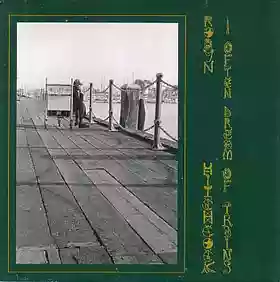
Robyn Hitchcock's 1984 album ‘I Often Dream of Trains’ marks an intimate, acoustic departure from his electric work with The Soft Boys. The record captures the artist’s creative freedom in isolation, blending surreal lyrics and varied acoustic techniques. Influences from Syd Barrett, Ray Davies, and other cult musicians are woven throughout. This loony and heartfelt album invites listeners into a unique, introspective soundscape filled with vulnerability and poetic oddities.Tracklist Lyrics Videos
Robyn Hitchcock
Robyn Hitchcock is a British singer-songwriter and guitarist, former frontman of the Soft Boys, and a key figure in neo-psychedelia. His solo work—often with the Egyptians—blends surreal, witty lyrics with folk, pop, and jangly psychedelia. He was the subject of Jonathan Demme’s concert film Storefront Hitchcock.08 Reviews
Other reviews
By GIANLUIGI67
Simply, in this work, he touched the strings of harmony.
Believe me, this is pure Hitchcock, visionary, innocent, inconclusive.
