
 •
Rating:
•
Rating:
THE REVIEW
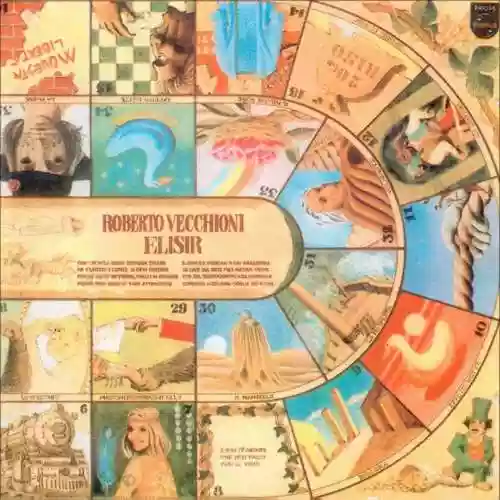
Dante, Petrarch, and Boccaccio. The 'Three Crowns' of Italian literature, what's the connection? Nothing except for the analogy of the number 3, this time regarding the diamonds spotted in Italian art music: 'Radici', 'Elisir', and perhaps the definitive, inimitable, and unsurpassable one: 'La buona novella'.
Now, let's not each make our own ranking, and don't scold me for the LP you love that I didn't include or for not having the same tastes as you (it would be crazy if we all agreed!), I'll try to explain why I included 'Elisir' among these beautiful moments of Italian music.
One of the few attempts at a 'concept album' by Vecchioni, who only after this record will start using a strong autobiographical component, often making albums 'accounts' of his tumultuous love life (especially 'Montecristo'), here we have a pure Vecchioni, who doesn't give much space to his invasive and unpleasant personal stories, something that will greatly impact 'Samarcanda,' making it a bit simple and dry for this reason.
The elixir is the journey into the unknown, the challenge to what is unknown, always holding your head high despite the total inability to understand what will be. In the review of 'L'isola non trovata' I mentioned the 'journeys' of Guccini and Vecchioni, which are indeed very different. Guccini's journey, towards an uncharted island, is a dark and desperate journey, a wandering through the shadows, with 'night' songs, without a destination, without meaning except to exorcise the fears of daily life and its vulgarities. One cannot avoid mentioning the LP 'Guccini', where 'Argentina' is somewhat the account of this senseless wandering, but above all, you can compare two model travelers: 'Gulliver', who dedicates his life to travel, and upon returning home finds in his hands only 'shells of words', which is what remains of his endless adventures; and 'Velasquez' whom we meet instead in this album, who is the eternal traveler, the one who continues traveling and must convince the crew to follow him, because only through travel does one advance, because standing still is dying, and an answer (which cannot arrive) must be sought. The elixir, the remedy for the 'hypertension' of two years prior, is for Vecchioni the fight, the strong faith in values of humanity and kindness, the struggle made primarily for and with others. I realize I have said a lot, but mostly there is much I have not said and will not say, about 'Velasquez'.
In the album, we find various reference points, let's not forget the obsession with artistic coherence, a theme that involves many of Vecchioni's 'ancient' works: these are Rimbaud, in the song A.R. (meaning round trip), the musician faithful to his art, pure and unblemished by compromise (Il suonatore è stanco) and even Guccini (Canzone per Francesco), the latter song has several facets, beyond the strong sentimentality, not yet a very strong component in Vecchioni, there is the profile of a 'mythical' figure, assimilated within for the parallels with the author's qualities and his history, this time it is a friendly figure, moreover in difficulty, the piece is a 'reply' to the beautiful 'Canzone per Piero', both songs end with the word 'male'.
I wanted to mention it but I forgot. Besides being full of beautiful songs, at least four of which can still be listened to live today (at least it happened to me) after forty years; besides being a 'conceptual' record that therefore has an individual and coherent story; it is also the album I would choose if I had to depict Vecchioni through just one of his LPs. Here lies everything, or almost everything, of the professor, and if you like this type of approach, where the entire output of an artist is encapsulated in an LP or a track (something I have heard about 'Smisurata preghiera' and consider ridiculous), here I could almost say that there's a track that is 'the' track, the one where all of Vecchioni is present, all his artistic strength and poetic gentleness, namely 'Figlia'.
"...and dreams, dreams, dreams come from the sea
for all those who have always chosen to make mistakes..."
an invitation to dream, to want to build even when convention deems us wrong. A discourse not unlike the one made in 'Sogna ragazzo sogna', more than thirty years later:
"...let them say that, in the world, those like you, will always lose..."
Moreover, the latter is a track written on the occasion of retirement and farewell, therefore, to the students. And of 'Figlia' he says precisely that "...it is a song I am glad to dedicate to my students..."
Loading comments slowly
Summary by Bot
This review praises Roberto Vecchioni’s album Elisir as a cornerstone of Italian music, highlighting its conceptual depth and poetic qualities. It contrasts Vecchioni’s journey motif with other artists and emphasizes the album’s artistic coherence and lasting impact. The reviewer sees Elisir as embodying Vecchioni’s essence and recommends the track ‘Figlia’ as a definitive example of his strength. The album is celebrated as both a tribute to travel and artistic purity.Tracklist Lyrics Videos
Roberto Vecchioni
Roberto Vecchioni is an Italian singer‑songwriter, lyricist, writer and academic from Carate Brianza. Active since the late 1960s, he’s known for literary, mythic and autobiographical songwriting. He won the Sanremo Music Festival in 2011 with “Chiamami ancora amore.”43 Reviews
Other reviews
By iside
"Geni, you either are from the beginning or you are not anymore/ I live in a world where we are all good, but none is a genius."
"We all think we are the only ones doing something important, and instead we only repeat other people's concepts; or, anyway, many of us in the same way are saying the same thing."
By MarkRChandar
Everything becomes warmer, and the torpor consoles you. A sort of temporary kintsugi that manages to connect sky and earth for 20-30 minutes.
No less than this, I am situated near the airport, a cloud of layovers and departures where countless planes come and go, tracing the same routes and consuming the sky.
By JpLoyRow
'Elisir' stands out as a testament to Vecchioni's enduring artistry.
The album’s lyricism and emotional resonance cannot be overstated.
