
 •
Rating:
•
Rating:
THE REVIEW
Time clarifies, it reveals with greater evidence. It happens that the kids at school suggest watching “Life is Beautiful” for Holocaust Remembrance Day. I think: “Oh no, I don’t feel like seeing it again. Nice, but… somehow annoying.” I don’t remember exactly when I first watched it—probably in the early 2000s. My memory was of a film with a brilliant, ingenious idea, and a corollary of little stories that were just so-so.
But time clarifies. A quarter of a century later, I watched it again as an adult, in the middle of an audience of twelve- and thirteen-year-olds who watched from the first to the last minute, laughing, getting emotional, applauding wholeheartedly. Times change quickly, and today the nineties seem like a golden age.
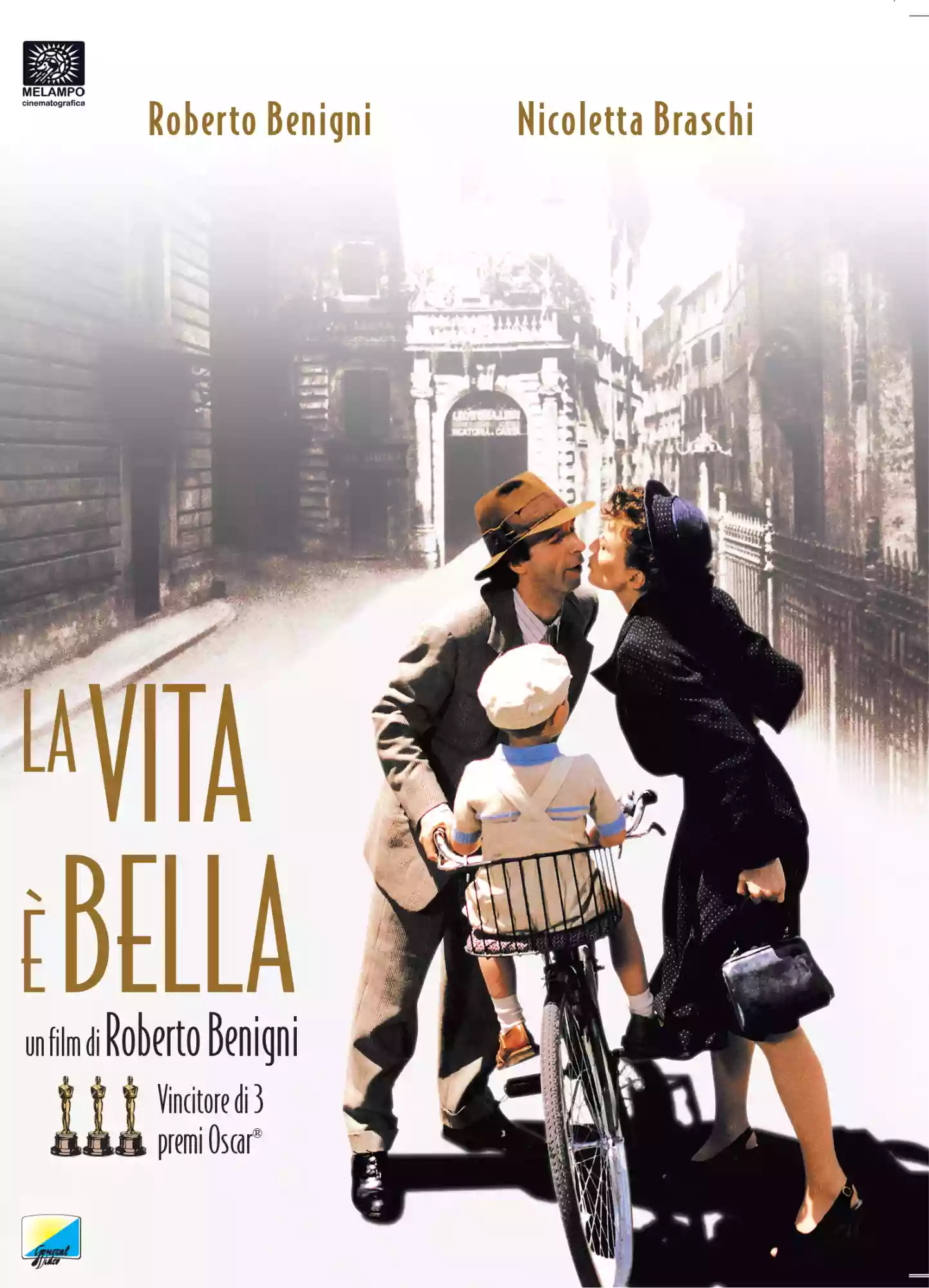
With the perspective of 2026, “Life is Beautiful” is almost a masterpiece. It’s a shame about Braschi’s acting (a bit stiff) and some production flaws (the camp setting isn’t entirely convincing), but otherwise I have to say it’s a remarkable work. Benigni manages to hold together simple, slapstick comedy (but never annoying), the horrors (never overemphasized), a love story and a story of death, but maybe, above all, a moving celebration of language that builds worlds, reshaping nightmares into play.
If years ago the juxtaposition of comedy (the first half) with historical tragedy (the second) struck me as rather jarring, rewatching the film now I actually think it’s one of its best ideas. Because extermination, Nazism, the camps are horrifying not only in themselves, but especially in the light of what came before—human bonds, stories in peacetime. Comedy illuminates the meanings of tragedy, because the latter alone (and emphasized) risks making us numb to it. We lose our sense of proportion, as History has taught us.
Instead, when we see Doctor Lessing in the role of the Nazi, we suffer more because we knew him from before. We’re embarrassed along with him, because it’s clear at that point that humanity must never be overshadowed by the uniform. Or at least, that’s how it should be.
The game invented by the character of Guido is not just a perfectly childlike counterpoint that highlights the follies of the adult world, but an authentic jewel of comic inventiveness. When Guido translates the Nazi officer dictating the rules, coming up with one trick after another to convince his son, we reach one of the film’s high points. Tragedy, the simplest and most popular comedy, literary transformation, the immense power of language and imagination. I still get chills just thinking about it.
The use of slapstick comedy is highly fertile. Guido is about to die, by firing squad, and he passes in front of his son’s hiding place, who sees him through a crack. But even in the face of imminent death, the man continues his act, marching like a fool so as not to disappoint little Giosuè. These are inventions that belong to a mind endowed with genius and great freedom.
Today, almost thirty years later, “Life is Beautiful” appears to be a distinguished work, despite a few small flaws, radiant. It illuminates life with an optimism that is never gratuitous or easy. A radical and difficult optimism: surrendering to horror is the most obvious choice; Guido finds the strength to rewrite the meaning of History, with words, with inventiveness, because we can’t show it as it is, especially to children. We must at least save them.
It made me reflect deeply. A very high ideal of civic, educational, artistic commitment. Perhaps even higher than the true possibilities of Benigni’s character. But this film stands as a testament. The degenerations of history are born from men who surrendered to the easiest logic, who gave up pursuing their dream, their princess, their fantastic story.
Guido doesn’t: he plays the clown to the end, even in front of the rifle.
Loading comments slowly
Summary by Bot
The review praises Roberto Benigni's 'La vita è bella' for its touching blend of humor and tragedy. Highlighting the film's powerful storytelling and emotional impact, the reviewer appreciates Benigni's direction and performance. The movie's optimistic outlook amid harsh realities stands out. Overall, it's regarded as a moving and unique cinematic achievement.
Roberto Benigni
Roberto Benigni is an Italian performer known for comedy as an actor and director, with international fame tied especially to the film "La vita è bella" ("Life is Beautiful").12 Reviews
