
 •
Rating:
•
Rating:
THE REVIEW
Reality or Madness?
The film directed by the German director of Polish origin Robert Wiene represents a journey into the deepest depressions and human frustrations.
The atmosphere is charged with tension and haunting fear. Fear of what might happen, terror of the future.
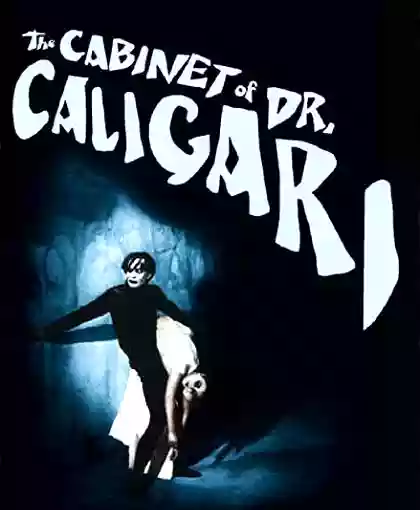
Everything takes place in an apparently tranquil provincial town, with its ordinary life and its ordinary psychodramas, accentuated by the surreal and dreamlike set design with its distorted perspectives, elongated shapes, and visionary colors.
Holstenwall drags itself into an exhausting and worrying routine that forebodes evil events, distressing omens, macabre enigmas.
A dark and obscure character and his infernal creature are about to overthrow the town's life. Dr. Caligari arrives with his burden of affliction at the moment of greatest social cohesion in Holstenwall, namely the town fair with its markets and attractions, proposing to the local community the classic freak show to leverage the morbid curiosity of the human soul.
Cesare the somnambulist, however, has a disturbing power. On order from his master, he wakes up and predicts the future. But his prophecies are of death that promptly come true.
The ones who pay the price are two friends, Alan and Franz, united by the same unhealthy curiosity and love for the same woman, Jeanne. The desire to know the future holds an intense attraction for them, and Cesare satisfies their wishes by foreseeing Alan's death at dawn the next day.
Faced with the loss of his brotherly friend, Franz finds no peace and begins a grueling search for the truth that will lead him to obsessively investigate Dr. Caligari's character. He will discover that the perpetrator of Alan's murder and other subsequent crimes was Cesare himself, who followed his mentor's orders to the letter.
The final result of his investigation will lead him to Dr. Oscar, director of the asylum, whom Franz suspects to be Caligari.
At this point, the drama unfolds.
Franz was right, Dr. Caligari is indeed the director of the psychiatric hospital, but what he still cannot understand is why the straitjacket immobilizes him and why Jeanne lingers so long in the asylum's garden. Could it all be a hallucination?
In the meantime, Dr. Oscar confides to him that he has discovered the cause of his illness and, therefore, is finally able to cure him…
According to some critics, Weine with his expressionist masterpiece wanted to warn the world of his anxiety about the situation that characterized the period between the two world wars, in which it seemed the German population awaited the dictator who would avenge all the humiliations suffered since the end of the Great War (not surprisingly, the film, which at the time of its release was unexpectedly successful, was censored by both Hitler and Mussolini). In this sense, it was theorized that Dr. Caligari represented Hitler, while Cesare the somnambulist symbolized the people composed of many will-less automatons, ready to blindly obey any order from the master.
However one may frame it, the fact remains that "The Cabinet of Dr. Caligari" represents an immortal cult classic not only of horror but of cinema as a whole.
Loading comments slowly
Summary by Bot
Robert Wiene's The Cabinet of Dr. Caligari is a masterful expressionist film delving into madness and societal anxieties through surreal visuals and a gripping psychological plot. The story explores dark themes of prophecy, violence, and truth in a provincial town disturbed by a sinister figure and his somnambulist. Considered a cult classic, the film carries deep allegorical meaning related to post-WWI Germany and remains a landmark in horror and cinema history.
Robert Wiene
Robert Wiene (1873–1938) was a German film director, best known for the 1920 expressionist film The Cabinet of Dr. Caligari.01 Reviews
