
 •
Rating:
•
Rating:
THE REVIEW
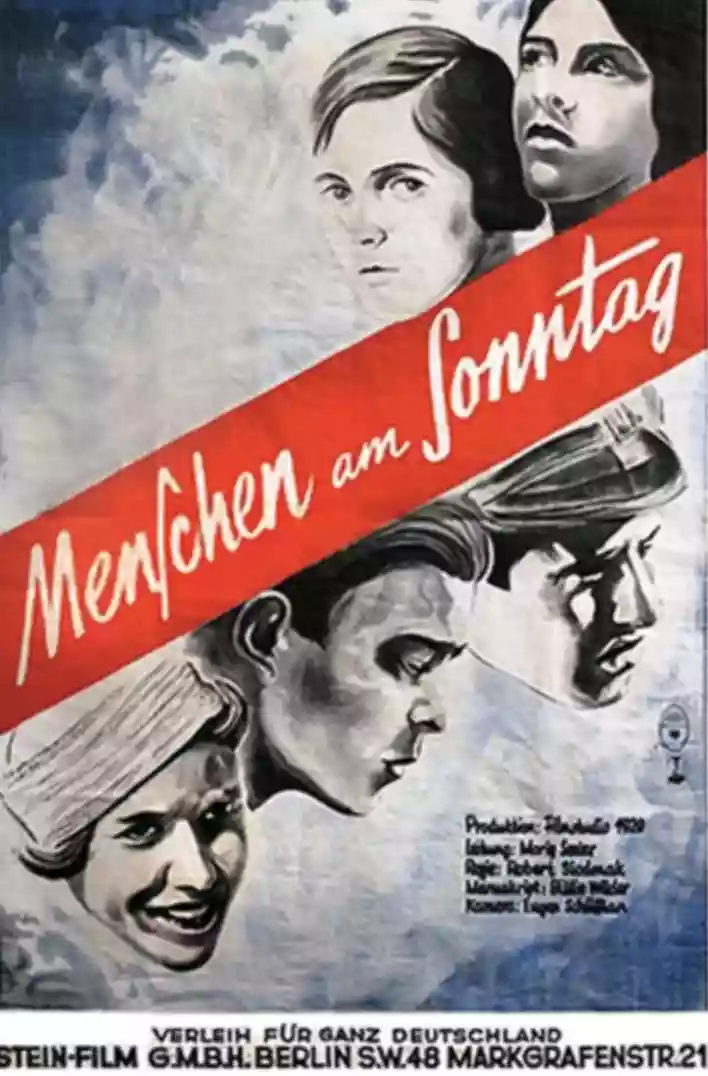
Traveling through time is an unattainable desire, a utopia that materializes indirectly only in literature and cinema. Menschen am Sonntag is a time capsule: a 73-minute silent film, often regarded as a forerunner of neorealism, which takes us back to 1930s Berlin with an almost documentary-like immediacy.
The Italian title, Uomini di domenica, alters the original meaning: "Menschen" simply means "people," and indeed the story follows a group of young Berliners - non-professional actors - as they spend their day off amidst flirtations, leisure, and small trivial events.
The taxi driver Erwin lives with Annie in a relationship that today we would euphemistically define as "conflictual." After yet another Saturday night clash, Erwin decides to spend Sunday with his friend Wolfgang, instead of Annie. Meanwhile, Wolfgang has met Christl and invites her to join them. The girl brings Brigitte with her, officially to keep her company, but in fact as a "spare wheel" for Erwin.
The quartet spends the day at the Wannsee lake, the favorite summer destination for Berliners. They eat, listen to music, swim, and, of course, flirt. Although the initial invitation was for Christl, Wolfgang quickly loses interest in her and seduces Brigitte. Later, he and Erwin begin to court two other girls they meet at the lake. On the way back, Brigitte tries to arrange another meeting with Wolfgang, but it’s clear he is not interested. Erwin, however, returns home to a furious Annie.
Despite its apparent lightness, the film portrays the brutality in relationships between the sexes, with raw realism devoid of moral judgments. For the contemporary viewer, there is an additional dimension, perhaps even more melancholic: that of an era at its twilight. The protagonists enjoy their Sunday in a crude and carefree way, while Monday (both real and metaphorical) looms - and with it, the end of the Weimar Republic. Freedom, cultural liveliness, and an unbridled zest for life are about to be trampled by the Nazi boot.
Directed by Robert Siodmak with the collaboration of his brother Curt and Billy Wilder, Menschen am Sonntag is available for free on YouTube.
Loading comments slowly
Summary by Bot
Menschen am Sonntag is a 1930 silent film directed by Robert Siodmak that captures a day in the life of young Berliners with documentary-like realism. The film explores youthful leisure and complex gender relationships without moral judgment. It also serves as a poignant reflection of a fleeting era before the rise of the Nazis. Praised for its historical and artistic value, it remains accessible and relevant today.
Robert Siodmak
German-born film director noted for his work in Hollywood film noir and for early films made in Germany. He directed Phantom Lady (1944) and co-directed/co-wrote the 1930 film Menschen am Sonntag with Curt Siodmak and Billy Wilder. He left Germany because he was Jewish and worked in the United States.02 Reviews
