
 •
Rating:
•
Rating:
THE REVIEW
"All week I have been at the piano and have composed, laughed, and cried at the same time; you will find the imprint of all that in my great Humoreske" (letter to Clara Schumann)
Contrary to what many believe, Robert Schumann was not a great virtuoso in practical terms. To achieve finger independence and reach a higher level, he used killer practices popular in the nineteenth century, which ended up partially damaging his hand. Chopin risked the same fate, but his father wisely prevented it in time. Unlike all the musicians who preceded him, Schumann was not a child prodigy, his maturation occurred later according to the era's standards and together with Wagner, he revolutionized the statistics. Great composers were emerging at an advanced age without particular virtuoso skills (Wagner had none for any instrument), yet capable of completely unpredictable creative innovations. Even his theoretical training was mostly self-taught, but this did not prevent him from becoming a virtuoso of the staff. Schumann's problem was having in mind works of extreme difficulty stifled by the inability to test them with practice; something that tortured him for life. Clara's father was his teacher. One day he made him play a Chopin polonaise and the comment was tragic: "You perform it like a dog!" he told him bluntly.
Feeling like a great composer capable of holding his own against Mendelssohn, Chopin, and Liszt, without possessing the same technical talent was a problem that significantly exacerbated his climb to the Olympus of the greats, consuming him from within. Fortunately, the greatness of a work always pays off in the long run, and Schumann wrote quite a few great works.
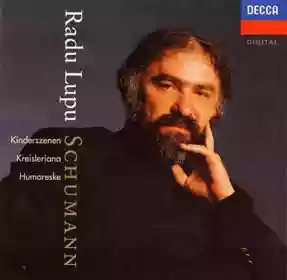
The Humoreskes are among the master's least known compositions for various reasons. I believe it was only because they had not yet found their ideal interpreter. That interpreter has finally arrived. Ladies and Gentlemen...
Radu Lupu!
The most beautiful gift the concert world has given us in the last fifteen years. A musician with a tough, serious, stern face, almost from another time. With his bohemian air completely out of context and a beard saying "clear the way as I grind you to pieces!" Someone who plays without having to prove he can astonish with technique, who takes his time, lays his sensitivity on the score, and lets emotions, moods, and feelings overflow. Someone who must give meaning to everything he plays; otherwise, it would make no sense to do it. In these compositions, he makes us feel everything; sudden mood changes, anguish, joy, confessions, languid romances, witty and cloudy trots, and the poetry of a soul. A true Chief!
The recording is perfect, but Decca is a label with serious standards that never fails. For those who want to hear an artist with a capital A a hundred floors high, this is a record that fits the bill. Great Schumann, thank you Radu Lupu. The hairdo is finished, go to the beach.
Loading comments slowly
Summary by Bot
The review highlights Robert Schumann's Humoreske as an underappreciated masterpiece, brought to life brilliantly by pianist Radu Lupu. Despite Schumann's limitations as a virtuoso, his compositions resonate deeply through Lupu's emotive and sensitive performance. The recording quality is praised, affirming this album as a must-listen for classical music lovers. Lupu's depth and mature artistry deliver the full emotional spectrum of the work.
Robert Schumann
Robert Schumann (1810–1856) was a German Romantic composer and influential critic. He wrote landmark piano cycles, songs, and four symphonies, and his marriage to pianist-composer Clara Schumann was central to his life and music. He struggled with mental illness and died in an asylum in Endenich.04 Reviews
