
 •
Rating:
•
Rating:
THE REVIEW
ROBERT FRIPP "Exposure" (EG Records) 1979
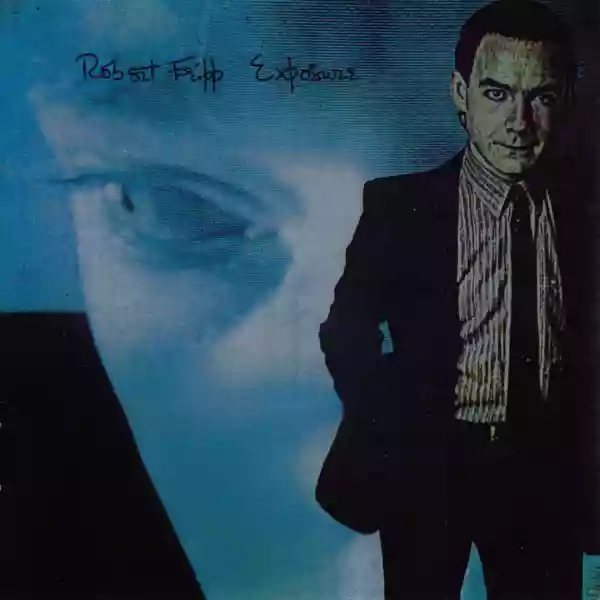
On the album cover, a photo of the musician with a large and perplexed female eye behind him. The image is grainy as if it came from a television broadcast, a closed-circuit video, or a snapshot. There’s a blurring of what we see and what watches us. The reference to the title is incredibly apt.
It is not a useless endeavor to contextualize temporally this work that appeared in 1979, amidst the cheerful beat of disco-music, the punk, and the burgeoning New Wave, marking a period of considerable transformation. Robert Fripp re-emerged into the music world that year after a period of absence due to an existential anxiety in which he was interested in various forms of esotericism, attending Yoga communities and following the teachings of mystics like Gurdjieff and Ouspenski. He began playing again, participating in albums by diverse artists: just to name a few, David Bowie, Brian Eno, Peter Gabriel, Brian Ferry, Roches, Blondie, etc.
The unusual aspect of this his first solo work is the fact that today it's possible to find in it an exact compendium of everything he had done but also everything he would realize. When I bought the album, I knew Fripp as a guitarist of extraordinary technique, never inclined to virtuosities for their own sake, and as a complex personality, sometimes pedantic, other times ironic, who had made musical research a strong prerogative of his. I found it an interesting but disorganized work, lacking organicity: a completely erroneous judgment, because, like a puzzle reassembling, it is a work that after thirty years reveals a stunning clarity of intent. Wanting to dive into a philosophical terminology, we could say that "Exposure" is a kind of phenomenological synthesis of Robert Fripp.
In the 17 tracks that constitute it, he allows the past (the King Crimson of which he was the guitarist and mastermind) to coexist and outlines his new musical interests. It is an album with distinguished participations: Peter Gabriel (who had recently left Genesis), Peter Hammill (who had disbanded Van Der Graaf), Daryl Hall, Phil Collins, Tony Levin, and Brian Eno. The tracks are half "canonical" and half anomalous, instrumental interludes ("Preface", "Water Music", "Haaden Two", etc.) in which you hear ambient sounds, frequencies, and hypnotic guitar interventions. In each of them, the "Frippertronics" is used, a name humorously boastful for a setup consisting of an electric guitar, two reel tape recorders with tracks dedicated to recording and others to playback through which the same magnetic tape is continuously looped: the sound, passing between the two devices, creates from each note of the performer an enveloping periodic repetition, an almost infinite echo that fades very slowly. A technique already present in tape manipulation of contemporary music but perfected here.
As in much avant-garde music, the listener should try to enter the flow of these "Urban Landscapes" without seeking the customary "before" and "after," but immerse in the "during." King Crimson fans will find traces of them in the melodic "NorthStar" and "Mary", and in the vibrant and syncopated "Breathless" performed with impressive and enthralling guitar technique. A homage to rock’n’roll is instead found in "You Burn Me Up Like a Cigarette" sung by Daryl Hall (one half of the duo Hall & Oates).
A significant portion of the lyrics (very original), are by Joanna Walton, a New York artist and writer who was among the 258 people who lost their lives in the Lockerbie, Scotland terrorist bombing of a Pan-Am plane in 1988. An example is the track "I May Not Have Had Enough of Me but I've Had Enough of You" with lyrics played on the lexical mixture of a phrase and its variations. In this song as well as in "Chicago", Peter Hammill's voice is present, so intense and powerful that it truly gives chills.
From a certain standpoint, the album shows episodes, real and imaginary, from Fripp’s life, for example in "NY3" where his guitar tensely follows the recorded voices of a quarrel between a girl and her parents in the New York apartment building where he lived. "Here Comes the Flood" written and performed by Peter Gabriel, is presented here in a different arrangement (voice, piano, frippertronics) compared to that on the ex-Genesis member's second solo album. The version here is, however, heavily dramatic. It appears clear Fripp's intention to push each singer to force their voice.
Indeed, the excellent Terre Roche shouts in "Exposure" articulating the single word of the text and its voice grows in intensity until it becomes piercing. A significant anticipation of today's visibility frenzy. This piece will also be interpreted by Peter Gabriel in his album.
In the introduction, you can hear the voice of J.G. Bennett (1897-1974), a curious figure of an English soldier and mystic, who in 1971 inaugurated the International Academy for Continuous Education in Sherborne, near Gloucester, declaring: "It is impossible to achieve an aim without suffering". Fripp met Bennett and attended his school: indeed, in the album, there is also a track entitled "First Inaugural Address To The I.A.C.E. Sherbourne House"
Shortly after "Exposure," Robert Fripp would rapidly release the more programmatic "God Save the Queen," "The League of Gentlemen," "Let the Power Fall," and re-enter the scene with King Crimson, reaching today’s fascinating soundscapes ("Pie Jesu," "November Suite," "A Blessing of Tears"), to continue a journey that seems endless.
P.S.
For those intrigued by subliminal messages, the track "Haaden Two" listened to in reverse, presents a strange phrase: "One thing is for sure: the sheep is not a creature of the air" taken from a sketch by the English comedy group Monty Phython, and not (as some seekers of satanic phrases would have it) a sacrilegious nod to Jesus Christ in the guise of the Lamb of God who takes away the sins of the world. It suggests that some Christians are more unreasonable than Satanists and rock...
P.P.S.
In 2006 a reissue of "Exposure" was published, which includes 5 additional tracks: they are interesting alternative versions of tracks already present on the album.
Loading comments slowly
Summary by Bot
Robert Fripp's 1979 solo album Exposure stands as a complex and revealing work blending his past with future musical explorations. Featuring collaborations with artists like Peter Gabriel and Brian Eno, it combines avant-garde ambient soundscapes with guitar innovations, including Frippertronics. The album merges experimental interludes with more traditional songs, reflecting Fripp's philosophical and musical journey. Exposure continues to impress decades later, especially with its 2006 reissue including bonus material.Tracklist Lyrics Videos
Robert Fripp
Robert Fripp is an English guitarist, composer, and founder of King Crimson. A pioneer of tape-loop guitar (Frippertronics) and later digital Soundscapes, he has collaborated with artists including Brian Eno, Peter Gabriel, and David Bowie.09 Reviews
Other reviews
By 47
The title track is pure madness, a voice spelling out the letters composing the word 'exposure' robotically and throughout the track.
This work follows the two albums in collaboration with Brian Eno, after the second disbandment of King Crimson.
