
 •
Rating:
•
Rating:
THE REVIEW
I almost don't feel worthy of commenting on such a masterpiece!
Rick Wakeman is the greatest keyboardist in the world, perhaps only matched by Keith Emerson. His career spanning over three decades has embraced all genres: from progressive to new age, from traditional Christmas carols to classical music. But of all of Wakeman's excellent discography, there is no doubt that this is the best album of all.
This work is still free of the pompousness that will characterize most of the subsequent albums. No orchestra, no singers, just the Wizard and his keyboards. 'The Six Wives Of Henry VIII' is an exhilarating work, a result of a moment of great inspiration. Recorded in 1972, the same year as the release of 'Fragile' with Yes, 'Six Wives' is a completely instrumental concept album where each song is named after one of the wives of Henry VIII.
It starts with Catherine of Aragon, where practically all of Yes play. This piece is perhaps Wakeman's most famous and immediately gives an idea of the album's atmosphere, which is magniloquent and marked by keyboard virtuosity (after all, it couldn't be otherwise). Choirs and acoustic guitar enrich the piece. Anne of Cleves is more lively, practically a long organ solo that lasts over 7 minutes.
Catherine Howard, on the other hand, is a slow piece and is perhaps the most beautiful song on the album: a magnificent piano intro, beautiful synthesizer stops, and the stunning folk played with the harpsichord. Pure poetry. In Jane Seymour, Wakeman's love for Bach returns because this is nothing but classical music with some synth interventions.
Anne Boleyn "The day thou gavest Lord hath ended" is the most prog track on the album, with multiple theme and rhythm variations where Wakeman lets loose. Catherine Parr is another memorable track with epic atmospheres. The number of musicians Wakeman used is incredible: Dave Winter, Steve Howe, Alan White, Bill Bruford, Chris Squire, Chas Chonk, Les Hurdle, Mike Egan, Dave Lambert, Barry de Souza, Ray Cooper, Frank Ricciotti, Dave Cousins.
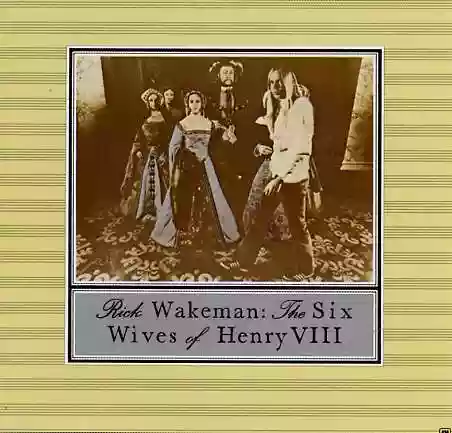
Also incredible is the number of keyboards Wakeman used: mellotron, moog, Hammond organ, church organ, electric piano, grand piano, the various synths and more (after all, just look at the back cover photo, where Wakeman is literally surrounded by them). But the most incredible thing is what he does throughout the entire album. Recording an album of this kind can't be easy at all. The cover is also amusing, with Wakeman cheerfully walking between Henry VIII and his wives.
No doubt about it: this album is truly fantastic.
Loading comments slowly
Summary by Bot
Rick Wakeman's The Six Wives of Henry VIII is hailed as his best album, showcasing remarkable keyboard virtuosity in a purely instrumental concept work. Released in 1972, the album features richly inspired compositions named after each of Henry VIII's wives, emphasizing classical influences and progressive rock elements. The absence of orchestras or vocalists highlights Wakeman's mastery across multiple keyboards, supported by notable musicians from Yes and others. The album remains a timeless and exhilarating masterpiece.
Rick Wakeman
British keyboardist and composer best known for his work with Yes and a prolific solo career of concept albums that blend rock, classical, and choral elements.06 Reviews
