 •
Rating:
•
Rating:
THE REVIEW
RICCARDO COCCIANTE 6-/10
Among the many (too many) books dealing with music, at least one is worth reading. It's from more than a few years ago, “Da una lacrima sul viso,” by Paola Marraone and Paolo Madeddu. Essentially, the two authors compiled a list of “sad” (or perhaps “deeply sad” would be a better term) Italian songs in which each of us could see something from our own badly ended love stories (and God knows how much, at this moment, I know something about that). Naturally, given the rather depressing choice of topic, the tone of the book is humorous. It’s worth reading. Among the selected tracks is “A mano a mano,” Cocciante’s version (Rino Gaetano’s cover is quite another matter). “...Because little by little the girl, tired of the room and driven by the mirage of hefty earnings, has become a lady of ill repute. We deduce this from the fact that before, ‘she was truer’ though poor, but now, ‘on Saturday nights,’ she no longer is. And this detail about Saturday nights doesn’t leave much room for other professions: go-go dancers, in ’77, hadn’t even been invented yet. Fine, if you really insist on defending her, let’s pretend she was a cashier at a (porn) cinema. Are you happy with this castle in the air? Don’t you want to just face reality?” write the two authors.
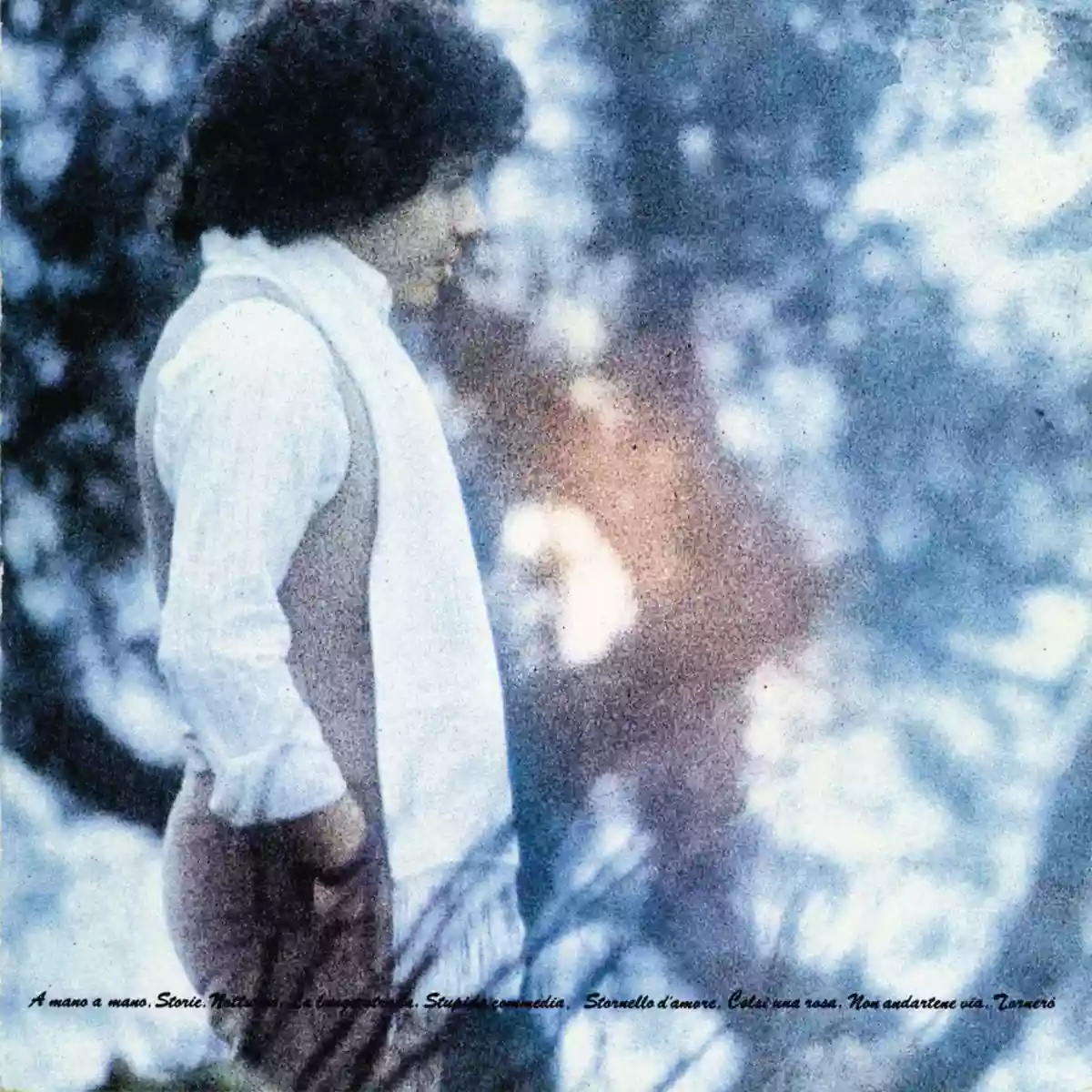
The laconic title of the album, “Riccardo Cocciante,” 1977/1978 (imagination at work—he’ll name another one “Cocciante” in 1982) comes out while the previous album, “Concerto per Margherita,” 1976, is still selling like crazy. In other words, it’s released too soon. What’s more, on the cover, Cocciante looks like a dandy out of time, head down, with a huge white scarf: in short, it doesn’t spark much joy. But then again, since when has Cocciante ever been cheerful? Perhaps only Mogol, with “In bicicletta,” gave him a lighter touch, but here we’re still at the collaboration with Luberti, and thus the tone is earnest. The most well-known song on the album is, in fact, “A mano a mano.” The album sold well (it reached, albeit briefly, second place in the hit parade, the single hit fourth place) and it represents a small (small, mind you…) “turning point” in Cocciante’s career, which shifts to a slightly more pop and timidly rock direction (meaning that on two tracks an electric guitar appears prominently), maintaining, heaven forbid, the usual lyrical and orchestral setup, here even more pompous than usual. The following album, that “...E io canto,” 1979, would plunge him into controversy over an alleged (and not entirely far-fetched) accusation of “making disengaged music” (therefore, not politically committed), and would be a flop whose roots can already be found in this 1977 self-titled work. Of course, the single aside—since it made history independently—the rest of the album is entirely (or almost entirely) anonymous, forgettable, and flat.
Two tracks are worth saving: “Notturno” and “Stornello d’amore.” The first is an “airy,” orchestral piece, not without a certain retro and melancholic charm; the second is a kind of stornello sui generis (but traditional in the jargon: jasmine flower; sunflower; mimosa flower, and so on) with a final refrain (but of course) that’s sad—love is over: “Fiore di margherita/non ha più senso questa mia vita/fiore di primavera/tu mi hai rubato la vita intera.” “Stupida commedia” wouldn’t be too shabby either, but that aforementioned electric guitar really gives the feeling of a half-baked experiment, left hanging with neither head nor tail. “Storie” and the final track “Tornerò” leave you perplexed, and not in a good way: the arrangement is heavily theatrical (it almost sounds like music for starting a hollywoodiano variety show—the kind where “the singer descends a staircase, dressed in white, hat in hand, dancers all around, and the show begins”—which has nothing to do with the mood of the album or even with Cocciante’s style). Too much of a good thing, as my grandmother used to say.
In short, it’s an album thought through, reasoned, and composed way too quickly, as if there were a fear that the success of the previous work might just vanish into thin air. Then, clearly, since we’re not talking about just anyone but a talented, capable artist like Cocciante, it’s obvious that, as said above, not everything should be thrown away—but that’s the “flaw” of most of his works: some beautiful moments, others much (much) less so. I struggle to think of a fully accomplished album of his. It had several foreign reissues, including a French one titled “Richard Cocciante.”
Loading comments slowly
Summary by Bot
The review delivers a harsh verdict on Riccardo Cocciante's self-titled album, awarding only 2 out of 5 stars. It suggests the album fails to impress in terms of originality or impact. The critical tone highlights the shortcomings of the release, reflecting disappointment. Little praise is found for the album's content or execution.Tracklist Videos
Riccardo Cocciante
Riccardo Cocciante (born 20 February 1946 in Saigon) is an Italian singer‑songwriter and composer. After early singles, he issued the prog‑leaning Mu (1972) and scored major hits in the 1970s–80s with piano‑driven ballads. Internationally, he is renowned for composing the musical Notre‑Dame de Paris and other stage works.05 Reviews
