
 •
Rating:
•
Rating:
THE REVIEW
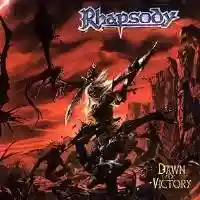
After two more than convincing albums, Rhapsody returns in 2000 with this Dawn Of Victory, which differs from the previous ones for a more direct and much heavier sound. The difference is fairly marginal, and Rhapsody continues to follow their now no longer innovative style, which blends orchestral music (Staropoli and Turilli are lovers of classical music) rather classical, fast rhythms in the typical power metal style, and epicness à la Manowar (with whom they share the title of band with the most nonsensical lyrics ever written).
The public and critics seem to have grown tired of this, and this album seems to mark a sad decline for the band. In my opinion, however, it remains a very good album thanks to its oozing epicness, and an excellent performance by the band (Turilli and Lione first and foremost).
Let’s take a closer look at the album: it opens with an epic intro, an essential in every work of the band, “Lux Triumphans”. After a very dark beginning, the intro reaches the pinnacle of epicness in a final crescendo and from the night rises the dawn, the dawn of victory, “Dawn Of Victory,” indeed, the title track, which maintains the epic tones of the intro with beautiful choirs and a great Lione, both enhanced by Turilli's guitar virtuosity. “Triumph For My Magic Steel” introduced by violins is a good track that stays on fast rhythms while “The Village Of The Dwarves” clearly harkens back to “Forest Of The Unicorns,” and is definitely one of the most successful tracks, reminiscent of typical medieval ballads, but with a pinch of extra epicness. "Dargor, Shadowlord Of The Black Mountain" is a nice track but not very original and together with the rather boring ballad "The Bloody Rage Of The Titans" is one of the least successful tracks on the album. "Holy Thunderforce" is the most unusual track, very aggressive and heavier than the Rhapsody standard, which displeased quite a few fans for its too direct style; in my opinion, however, it is another among the best tracks of this album. "Trolls In The Dark," an instrumental run dominated by Turilli's guitar introduces another beautiful track, "The Last Winged Unicorn," another typical run equipped with the usual epic choirs and the usual Turillian virtuosity. As usual, the last track, The Mighty Ride Of The Firelord, is the longest on the album with frequent rhythm changes and some citations from the intro and from "Eternal Glory," but it fails to convince as tracks with a nevertheless similar structure did ("Legendary Tales" and "Symphony Of Enchanted Lands") and proves to be far too long and verbose, considering also its constant repetition.
Here, it’s time for conclusions: Dawn Of Victory does not abandon the typical structure of previous albums (an intro, seven tracks, an instrumental, and a long final track that cites the intro) and the sound, which is nonetheless heavier, does not abandon the band's most typical clichés, such as epic choirs and orchestral accompaniment. The lyrics are as always terrible. In short: we are not at the levels of Symphony Of Enchanted Lands, nor even at those of Legendary Tales, but the album we are facing is nonetheless a good symphonic/power/epic work, although now not very original anymore.
Loading comments slowly
Summary by Bot
Dawn Of Victory continues Rhapsody's signature blend of symphonic orchestration and power metal with a heavier sound. While it lacks originality and some tracks fall short, the album still delivers strong moments of epic metal and impressive musicianship. The lyrics remain a weak point. Overall, it shows a decline from earlier releases but remains a solid metal work.Tracklist Lyrics
Rhapsody
Rhapsody are an Italian symphonic/power metal band associated with epic fantasy concept storytelling (notably the Emerald Sword Saga) and an orchestral, choir-heavy approach. Reviews frequently highlight the songwriting partnership of Luca Turilli and Alex Staropoli and the vocals of Fabio Lione.18 Reviews
Other reviews
By Starblazer
A song that is like an eternal flame warming the heart.
On its own, it’s worth the entire price of the album.
