
 •
Rating:
•
Rating:
THE REVIEW
Even though we are talking about an incredibly varied genre like prog, there is a component that unites almost all bands of the genre, whether we are talking about Jazz-Addicted, folklore, space-rock, experimental, and the like: the vocalist. Although some mentioned bands use their singers sparingly (especially speaking of some representatives of the Canterbury scene like Camel and the 2nd reincarnation of Caravan, Hatfield and The North), or even do not use vocalists at all (the first two works by Henry Cow must absolutely be mentioned in this context), the male gender at singing is an indisputable common denominator... nevertheless, there is the exception that proves the rule: Renaissance.
Born from the ashes of the Yardbirds, Renaissance changed their lineup multiple times before reaching their most successful formation; this happened after the first two albums, when, after yet another shake-up, Annie Haslam was hired, a vocalist still capable today of hitting very high vocal notes; her singing perfectly harmonizes with the artistic process of the band, led by folk guitarist Michael Dunford (who later became a composer and arranger at the expense of Rob Hendry), pianist John Tout, and drummer Terence Sullivan. Thus, Renaissance's most successful lineup was born, debuting with Prologue (1972, Sovereign), followed closely by Ashes Are Burning (1973, Harvest Records), with yet another change in lineup, due to the removal of the electric guitar, which led to Dunford's return to the guitar.
The change in sound between Prologue and Ashes Are Burning isn't as marked as it might seem, despite the removal of the electric guitar both albums are greatly influenced by quite clean melodies reminiscent of classical music greats like Debussy, Albinoni, Bach and others, without seeking gloomy or violent atmospheres; therefore, we are faced with a pure progressive group, rock rhythms are only accompanied by drums and bass, the use of electric guitar solos or sudden metronome accelerations are the prerogative of other bands, certainly not Renaissance, but this does not mean that we only find ballads and the like... it's a band with rather fast rhythms, songs like Prologue and Can't You Understand can make the concept extremely clear.
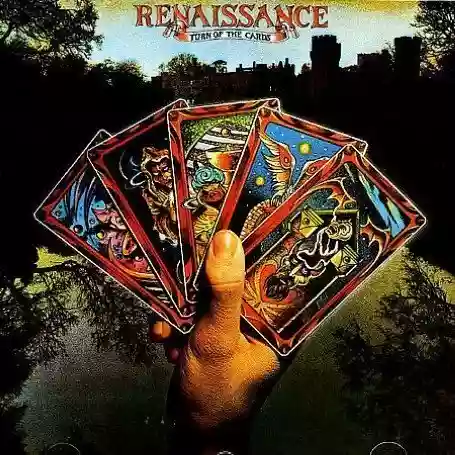
With Turn Of The Cards (1974, Sire), we probably reach the definitive maturity of the group: the result is a multifaceted album, each of the six songs will give us a different atmosphere, none will be identical to the previous one, even though we may not find a track that stands out above the rest; often this musical aspect is seen as a weakness, but in the case of this LP, we can safely say that the variety of songs is, in reality, its true strength.
Side A is presented with two medium-long compositions ranging from the epicness of Things I Don't Understand to the cheerfulness and light-heartedness of Running Hard, interspersed with the brief ballad I Think Of You, with a strong melancholic flavor marked by Dunford's folk guitar. Already the first three tracks let us understand that we are talking about an album that unfolds musical forms in continuous transformation, but the best is yet to come with side B.
We start strong with a piece rightly considered one of the group’s masterpieces: Black Flame is a track that starts slyly, then flows into the medieval notes of the refrain, which although accompanied by Haslam's gentle and resounding voice, present themselves to our ears quite strongly, thanks also to Dunford's guitar. The next track changes completely with the dramatic Cold Is Being: to better understand the drama this short but very intense piece can convey, let's assume you know Tommaso Albinoni's Adagio in G Minor, now imagine Haslam's incredible voice singing about an almost "apocalypse"-like atmosphere, add a haunting organ, and you have one of the most dramatic pieces ever written; if you don't know Albinoni's Adagio, well, know that it is one of the most serene but sad melodies ever, only Renaissance reinterpreted this melody by eliminating the serenity effect entirely. With Mother Russia we return to the epicness heard at the beginning of the album, with rhythms much more pressing than the previous songs, interspersed by brief moments of apparent tranquility and epic choirs sung by Haslam; a song that incredibly manages to give the sense of "cold" represented by the lyrics.
We have reached the end of an LP rich in ingredients and emotions, perhaps their best work, a must-buy for all Progressive lovers: if you are already familiar with Renaissance and are not yet aware of this work, it’s time to discover it; if you are a music lover and have never heard of Renaissance, you absolutely must remedy this.
Loading comments slowly
Summary by Bot
This review praises Renaissance's Turn of the Cards as a seminal progressive rock album led by Annie Haslam's exceptional vocals and Michael Dunford's folk influences. It highlights the album's musical maturity, variety, and emotional depth. Each track offers unique atmospheres ranging from epic to melancholic, making it a must-have for prog enthusiasts. The review emphasizes the band's distinct sound within the genre's landscape.Tracklist Lyrics Videos
Renaissance
Renaissance are an English progressive/symphonic rock band noted in these reviews for classical-leaning compositions, piano-forward arrangements, and the defining soprano voice of Annie Haslam. Their best-regarded period centers on the early-to-mid 1970s albums Prologue, Ashes Are Burning, Turn of the Cards, and Scheherazade and Other Stories, with later work moving toward more pop-adjacent sounds.12 Reviews
