
 •
Rating:
•
Rating:
THE REVIEW
Essential History of Electronic Music
XI. Skinny Puppy and the Second Industrial Era
The Factory of Death had spread the suffocating and heavy fumes of the industrial era into the air, at a time when the new decade was heralding contradictions in social, political, and cultural arenas. At the dawn of the '80s, at least three fundamental currents divided the ashes of the infernal mechanism marked by Throbbing Gristle: the English school of Cabaret Voltaire, Clock DVA, and Coil (founded by the veteran Christopherson), the German collective Einstürzende Neubauten, and the Canadian ensemble Skinny Puppy. In the most remarkable of artistic paradoxes, the English collectives distanced themselves significantly from the horridgian lecture by defining music detached from gruesome representations and essentially aimed at the recorded product (in fact, the Coil brought to light the most commercial effect of industrial music, quickly distorting its primordial meaning), while both in the unpredictable Germany of Einstürzende and in the even more unexpected Canada of Nivek Ogre and associates, industrial erupted in all its violent and bestial impetus. The Germans, anchored to the multifaceted talent of Christian Emmerich, immediately turned towards the shores of concrete music, forging an absolutely original artistic-cultural avant-gardism within the industrial Europe: armed with pneumatic hammers, barrels, metal saws, and anything else destined to produce the most unpleasant noises, the Einstürzende were able to create an art that was at once music and orgiastic representation. However, destined to more exquisitely popular success, were the Canadians Skinny Puppy, led by that controversial figure Nivek Ogre, a real neo-reification of Genesis P.Orridge's occult creativity.
Born in 1982 in Vancouver by the hands of Ogre (in real life Kevin Ogilvie) and drummer cEvin Key (Key Kevin William Crompton), Skinny Puppy quickly demonstrated, through their early works, a clear delineation of the traits of their musical aesthetic, distancing themselves from the chaotic noise of Throbbing Gristle in favor of a more conventional use of the instruments made available by electronics: synthesizers, drum machines, keyboards, and samplers soon became the main interlocutors of the Canadians' industrial nightmare. The first stone thrown into the pond was the eclectic "Bites" of 1985, already a marvelous example of Skinny's poetics: supported by an engaging live promotion, Nivek Ogre immediately placed himself as the modern bard of life's malaise, extracting from his Pandora's box the most brutal and feral aberrations of the contemporary age; in a scenario afflicted by eternal political conflicts, epidemics, violence against humans and animals, Skinny Puppy screamed their silent pain through Ogre's masochistic performances and a song form rooted in the most catatonic of streams of consciousness. In this regard, "Assimilate", the album's frontrunner and its strong piece, was indicative: on a soundscape too danceable to bring to mind the Throbbing sound, Nivek Ogre with a devilish voice enjoys dissecting references to contemporary man's discomfort, AIDS, animal experimentation, granting the electronic fabric a danceable hook like "Rot and assimilate, so hot to annihilate", closely confirming the self-destructive and decaying nature of the Canadian band. Nivek Ogre shortly shaped the conceptual current of Skinny, imposing his firm beliefs about the defense of human rights and thus becoming the controversial champion of a morality that might have amused any follower of the most nihilistic Throbbing Gristle. So if "Mind: The Perpetual Intercourse" (1986) was the album of reflection on the human condition, and "Cleanse Fold and Manipulate" (1987) dealt with AIDS, abortion, and religious issues, in 1988, "VIVIsectVI" denounced one of the topics dearest to Ogre's cause, the respect for animal rights, in a sort of concept where contemporary vivisection practices and related summary executions were put on the scaffold. What Skinny Puppy succeeded best in was visually captivating the crowds, when with long and exhausting experiments like the video version of "Testure", happily realized in a contrapasso where it is a human being vivisected, they managed to spread, censorship permitting, lethal realities through television.
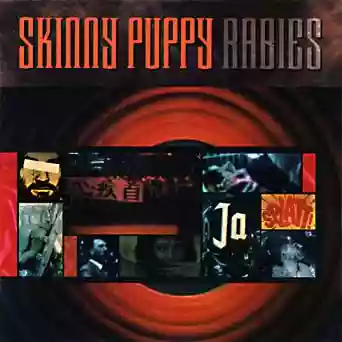
Amid lamentations about the censorious climate, the expressionistic masterpiece of the Canadian collective, the searing cry of "Rabies," saw the light in 1989. Fueled by the excellent contribution of Dwayne Goettel - acquired two years earlier - on keyboards, with a particular tribute to digital sampling and music production by Al Jourgensen of the Ministry, it stood as the group's mainstream work, endowed with an impetuous and iconic substance never seen before. If "Rodent" opens the dances through a triumph of musical and vocal samples lent to the dance hall, it is "Hexonxonx" that explodes in a martial dance nicely adorned by Ogre's usual stream of consciousness: among the masterpieces of the Canadian band, it stands as one of Nivek's most violent vocal expressions, a raging nursery rhyme where everything leads to the lamentable scream of "Taking blame", which is at once an accusation and a release. In perfect industrial metal style is then the neurotic "Tin Omen," another solid monolith where Jourgensen's guitar section follows the frenzied wake of "Fascist Jockitch," a noisy apocalypse where Ogre, Key, and Jourgensen seem to chase each other like fighting cocks. However, there is a musical and conceptual masterpiece, and this is "Worlock," a crucial point of the cosmic annihilation process through which Nivek Ogre passes, consuming himself in one of the most composed mad dramas of the entire Skinny Puppy production. In "Worlock," the Vancouver band accesses a visual language that surpasses the musical one, with good support from the usual video clip made with scraps from '70s and '80s horror, a legendary film which, further proving Ogre's denunciation of the excessive rigidity of European censorship, was ousted from MTV, much to the dismay of many aestheticists inclined to laxity. Nivek sings at first in an orderly manner, without exaggerating, in perfect harmony with Goettel's synths, with a manipulated voice that often abandons the unstructured form of the flow of consciousness: it's Ogre's composed madness that looks detachedly at the existing, the lucid and desperate awareness that "Soft Spoken changes nothing," a well-reasoned lethal notebook where scattered notes are penned. But shortly, after dissecting the most atrocious contours of life's malaise, Nivek accesses the most heartfelt of human laments; the transformation takes place in a non-electronically modified voice, and it is the human Ogre who, with a normal voice, screams from his painful abyss the cruelty of existence: "View so cruel" is the desperate lament born from the awareness of human temporality, the song of pain that lives in the human Ogre and not in its electronically distorted copy. "Worlock" is the masterpiece of Skinny Puppy's poetics, the intrinsic essence of an aesthetic that is painful participation in the existing. The album also features at least a couple of miraculous performances by Key and Goettel like "Rivers" and "Choralone".
The Skinny Puppy saga will still give birth to two good works: "Too Dark Park" (1990) and "Last Rights" (1992), able to confirm the group's skill in providing almost a decade of high-level music. Internal divisions first, and then Goettel's death in 1996, will define the decline of an already exhausted and uninspired band. Yet, Ogre's anguish will continue to linger for decades, the woeful litany of a barren and inhospitable landscape and its
cruel view.
If you didn't like this review, you can wait for the next chapter or go back and make another choice!
Loading comments slowly
Summary by Bot
This detailed review highlights Skinny Puppy's 1989 album Rabies as a landmark industrial metal work. It explores the band's evolution, blending synth-driven sounds with strong social and political themes. The review praises Nivek Ogre's expressive vocals and the collaboration with Al Jourgensen. Rabies is considered a pivotal album in the second industrial era, noted for its dark aesthetic and impactful visual elements. The review places the album firmly within the broader history of industrial music and Skinny Puppy's legacy.
Skinny Puppy
Skinny Puppy are a Canadian electro‑industrial/EBM group formed in Vancouver in 1982 by cEvin Key (Kevin Crompton) and Nivek Ogre (Kevin Ogilvie). Pioneers of dark, sample‑heavy industrial music and noted for confrontational, horror‑tinged live shows and animal‑rights advocacy, they were joined mid‑80s by Dwayne Goettel, whose contributions defined their classic period. After disbanding in the mid‑90s following Goettel’s death, they later reformed, releasing new work including The Greater Wrong of the Right and HanDover.06 Reviews
