
 •
Rating:
•
Rating:
THE REVIEW
Most likely, Wyatt's post-Dadaist ideas were not well-received by the members of the band he was in, the Soft Machine, perhaps because they were considered anti-jazz or maybe simply because they weren't grasped by the group... the fact is that the band's continuation without that important figure settled well within the boundaries of free-jazz, yet never reached those compositional heights that were present in their early albums, thanks to Wyatt's influence: "Hope for Happiness", "Why are we sleeping", "Pataphysical Introduction", "A Concise British Alphabet", "Dada Was Here" and the sublime "Moon in June" were among the best episodes featuring Wyatt with the band, proving that the young man in question was not only a skilled multi-instrumentalist and a distinctive singer, but above all, an excellent composer, a free thinker, a visionary across the board, a master of musical manipulation, a traveler without chains. And the Soft Machine felt constricting to him... or was it the other way around?
In an interview, he declares: "I felt really lonely and excluded. So I decided to record an album on my own. They let me do it because they thought it would all be in the style of Moon in June but I wanted to go further. There was supposed to be Mongezi Feza, but in the end, I did it with Elton Dean and Mark Charing; and my brother Mark played a bit of piano. It was a taste of what I could do. And I'm glad I allowed myself some piano parts, something I would never have dared to do in public, in front of real people. A touch of madness I like, it's one of my favorite human qualities. In the end, the things I always find myself working on have nothing to do with rock or jazz but rather with strange combinations of tapes and voice, more influenced, if anything, by the Goons [a BBC comedy group from the '50s and '60s, specializing in vocal alterations]."
In short, he demanded space... and with this album, he has gone beyond.
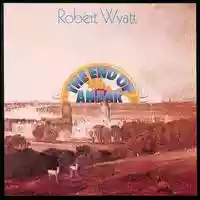
The music present in "The end of an ear" is unlabelable except as "free form", a musical proposal of Burroughs' "cut up", which he also drew inspiration from for the name of the Soft Machine. Wyatt manipulates tapes, shapes the musical matter at will, plays with sketches, sounds, noises, single notes, free vocalizations, in short, it seems like a primitive version of what samplers would do many years later, and theoretically, he can be considered one of the fathers of it.
It might just seem like a risky experiment, but it turns out to be more than successful: an extraordinary sound collage like none had been heard before, bathed here and there by droplets of jazz and psychedelia, positioning itself as a refined Dadaist version of Evans' "Las Vegas Tango" (already defined by the Canadian composer himself as "a sort of minor blues of impressionistic taste"), whose original jazz structure is terribly shattered and put back together.
The study of vocal harmonies pursued by Wyatt materializes into a balanced voice instrument, which, however, sounds mad, chaotic, almost apocalyptic, rising, lowering, fleeing away without the need to construct a motive but simply caressing it. Always in the background, the notes of the piano sting like "jazz-horror" arrows, and Wyatt's percussions almost like pliers suspend us in that chaotic and disordered whirlpool.
But Wyatt managed to go far beyond: if on one hand, his collage was musically abstract, on the other, the meaning it took on was more than concrete: he didn't need words to convey the state of mind of any idealist, which he probably was, in that period, the cradle of so many changes for humanity, actually adapting musical decomposition to human moral collapse. To say the least, brilliant.
"Las Vegas Tango" is all this, as well as "the end of an ear", and it stands proudly among the musical peaks reached in the last century. Among the two parts that make it up (the first of which is the "repeat" of the second) are the remaining seven tracks, with titles dedicated to friends, each worthy of note: it goes from the rhythmic Dadaist march of "To Mark everywhere" to the sharp whistle that converges with sax and horn at the end of "To Saintly Bridget", from the dazed bouncy rubberiness of "To Oz Alien Daevyd and Gilly" to the avant-garde jazz of "To Nick everyone", from the macabre organ of the catchy "To Caravan and Brother Jim" to the decidedly less somber piano of the carefree "To Carla, Marsha and Caroline (For making everything beautifuller)", not disdaining particular electronic experiments up to date, if not even ahead, as in "To the old world (Thank you for the use of your body, goodbye)."
The musicians involved in this album are: Robert Wyatt (drums, piano, organ, voice), Neville Whitehead (bass), Mark Charig (cornett), Elton Dean (saxophone), Mark Ellidge (piano), Cyril Ayers (percussions), David Sinclair (organ).
All friends with whom Wyatt simply wanted to make a youthful madness, and instead, he found himself with a great musical masterpiece.
Loading comments slowly
Summary by Bot
Robert Wyatt’s 1970 album The End Of An Ear is a bold and visionary solo project departing from the boundaries of jazz and rock. Infused with Dadaist and free form elements, it showcases Wyatt’s skills as an experimental composer and multi-instrumentalist. Featuring collaborations with noted jazz musicians, the album is a pioneering prelude to later musical sampling techniques. It stands as a unique sound collage blending chaos and harmony with psychedelic and avant-garde texture.Tracklist Videos
01 Las Vegas Tango, Part I (repeat) (08:13)
02 To Mark Everywhere (02:26)
03 To Saintly Bridget (02:21)
04 To Oz Alien Daevyd, and Gilly (02:09)
05 To Nick Everyone (09:12)
07 To the Old World (Thank You for the Use of Your Body, Goodbye) (03:17)
08 To Carla, Marsha and Caroline (For Making Everything Beautifuller) (02:46)
09 Las Vegas Tango, Part I (11:09)
Robert Wyatt
Robert Wyatt is an English musician, singer, and composer associated with the Canterbury scene, known for work with Soft Machine and Matching Mole and for a solo catalog blending jazz-rock, avant-garde experimentation, and politically engaged songwriting. In 1973 he suffered a fall that left him paraplegic; his 1974 album “Rock Bottom” is widely regarded as his defining masterpiece.24 Reviews
Other reviews
By alerussian
"The best way to describe madness is through the distorted and childish vision of reality that a child can have."
"Wyatt managed to rationalize madness by expressing it in a 'manneristically' Dadaist key."
