
 •
Rating:
•
Rating:
THE REVIEW
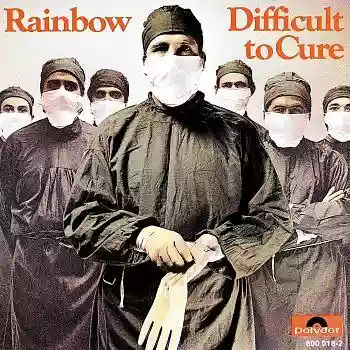
"Difficult To Cure".
There is no more fitting title for Ritchie Blackmore's personality; his mania for changing the line-up with each album is difficult to cure. In 1981, he decided to fire both Graham Bonnet and Cozy Powell, hiring drummer Bobby Rondinelli and American AOR singer Jou Lynn Turner. The first album of Rainbow's Mk V is centered on American Rock-Pop style. The elves and wizards, so dear to the Ronnie Dio's epic rock style, are now completely gone. Technically, it's an excellent album without a doubt, with Don Airey's contribution on keyboards proving invaluable, as is the rhythm section created by the Glover-Rondinelli duo.
The album opens with "I Surrender" (which was also the single from the record). It seems like an echo of the previous "Down To Earth" (which I appreciate, by the way), a song specifically built for Bonnet's voice, to which Turner must adapt. It's a catchy, typical AOR song, but not unforgettable. However, unforgettable is "Spotlight Kid", the speed-track that would open concerts in the '80s. A perfect, fast track, with a neo-classical interlude performed by Blackmore (just to keep his skills sharp) and a Moog solo by Airey.
"No Release" seems to come from a Michael Jackson album, with a beautiful intro by Blackmore, and the song seems promising but gets lost along the way, turning into an almost disco-like pop track. "Magic" is more of a filler song, too contrived and uninspired. In short: a workmanlike job.
"Vielleicht Das Nächste Mal (Maybe Next Time)" is a beautiful instrumental, a clear sign that when one strays from AOR, something good is composed. Excellent duet between Blackmore and Airey, who alternate and support each other. This track, in my very humble opinion, still seems to feel the influences of the previous album; let's say there is much more Britain than the USA. We return to the USA with "Can't Happen Here". A nice rock 'n' roll adapted to the '80s, in which Blackmore inserts another classical interlude that adds that extra touch and gives us a well-executed, gritty solo, as is Turner's performance.
"Freedom Fighter" is another song for American radios, while "Midtown Tunnel Vision" is extremely interesting, in which Turner tries to take on the role of a blues singer, with a song featuring a Hendrix-style intro (and vaguely reminiscent of "Dealer" from Deep Purple's "Come Taste The Band" album). The result is, in my opinion, really excellent; a bit of blues always does good.
The last song is the title track, "Difficult To Cure", definitely the best song on the album and one of Rainbow's most beautiful ever. The entire song revisits Beethoven's Ninth Symphony in a rock key (and I confess that thanks to it, I became passionate about that work). An enveloping song, from the first notes, you understand that you're about to listen to a cornerstone of Hard Rock. Blackmore reaches extraordinary heights of skill with his solo, and when you add Airey's accompaniment, using various effects (from chorus to strings), the result is simply marvelous.
Turner's debut is undoubtedly good, and his musical culture will lead to the much-hoped-for genre change desired by Blackmore, taking Rainbow towards a more commercial Rock for the American market.
For fans of the "Rainbow", this record is a must-have.
Loading comments slowly
Summary by Bot
Rainbow's Difficult to Cure marks a significant shift to an American Rock-Pop sound with Joe Lynn Turner's debut. Despite some weaker filler tracks, the album boasts strong performances, especially on the instrumental title track. Blackmore's guitar skills and Don Airey's keyboards shine, making it a must-have for fans. The album balances rock aggression with melodic AOR influences and hints at further genre evolution.Tracklist Lyrics Videos
Rainbow
Rainbow are a British rock band formed by guitarist Ritchie Blackmore after leaving Deep Purple, known especially for the Ronnie James Dio-fronted mid-1970s run mixing hard rock with fantasy/epic themes, and later for a more AOR-oriented direction with different singers.20 Reviews
