
 •
Rating:
•
Rating:
THE REVIEW
The opening 8 seconds of the most beautiful work by Raf that I know from the albums released between '89 and '93 ("Cosa resterà..." and "Cannibali") highlight a characteristic of his that is often underappreciated: the ability to write (on his own or with others) songs where the human element or love coexists perfectly with what happens in society and/or the world.
Yes, indeed, who would have ever written "Agnus Dei / there will be no redemption for our sins" in a summer song ("We are alone in the immense void that there is")? Tell me if in the '90s there was anyone else like him who combined all these elements in such a perfect way. I am certain the answer is NO.
Raf, having closed the previous decade in his own way two years earlier at Sanremo with "Cosa resterà degli anni '80" (a "particular" text, in some sense, for a young man of almost 30 years at that time), presented at the same festival with a very touching ballad in which the protagonist confesses his sense of disorientation (the same one that characterizes "We are alone" for other reasons) and his loss (or lack) of faith (of a "god") in the face of the upheavals of the world (for example "the arrival of other peoples"). And only in "love" is the key to be reborn.
I am talking, of course, about "Oggi un dio non ho". And it's truly true that the world (ours, the Western one) of 1991 had somehow lost its bearings: Gorbachev's perestroika, the fall of the Berlin Wall, the immigrations (especially in Italy) ("the arrival of other peoples") bringing new faiths and other cultures, the dissolution of the USSR, the endless conflict between Israelis and Palestinians...
In the face of all this, how can you stay upright with all the falling points of reference? Only the eternally sung love seems to be the answer (and the hope) to this.
Like Tozzi for other reasons, Raf arrives at the right time to sing about a new situation (for that time) for the common man: the approach to new faiths and cultures (from outside) that put or seem to put one's beliefs and/or ideologies in crisis (and the consequent sense of disorientation that characterizes it).
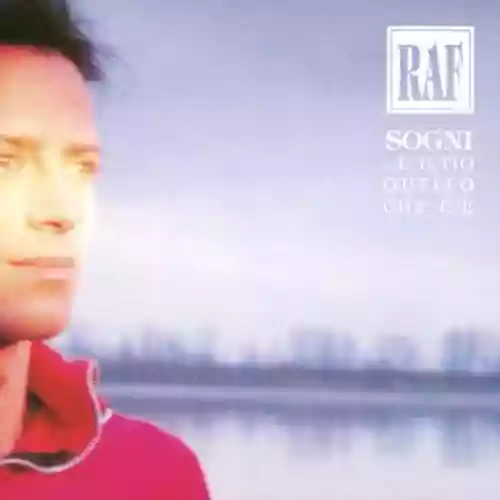
And closing with the theme of "disorientation," I am speaking of the final title track "Sogni".
"Sogni...is all there is". Exactly! When everything collapses and the world around you is unstable, it is only dreams that save you, our protagonist tells us. And it's really true! I will never be able to say enough about this (masterpiece of) album.
Another track I want to highlight is just one: "Interminatamente". The second track on the album and a word that has never, in my opinion, been used in common language, but a beautiful love song.
To note (my tastes, of course) also "Malinverno", "Anche tu" (sung with Eros Ramazzotti) and "E' meglio così" (especially for the harmonica solos).
Yes, I firmly believe that Raf had his moment of (great) glory between '89 and '93, with the most beautiful episodes, in my opinion, being "Ti pretendo", "Cosa resterà", "Santi nel viavai", "Oggi un dio non ho", "Siamo soli", "Battito animale", "Cannibali" and "Due" (a parenthesis with "Infinito" in 2001).
The rest, however, went, in my opinion, to acceptable levels. What do you think?
Loading comments slowly
Summary by Bot
This review praises Raf's 1991 album 'Sogni... e tutto quello che c'è' as his finest work between 1989 and 1993. It highlights how Raf beautifully intertwines personal love themes with social and political upheavals of the time. Special mention is given to songs like 'Oggi un dio non ho' and 'Interminatamente', alongside his collaboration with Eros Ramazzotti. The album is celebrated for its deep emotional resonance and reflection on faith and cultural shifts.
Raf
Raf (Raffaele Riefoli) is an Italian singer‑songwriter active since the 1980s, known internationally for Self Control (1984) and in Italy for hits such as Ti pretendo, Cosa resterà degli anni '80, and Infinito. He performed at the Sanremo Music Festival and worked closely with lyricists Beppe Dati and Giancarlo Bigazzi in his late‑’80s/early‑’90s peak.06 Reviews
