
 •
Rating:
•
Rating:
THE REVIEW
Ok Computer, a sincere and detailed analysis of the oppressive society surrounding us, a society sodomized by plagues such as consumerism, superficiality, and conformity. This album, the third by Radiohead, represents both a critique of the modern era (and not only) and a melancholic and anguishing desire for escape, for estrangement.
It is from this album that Radiohead's first experiments begin, as in the two preceding albums they had focused on a less original alternative but still very enjoyable. However, they have retained the melancholy that distinguishes their entire discography, including the four subsequent albums where electronic experiments became more pervasive. In this sense, we can consider Ok Computer as a watershed within their artistic production.
The album is introduced by "Airbag" with its aggressive arpeggios that quickly move to the background to make way for a dreamy and spatial atmosphere, just like the lyrics; then comes the turn of "Paranoid Android", a song much loved by Radiohead fans and that sparked much discussion because it was chosen as a single despite its duration (almost six and a half minutes, but after all, this anti-commercial choice is part of the group's policy). The song is perhaps the most controversial of the album: Yorke explains his stance on abortion, saying he is obsessed with the voices of all the chicks never born. He then invokes a purifying rain to wash away this and other evils of humankind which personify in a branded fat lady and yuppies; "Subterranean Homesick Alien" is, in my opinion, the song that best embodies the Radiohead philosophy: a sweet and melancholic melody is the backdrop to the lament of an alien found imprisoned on our planet, shocked to see how humans fuss uselessly, so nervous that they even manage to disturb the peace of the alien who wishes for nothing more than to be taken away by other aliens like him; we are only at the fourth track and Radiohead already seem to want to bid us farewell with "Exit Music (For a Film)": they invite us to wake up from what has been both a nightmare and a wonderful dream, but it isn't so, we still haven't seen enough, without preambles we get catapulted back into their visions with "Let Down", a sort of Judas kiss in the form of a song, with a cheerful sound (by the standards of Our Guys) and almost brit-pop-like that accompanies the prediction of an oppressive and inescapable future; now we are at "Karma Police", the album's most famous and genuine flagship of the group, a song with a simple melody (with Jhonny Greenwood, the musical soul of the group, who for once forgoes synths and electronic keyboards to make way for an equally effective piano, accompanied by an equally simple acoustic guitar riff) but with a very harsh meaning: it is at this point that one gives in, and after invoking the karma police to arrest alleged criminals who do nothing but go against the current, one gives in to the final lament (for a minute there I lost myself) which could indeed be interpreted as an admission of having sinned, even if only for a minute, of bigotry (and, in any case, who performs the act of apologizing? Is it us listeners or are it the Radiohead themselves? The answer is that Radiohead went on this journey long ago, and now they invite us to share their nightmares), but what sense would it make to exonerate oneself at this point in the journey? The probable meaning of that lament is the promise not to indulge anymore in excesses and various anticonformisms, harmful to the automaton-community; at this point we are ready to be placed on the assembly line: the robotic voice of "Fitter Happier" re-educates us (or, better said, brainwashes us), explaining how to be good automata in a society of good automata, pigs in a cage, on antibiotics. Now that we have been re-educated, we can in turn perform this operation with a role decidedly not subordinate: in "Electioneering" our task is to go in search of other free thinkers (as we once were) and bring them to our side using bad or worse measures; Over the distant and otherworldly melody of "Climbing Up The Walls" emerges (the image of the awl in the ice is beautiful) our ex-personality, the intelligent and free one, which however somehow is perceived as an enemy, and yet it reassures us and threatens us at the same time, warning us that wherever we are, we will find it there in our head, climbing the walls, but by now it is too late, we are totally automated, and "No Surprises" is proof of this. This song is what most prompted me to write this review, as nearly everyone has misunderstood its message by considering it a simple moment of consolation and relaxation. In reality "No Surprises" is the most devastating song of the album, the one that condemns us to eternal apathy and to have as our highest ambition owning a nice house and a nice garden. I like to think of it as the younger sister of "Sunday Morning" by Velvet Underground given the evident analogies: both have a very sweet background melody, both implicitly push us to give up, to end it, and so both cuddle us while they kill us (a bit like one does with rabbits, if you know what I mean). It seems that everything is lost when "Lucky" and its faint gospel choirs in the background reignite a glimmer of hope, a light at the end of the tunnel that is metaphorically translated into a new, true love, saving us from the huge accident in which we are trapped, a feeling so deep that it even makes the call of the big boss of the land of androids, who now seem only like stupid tourists to us ("The Tourist"), pale in comparison, and not tourists in the sense of a new city to discover: they are the tourists of life, apathetic and impassive yet frenetically trapped within their stupid daily routine and hostile to us who are so different. Probably they don't even remember the world we now see, now that we have come to our senses, given that the mechanism they are inexorably embedded in probably doesn't allow the dissemination of postcards depicting this paradise of colors and emotions.
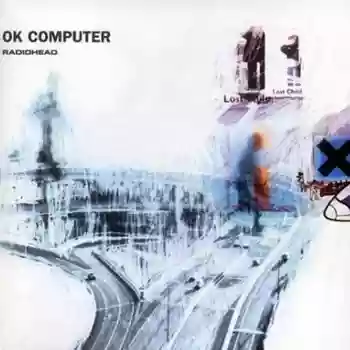
And upon reaching the end, even the album cover, which at the start seemed incomprehensible to us, is crystal clear to our eyes, with its cold colors and its frenetic lines.
So ends Ok Computer, a work as pleasing and rewarding as it is terrifying and introspective, as much a soul-searching exercise as a rigorous analysis, capable of making us experience Hell, Purgatory, and Paradise in 12 songs.
Loading comments slowly
Summary by Bot
Ok Computer is Radiohead's third album, marking a pivotal moment in their artistic growth with a profound critique of consumerism and conformity. Blending melancholy with emerging electronic experimentation, it delivers haunting melodies and thought-provoking lyrics. The reviewer emphasizes key tracks like Paranoid Android, Karma Police, and No Surprises for their depth and anti-commercial stance. The album ultimately offers an introspective journey through despair, automation, and fleeting hope.Tracklist Lyrics Videos
Radiohead
Radiohead are an English rock band formed in Abingdon, Oxfordshire. The members are Thom Yorke, Jonny Greenwood, Colin Greenwood, Ed O'Brien and Philip Selway. They evolved from guitar-based alternative rock into work that incorporates electronics and orchestration.120 Reviews
Other reviews
By condor
Take me on board their beautiful ship / Show me the world as I love to see it.
I’d show them the stars / And the meaning of life.
By dado
Everyone is so tense I wish they would descend into a country lane late at night while I'm driving.
I would show them the stars and the meaning of life, they would have me committed but I would be fine.
By hobbit1
Listening to the record is like looking at that cover again... Perfect harmony between visual and sound art.
It’s as if someone penetrated your brain and never stopped, a subterranean alien that kidnaps you and takes you to another planet.
By wolf
OK Computer represents the perfect synthesis of what the English group had done in the past and will do in the future.
Paranoid Android is the album’s gem (and perhaps of their entire discography) with a tense acoustic beginning that flows into an intermezzo of distorted guitars.
By Piroz
It is an album that captures you, never bores you, doesn’t sadden you, and after daily stress, it actually relaxes you.
Radiohead could be a good step forward in the right direction.
