
 •
Rating:
•
Rating: THE REVIEW
Ok, now I don't want to hear a word about this being the four thousand six hundred and fourteenth review of the radiotesta. No. Because reviews are useless when they add nothing conceptually to better appreciate the work compared to the reviews already available. And realizing that Kid A is a fundamental album of modern music and no one, but really no one, has been able to explain why, here comes the old black angel, always on time to clarify the matter and give a minimum of deserved glory to a band now considered discredited. Tristessa.
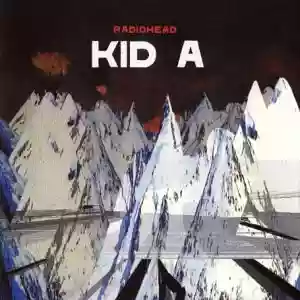
Kid A is a fresco of the postmodern era. The postmodern era is the ice age. Kid A is the portrait of the ice. We live in a world where dark forces, not so obscure, tend to freeze every vital impulse. A world in which we are immersed in a mammoth network of secondary relationships (sorry for the sociological reference) that atrophies every sense of compassion and openness. A world in which the great flows of mass communication tend to depersonalize individuals who remain alien to such a flow and which drains all warmth from the human feelings it deals with (a theme also developed by the same band in “Let Down” from Ok Computer).
We live inside a large cube of ice.
With “Everything In Its Right Place,” a small crack appears in the ice. Madness. Nonsense. Dostoevsky said that it's not always advantageous for a man to rationally calculate what's beneficial. Sometimes it's much more advantageous to do the stupidest thing to break that cold equilibrium of rationality that imprisons us in our mathematical schemes. To preserve that shred of humanity and personality that can only save us from the implosion of our society. The song unfolds an electronic pattern of icy melody, without peaks of intensity, without explosions of emotion. Radiohead constructs a new musical structure based on flatness and on a harmony imprisoned in its own ice. The only sound modification is in the jolts of the voice that I would dare to define as “dazed” of the little alien, when it sings “yesterday I woke up sucking a lemon”, “there are two colours in my head,” “what, what is that you tried to say”. On the apocalyptic keyboards that keep everything in the right place, there stands a discordant note, a breath of nonsense that slightly cracks the perfect crystallization of the icy world.
The discordant note is represented by Kid A, an imperfect fruit of industrial production (note the contemporary success of cloning practices with the album). Kid A is the mad being who stands to music a bit like Zeno Cosini or the esteemed Prince Lev Nikolaevic Myskin stands to literature, that fearsome “different” individual capable in its ineptitude of cracking the polar equilibrium of a society founded by men in series, made with a stencil. Kid A is unwittingly evolution.
“The rats and children will follow me out of the city
The rats and children will follow me out of their homes
Come on, kids”
And here comes the obsessive rhythm, always the same, without highs or lows, but this time overwhelming of “The National Anthem”. It now paints society, with a masterpiece of irony and metaphor. In the continuous bass line arrives the always whining but still dazed voice of the little alien to sketch in four words a world where everyone appears close in fear and anticipation. The twist occurs with the burst of that orgy of trumpets and trombones and trumpets that astounds any musically reasonable eardrum. The brass instruments lay down deaf and unbridled solos, whether low or high. And it's incredible how they echo the voices of society, whining voices, eccentric voices, noisy voices, crying voices, powerful voices, all united by the same disregard for the other. A cosmic chaos emerges that envelops the same cry of the overwhelmed little alien and casts a heavy veil of pessimism and incommunicability over the whole society.
The ice continues to melt.
And so we move on to the masterpiece. “How to Disappear Completely” is life. It can be considered the musical perfection of the Kundera's perspective on the unbearable lightness of being. The voice of the little alien dances transported in the dreamlike melodic cradle that is woven by the acoustic guitar and periodically crossed by a descending violin line.
“That there
That's not me
I go where I please
I walk through walls
I float down the LiffeyI'm not here
This isn't happening
I'm not here
In a little while
I'll be gone
The moment's already passed
Yeah it's gone
And I'm not here
This isn't happening
I'm not here
Strobe lights and blown speakers
Fireworks and hurricanes
I'm not here
This isn't happening
I'm not here”
We could liken man to a leaf dancing immersed in its life of ups and downs and the violins to gusts of wind that sweep away all the leaves floating in the air. Man becomes aware of being a leaf in the wind, of the abysmal lightness of every action, of the ontological inconsistency of existence, in front of the spatial and temporal infinity of life. But the uncontrollable dance of our little leaf comes to a moving finale when Thom's voice is supported by the violin orchestra in a dramatic crescendo of desperate passion, only to lose itself too in the last gust, where the voice is swallowed by the wind and so the leaf by its death.
We have, for the first time, an emotional jolt in the album, but in reality, it is only an apparent surge. The vision of life in "How To Disappear Completely" brings us back in any case to a metaphysical coldness that strips every human affair of any meaning and warmth, relegating “fireworks, strobe lights and hurricanes” to an illusory reality and still sequestered to the small mind of the individual. A nothingness in the infinite ocean of the universe.
This explains the presence of even more glacial music like “Treefingers” afterwards, with a structure that is extremely dilated and almost motionless. This is the only song that could logically follow "How To Disappear Completely," precisely to reveal its emotional deception.
We then reach "Optimistic," which leaves us even more astonished for the rock rhythm completely at odds with everything we've heard so far. From this point of view, it probably wouldn't have been out of place even in Pablo Honey. An apparent fracture also appears in the text:
“You can try the best you can
If you try the best you can
The best you can is good enough”
you might ask: and now what the hell does all this matter? And instead, the mystery is unveiled in the last line:
“Dinosaurs will roam the earth”
There's no denying, it's a lovely mockery, like: you can give more without being heroes, but in the end, the dinosaurs will dominate the earth. The little alien shouts in the face of the world also the same impossibility to move to change something, an immobility of humanity that leaves no other path than vomiting one's own despair upon oneself. In the end, ours is nothing more than living in a limbo of illusions:
“You're living in a fantasy
I've gotten lost at sea
Leave me be
I've gone astray”
We have arrived at "Idioteque." The deaf revolt of Kid A has nonetheless partially cracked the ice. The impression I've always had listening to the song is of a Thom Yorke trapped with his body in the ice but able to push his head out and scream, in a climax of schizophrenia and anger. To scream “ice age coming”. The claustrophobic sense of revolt is at its peak. And the paradoxical thing is that such claustrophobia is marked precisely by freedom:
“Here, everything is allowed
All the time”
It's 20th-century freedom, a freedom that in its corruption and compromises turns into the greatest spiritual and intellectual prison. The first time I listened to “Morning Bell,” the words “cut the kids in half” gave me chills because they came from a climax in which it seemed that man was slowly regaining his rational dimension. Here, cosmic pessimism projects onto a small family tragedy, where a man losing his family convulses in his own cold and hallucinatory madness. The text seems to refer to a stream of consciousness reminiscent of Joyce, however, it's broken by the macabre thought of cutting his own children in half as the only way to divide them with his wife. Everything is absorbed by the cold warmth of the usual piano chords, which lead all the cracks that were beginning to be seen in the cosmic ice to a bleak and insane despair. A silent despair.
A madness that is ultimately embraced in a sweet and affectionate smile. It's “Motion Picture Soundtrack,” the final act of this little journey between attempts and failures, screams and resignation. Madness finds harmony in the serenity of man's consciousness. Among lyres and melodic arpeggios.
“I will see you in the next life…”
Chapeau.
Loading comments slowly
Summary by Bot
This in-depth review celebrates Radiohead's Kid A as a postmodern masterpiece encapsulating societal alienation through icy soundscapes and emotional complexity. It explores key tracks like 'Everything In Its Right Place,' 'The National Anthem,' and 'How to Disappear Completely,' highlighting the album's innovative musical structure and its reflection on modern coldness and emotional detachment. The review frames Kid A as a fundamental work that challenges listeners with its bleak yet profound narrative.Tracklist Lyrics Videos
Radiohead
Radiohead are an English rock band formed in Abingdon, Oxfordshire. The members are Thom Yorke, Jonny Greenwood, Colin Greenwood, Ed O'Brien and Philip Selway. They evolved from guitar-based alternative rock into work that incorporates electronics and orchestration.120 Reviews
Other reviews
By serestoppone
"Kid A sounds like a fogged brain trying to recall a foreign abduction, and it has the effect of numbing it after listening."
"Radiohead stages the crisis of artistic expression and, simultaneously, its rebirth."
By Mellon
The first notes of "Everything In Its Right Place" speak clearly: our minds are overwhelmed by frenzy, phobias, and senseless obsessions.
Close your eyes and open your heart... on the other side, someone is looking for you to take you away from this hell.
By wheredowegofromhere
That’s when I understood music that transcends all rhetoric, that frees itself from being just music to become a state of the heart.
Thanks to the music of Radiohead, I turned the other cheek, and not only that, to all my cellmates.
By Mr_Iko
Radiohead produce through irradiation up to the bones of the arm, the phenomenon of combustion (sometimes explosion) of the psychological states of the host organism.
Prolonged use is not recommended.
By JULIANHAMPSHIRE
"Idioteque is the best track on the album, it’s one of the few that even made me cry."
"Experimenting is fine, but with the right balance as they later did in the wonderful 'Hail to the Thief'."
