
 •
Rating:
•
Rating: THE REVIEW
Roger Nelson is today a victim, despite recently showing signs of life, of a surprising removal considering the character's worth; but it is not entirely inexplicable if we add to his antics and a certain self-destructiveness, the fact that we live in a phase in the Black scene, and not only, of disheartening homogenization.
The "prince" of the '80s, a period often described, not without reason, as a neoconservative backlash, managed to ascend the throne with countertrend, free, unconventional, politically incorrect attitudes, especially with the obsessive exaltation of "dirty" sex, almost pornographic, but tinged, in certain instances, with a very personal romanticism.
Of course, the first albums had already indicated to those equipped with appropriate tools to understand it, that they were faced with pure talent, both as a musician and a singer, but the reception was rather cold, both from critics and the public. Others with less personality would have changed course in the face of that failure, related especially to the great expectations of an oversized ego or at least would have adjusted the aim a bit. Instead, Prince stood firm, making that funk+pop+rock formula only a bit more direct, turning it into a real trademark, and with "1999" managing to reach the mainstream audience for the first time and, more importantly, inaugurating that series of masterpieces that would mark those years and the history of modern black music.
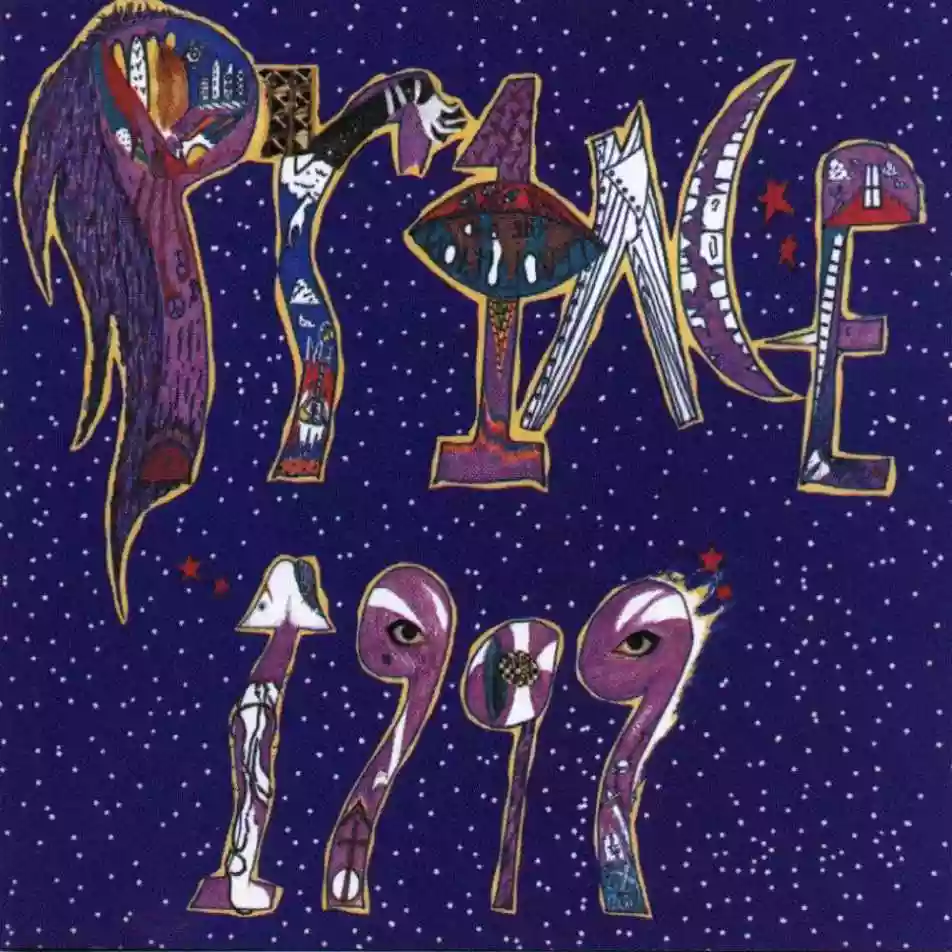
The double album should have been called "The Revolution," with a purple-red cover that would make a cardinal envious. That didn't happen; however, "the Revolution" and the "Purple" would not be lost: we'll find them two years later in the work that perhaps best expresses his idea of black music, in that colorful downpour apotheosis, amidst Hendrix-like solos.
"1999" is quite an atypical work for pop. Not just a double album, but many of the tracks exceed six minutes, and three even last around nine: an eternity for the radio of that era; nonetheless, the title track and "Little Red Corvette" would effortlessly assert themselves. The little-great prince of Minneapolis, a modern-day Janus, manages to look, simultaneously, to the past and the future, without falling into melancholic nostalgia or succumbing to senseless modernism. In all the tracks of the album, this is the characteristic that emerges the most, his ability to be a conscious "hinge" between tradition and innovation, along with that drum machine sound, that beat which the great Miles did not hesitate to define as the "rhythm of Prince".
The most significant episodes of the album are the funkiest ones, like "Automatic," "D.M.S.R.," "Lady Cab Driver," where the rhythm rises, the atmosphere becomes incandescent, where that frenetic beat serves as the soundtrack to the crazy party for a century's end over which, however, looms the atomic apocalypse ("Mommy, why does everybody have a bomb?", says the title track). Even when the lights dim, the adrenaline drops, the moans of pleasure (how many women participate in the "chorus"! Jill Jones, Vanity, Wendy, Lisa...) are replaced by whispers, as in "International Lover" or "Free," our man shows his ability to disengage in his unique way, showcasing an inimitable and flexible voice and drawing from a more classical repertoire. But the track that stands out the most, the one that most clearly gives the idea of being in front of a genius in his field is "All The Critics Love U In New York," a song of extreme modernity that could provide not a few ideas for the many, too many, who in that area are unable to find any shred of an idea.
Prince has now been dethroned; he has returned to being Mr. Roger Nelson. But he is among the few in the last twenty years not to be considered an usurper, to have worn those jewels with regal demeanor, of which too many of his so-called successors have a tacky abundance.
Loading comments slowly
Summary by Bot
The review highlights Prince's resilience and genius displayed in his 1982 double album '1999.' Despite initial setbacks, Prince's blend of funk, pop, and rock ushered him into mainstream success. The album's long tracks, innovative sounds, and provocative themes set it apart from typical pop works of the era. Standout songs like 'Little Red Corvette' and 'All The Critics Love U In New York' exemplify his musical foresight. The review praises Prince as a pivotal figure bridging tradition and innovation in black music history.Tracklist Lyrics Videos
Prince
American singer, songwriter, multi-instrumentalist and producer; seminal figure in funk, pop and rock who led a prolific career from the mid-1970s until his death in 2016.29 Reviews
