
 •
Rating:
•
Rating: THE REVIEW
Ok, let's try it, I said to myself...
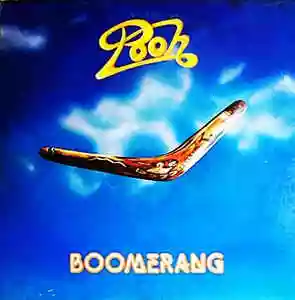
And so: here I am, this time with Boomerang by Pooh.
For you, my personal review for Debaser.
Civilities:
We're in 1978 and our 4 guys had just finished working with Lucariello. This album, in fact, is the third after Poohlover and the second after Rotolando Respirando; always "self-produced" - and always alone -, but on this specific occasion, the production was: even more rustic (in terms of listening), and more introspective (on a poetic level). Now, let's try to grasp as best as possible what we mean by introspective production.
The Tracks:
It's about understanding that, in these golden years, the Pooh tried - at all costs - to be appreciated as emerging musicians: the themes left the ship of love to flow, then, - thanks to the aid of more 'appropriate and fitting' lifeboats - and at an artistic caliber level -, into the sea of lyrics; the song form is chanson. And to take care of this mentioned style, obviously, will be the brilliant mind of the poet Valerio Negrini: who will talk to us about delicate themes - like the journey from one city to another, or, commuters; in the track La città degli altri. A song, this one, strongly pop (as, for the rest, as we will see, the entire album will be). Ci penserò domani: a big piece; which is more a script of a love drama rather than a song.
And the way, through which, the Pooh will tell us about love will change; and it must be said that, like a woman's notebook, and, the sky boy, the piece (ci penserò domani) will be included in Opera Seconda (a collection of rearranged tracks in a symphonic key). It means that this LP is very important for them. Even Dodi, in his "Perle", will include some tracks from Boomerang. One thing that bothers me about the subject, though, is that no one specifies that just because we're in the '70s the arrangements are more peculiar. Sorry, but what kind of excuse would that be - Better: it would be an excuse to say: "... it's a cute disc"; but, to assert it because it was produced in the '70s? Does that mean that in current days exclusively music (pop-rock) of less value is produced!? Did I get that right? If an album is good, it's good. Period. It doesn't matter when it was recorded.
Let's get back to us:
these two tracks, with a strong pop flavor, have peculiar arrangements, the music mainly comes from Roby's keyboards; and from Dodi's (solo) electric guitar. Red and Stefano wonderfully accompany the tracks, transforming each one into a perfectly rhythmized work.
It will be with track number three, right with: pronto buongiorno è la sveglia, that we will all find ourselves together under a rock parterre. You heard right... I said rock. And, if I didn’t like this word, because I’m talking about the Pooh, and these artists make evil music, I could use the following expression: AOR. Therefore, pronto buongiorno è la sveglia: it has a rhythmic-electric guitar inaugurating the dance; and to which Red's bass immediately joins. Then Stefano. And a simulated grand piano will accompany everything: it's Roby's turn. The very funny lyrics tell the routine of the 4. In short, this track can be summarized in this way: comma (guitar), semicolon (bass and drums, I also mention “love and violence” ?? ) and the period (keyboards).
Cercami. The single of the album. This track was chosen instead of "Giorno per Giorno"; because, for the 4 Pooh, it was more of 'easy arrival'. The track in question!? It's an auditory ram. Rhythmic: in a monstrous way. The Pooh: are of a smothersick talent. In my view, there is no more beautiful album than Boomerang, speaking of this genre. You’ll agree with me that, this LP, in particular, can be an aid to bring, the children of the nex-gen, closer to rock music: and, the reason why I assert this is that the music inside it is simply simple. Take the disc and put it in the player and listen. Turned up the volume of the stereo. You won't regret it. The disc is stunningly beautiful, I know, at times it may seem grandiloquent; especially for the arrangements and the singing. But do me a favor: listen to Boomerang- the magic of pop rock will return back to you. Do it: with a stereo that has a good subwoofer and you won't regret it. Little. But sure.
La leggenda di Mautoa. Lyrics: by Stefano d’Orazio. Music by: Roby Facchinetti. To introduce the track to you, I would like to quote the same but inserted in another collection: Dove comincia il Sole live at Este's castle. To understand what I will say in a whisper, you should listen first to the (re)edition, and then, the original one present on Boomerang. Do you understand what I said before? The music of today is different from that of the past; there was another way to understand it. And produce it. Listen to both. Then write to me in the comments if you understood. Yes, of course, the percussion is missing in the new one, Roby cut some arrangements but, I wouldn't be entirely sure of that; you know where the real difference shows up - Between the two pieces? The first one is a Contemporary pop… the second - the original - is a Progressive, you read that right. Prog my dear sirs. And my thesis that we are in the blessed '70s enhances its content.
Air India: a wonderful text, conceived by the formidable Negrini, which text will be set to music by Roby and Dodi. Beautiful acoustic arpeggios - confirming the fact that Battaglia is not just a guitarist 'put there for the solos'. The instrument in question, which Dodi uses for this track, is a sitar. We're in art pop here, gents. Listen to believe. It's a musically inspired Dodi Battaglia, who, observing a love scene at the airport - in Sri Lanka - is strongly impacted. And writes the score of the piece with the sitar in hand. Facchinetti will conclude the music with the chorus: well done, Pooh!
Quaderno di donna, which will be included in Opera Seconda and which will become, in the relevant tour, (in my opinion) the flagship; because, in the (re)edition - in fact, it will seem like listening to: the “Dream Theater”, or, even the “Evanescence”. A piece that, on a textual writing level, goes back to telling us about the social: narrates the story of a woman during the feminist movement of the '70s. Beautiful Dodi's phrasing: I think he uses a Les Paul ’54 in this piece, but I wouldn’t want to be wrong. Text by Valerio Negrini, music by Roby.
Incredibilmente giù; I really felt like that, so, the more I listened to Pooh, the more I felt up (with the morale). Lyrics by Valerio, music by Roby, sung by: Dodi. From a musical point of view, here is another pearl, with a solo by Dodi at the end of the piece; that I wouldn't really know how to define. I can only say: “it’s really scary, it’s monstrous”. At times, the rhythms seemed to me a bit funky. But judge for yourself. The fact remains, the solo at the end is powerful.
Classe ’58. What should I assert about this track? Can it be considered a rock-tinged track? Or, is this one “accessible”, not to say, “catchy” in the way it is played - (To make the whole listening experience decidedly pop)? This is an opinion but, I, possess a different one: and if the Pooh had in mind another type of concept – If they had wanted to make: “not a rock opera”, but, rather, a pop one? What is, then, Classe ’58? A track within which our friends speak about the mandatory military service: the sadness, the loneliness, the pastimes; what does a young twenty-year-old experience!? Surely, this is not a trivial text. The poetry is by Negrini, the music by Facchinetti; voice and final solo: by Battaglia. “Classe 58”, that is, those born in time - precisely 20 years within that date, to perform mandatory military service. Magic, poetry: these you will hear if you decide to follow my advice. A Fender Stratocaster for the final solo dominates the scene. And, probably, Dodi, for this final solo, used specific settings; such as: very little reverb. Listen to believe. It would be useful for me to cite some tracks; to inform you 'on what style' or, 'what musical carat', the Pooh resemble during this period. So, listen to: “Discovery”, by “Mike Oldfield”; listen to- “Born in the U.S.A”, by “Bruce Springsteen”. Listen to: “Taurus 3”, again by Oldfield; listen to: “Born to Run”, again by Springsteen.
With Il ragazzo del cielo (Lindbergh), we have reached the omega. The subtle atmospheres of ROBY's synthesizer (Polymoog), together with RED's bass solo (Fretless), open the scene to the vocalist; always Canzian. A singing - actually, a slow and melodious lullaby -, is the style; through which our bassist will interpret the poetry (of the immense Negrini). Bass and drums, in perfect harmony with each other, are the spices used for our gulasch. The prime-quality meat is the text and electric guitar phrasing, explaining the true story of Charles Lindbergh aboard his own light aircraft. The flight was accomplished non-stop. The fresh sauce used for our recipe is close, in style, to that employed by the keyboardist of the “Genesis”: “Tony Banks”; which, literally, makes the mellotron sing. And, in the same way, our Facchinetti makes his...(of mellotron) sing. If you don't believe me, listen to il ragazzo del cielo first, and quietly, “Dancing With the Moonlit Knight” by Genesis, so, at minute '1.50', you'll hear the mentioned instrument. “Sing”. From minute ‘2.45’, instead, you’ll hear it in the Pooh's track. So, the dish is served and, the chefs are the Pooh!
Review:
Boomerang is an easily accessible, derivative record. It does not propose a demanding listen because the musical style contained within comes from an existing source and, as Plato would say: “true art is impossible”; since pulling it out of nowhere, new, with zero ideas available, is almost unthinkable. The disc, being easy to listen to, suffers from the influence of light music or, in any case, of great music in general. The critique therefore brings albums like this under the category of Contemporary. This is the mistake. Now, to conclude what has been exposed, I will try to find the flaw in this opinion and refute this way of thinking from my perspective erroneous. As a first thing, we have stated that, that false myth should be debunked which, imposes - with vehemence and arrogance - the genre and the style of the album, and does so, only in relation to the era; the era during which it was recorded. The following excuse is used: “it's the period, - the 70’s - that makes the album good”. Said in another phrase: the album is good, not because it is in itself, but, because, we are during the years of great music. This is the excuse that criticism uses to not give ‘Caesar what is Caesar’s’. Straightforwardly. In conclusion: the Pooh did not make great records because they were in the golden years of music; the Pooh made great records - like Boomerang - because they are decent musicians. The same goes for artists like: "Le Orme", "New Trolls" and so on. The fitting example would be to imagine “Dove Comincia il Sole”, also by the Pooh, as published in current days. But, in fact, the cited album was published currently, precisely in 2010. So then - What should we say - According to this explained axiom? That, since Dove Comincia il Sole was not published in the '70s, for this reason, it cannot be a good album!? No! On the contrary: just because Boomerang was published in '78 doesn’t mean the critics have to label it as Contemporary. Enough.
I hope my reasoning was clear.
I'll take care of doing a professional review of Boomerang; right now, that the band is about to (re)return. More in shape than ever, in the entire history of music...
Boomerang, Pooh, generates: Progressive Pop, Art Rock. These 2 were missing; I'll add them myself, it doesn’t matter, now it's correct to say: genre “pop-rock”, after my reasoning… Dear music critique.
Just like the legendary Boomerang: which always returns, to the sender...
Federicocope, for Debaser.
Loading comments slowly
Summary by Bot
This review dives into Pooh's 1978 album Boomerang, highlighting its introspective lyrics and distinctive pop-rock arrangements. It emphasizes the band's genuine musicianship beyond 1970s nostalgia and underlines the album's blend of progressive and art rock elements. Each track is closely examined for its musical and lyrical depth. The reviewer challenges critics who undermine the album due to its era, affirming Boomerang's timeless quality.Tracklist Videos
Pooh
Italian pop/rock band formed in 1966, noted for melodic harmonies, symphonic/prog experiments in the 1970s and a long commercial career.60 Reviews
Other reviews
By Teryolpul
"The sound becomes more direct, guitars take precedence over violins and various strings, and the rhythm immediately appears more carefree and playful."
"Just as the historical excursion penned by Stefano D'Orazio doesn’t work... An experiment to be forgotten."
