
 •
Rating:
•
Rating:
THE REVIEW
EPPURE SOFFIA (1976) 6.5/10
At the time of writing, there are 49,431 reviews on Debaser and not a single one about this album. Shameful. (Just kidding!). But Bertoli, from what I can see, isn’t really “trending” on the site, although he reminds me of my aunt (who’s still alive): I didn’t even know who Bertoli was until I was 20 (he had already passed away by then) because there weren’t any of his records at home (there were De André, Battisti, Dalla, Guccini, Pink Floyd, Rolling Stones, Dylan), and honestly, can you picture a kid that age in 2004 listening to Bertoli? Loud house music, forget about singer-songwriters. Then my aunt tells me she never missed a Bertoli concert in Milan, she saw all of them, and from a dusty shelf she pulls out all the LPs by the Modenese artist. Well, who the heck is this Bertoli? I listen to them, they don’t say much to me, but some things do appeal. I listened again about ten years later: at 30, I started to like him.
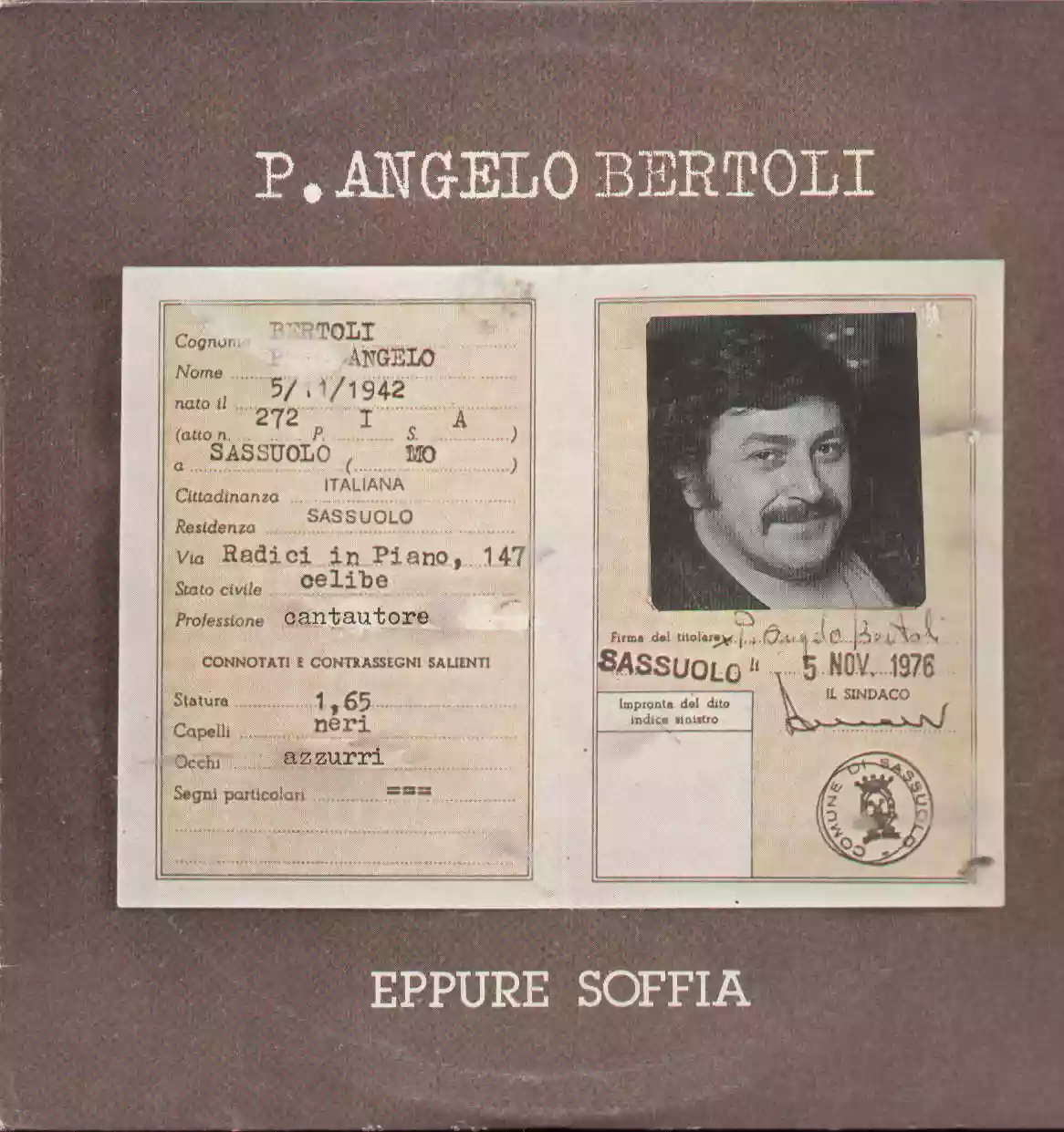
“Eppure soffia” isn’t a masterpiece; next to some beautiful tracks, there are a few second-rate ones. It’s 1976: Guccini releases an album where he “reveals” his address (which in Bologna and surroundings was an open secret), Bertoli goes all out and puts his own ID card on the cover. Different times — after all, there was no Google Maps. With help from fellow native Caterina Caselli, he takes 3 tracks from his previous LP (his first) and records 9 brand new ones. Now, Bertoli was an artist of great sentimental songs but, above all, he was a politically engaged singer-songwriter, left-wing (he was a factory worker before becoming a songwriter), less noble than De Gregori, less cultured than Guccini, less “musical” than Lolli: let’s say more “earthy.” A man of the people, as would be said today — one who called a spade a spade, no beating around the bush, not too many metaphors or difficult hermeticisms (Bertoli could never have written “Informazioni di Vincent”, but on the other hand, De Gregori could never have written “Eppure soffia”). Clearly, this album is no exception, and to fully understand it, you need to “immerse” yourself in the Italian political reality of 1976 (or simply have lived through it): an Italy leaning to the left, on the brink (unknowingly) of the so-called “Years of Lead.” So, labor struggles, strikes, pickets, and the historic compromise. Except there’s a small problem: of these 12 songs, the one I like best (and I think it’s one of the most beautiful songs in Italian music) is “Sera di Gallipoli”, which is the only one not written by Bertoli (neither lyrics nor music). I’m in a bind: it’s tough to praise an objectively more-than-worthy album and highlight the only song not signed by the author and, on top of that, not even political. The fragility, ready to break at every instant, of human relationships, so delicate and elusive, and the relentless passing of time are at the heart of a stunningly evocative and musically charming song (“...le spalle curve ce ne andremo in cerca della Luna”).
The title-track (which was originally going to be called “Mario Bruno” and was supposed to have a much more political lyric) dates from Bertoli’s time with the Canzoniere del Vento Rosso. It was his first, albeit shy, success: the blunt (and often “heavy”) lyrics hit home (“...i crimini contro la vita li chiamano errori”: nowadays those words ring even truer than in 1976!) and that fantastic pair of guitars underscores the whole track. Covered by Stadio and Angelo Branduardi, it’s one of the few beautiful ecological songs (but it’s not just that) ever made in Italy, where we were still stuck with the “ragazzo della via Gluck” from 11 years earlier (I don’t count Celentano’s nonsense like “Un albero di trenta piani” or the like — come on, let’s be serious).
Other songs worth mentioning are “E’ nato si dice”; the country of “Povera Mary” (a very sad story, on par only with the poor Stefania of Guccini’s memory) and, above all, “Racconta una storia d’amore” which, in a sense, is his manifesto. In an era when left-wing artists were criticized for being too distant (or insensitive, according to their detractors) from the political and civil cause, Bertoli mocks all those who hide behind telling about the world’s miseries and take shelter in the most trite, classic love song. From the previous album, he also brings in the furious “Non vinceranno”, but the other songs (including the two tracks in Modenese dialect) seem weaker to me, though two tracks like the title-track and “Sera di Gallipoli” would be more than enough.
Loading comments slowly
Summary by Bot
This review offers a balanced look at Pierangelo Bertoli's album 'Eppure Soffia.' It evaluates the album's strengths and presence in Italian music. Rated 3 out of 5, the review reflects a moderate appreciation. Listeners are encouraged to consider its cultural and lyrical significance. The review caters to those questioning Bertoli's place among Italian artists.Tracklist Videos
Pierangelo Bertoli
Pierangelo Bertoli (Sassuolo, 5 Nov 1942 – 7 Oct 2002) was an Italian singer-songwriter known for a direct, socially engaged style. He used a wheelchair due to polio and was discovered by Caterina Caselli. Signature pieces include Eppure soffia and A muso duro; he duetted with Fiorella Mannoia on Pescatore and reached Sanremo 1991 with Tazenda on Spunta la luna dal monte.05 Reviews
