
 •
Rating:
•
Rating:
THE REVIEW
"Nothing is more anarchic than power. Power does practically whatever it wants, and what power wants is completely arbitrary, or dictated by its economic needs that escape common logic. I particularly detest today's power. Everyone hates the power they endure, so I hate today's power with particular vehemence."
I write this review because I felt the need, after watching this perverse film, to translate the emotions I experienced while observing what was happening on the screen into movements of my fingers on the keyboard of my computer.
A disarmingly lucid display of images; in their ambiguous and unbridled perversion.
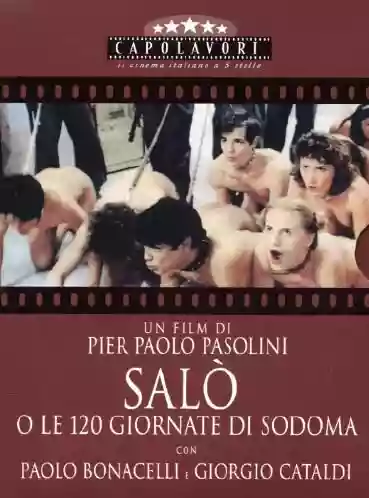
The latest film by Pier Paolo Pasolini, a man who combined poetic excellence with cinema; this film represents a list of perversions, vices, manias; everything is structured on a lucid delirium. Four Nazi-fascist gentlemen, a hunt for young sons and daughters of partisans from any political faction; a castle isolated from the outside world, and 120 days to satisfy all (and I mean all!) the manias and perversions known to humanity.
A cruel, realistic, dark film; an equally violent plot, but refined, with a refinement that reaches aesthetic perfectionism. Without delving into a thorough paraphrase of the film's content, as I wouldn't be as exhaustive as any literature professor, in my most humble opinion, this represents one of the greatest cinematic "works" of the 20th century.
The key concept of the entire film is Pasolini's concept of power: everything is constructed as an allusion to the structure of Dante's Divine Comedy to underline modern homogenization and the now-decadent concept of capitalism; the film transitions from an antiferno, where the young people are captured, to a circle of manias, another of excrement, reaching finally the last circle: the one of blood.
The film is deliberately mocking to the viewer as actions of all kinds are perpetrated by these four gentlemen who symbolize power and its deviations. It's as if Pasolini wanted to transliterate his concept of power to the human being, interpreting it as a mere satisfaction of one's sexual instincts; a power without constraints and without restraint.
I've decided never to watch this film in my life again, as I'll never erase it from my mind, (I couldn't watch 2girls 1cup, so you can imagine what happened to me at the excrement circle). However, I strongly recommend it to all true film enthusiasts as an art form: it must be watched at least once in a lifetime. I believe I can emphasize the exquisiteness of Pasolini's dialogues, the beauty of the cinematography, and appreciate the genius, always paying homage to such a controversial yet equally imperious work, from a cinema aesthete and a great writer.
They killed a poet on that 2nd of November.
Loading comments slowly
Summary by Bot
This review analyzes Pier Paolo Pasolini’s film Salò or the 120 Days of Sodom as a powerful, dark, and aesthetically refined portrayal of power’s arbitrary cruelty and capitalist decadence. The film’s disturbing content and complex symbolism render it a masterpiece of 20th-century cinema. Despite its harsh subject matter, the reviewer highly recommends the film to true film lovers for its poetic and artistic qualities. The work is seen as a tribute to Pasolini’s genius and tragic legacy.
Pier Paolo Pasolini
Pier Paolo Pasolini (1922–1975) was an Italian writer, poet, and filmmaker whose work often confronted power, capitalism, censorship, and social hypocrisy, moving from neorealist depictions of marginal lives to allegorical and radically provocative cinema.26 Reviews
Other reviews
By eletto1987
Pasolini’s entire body of work, always charged with strong, sensual, even hard scenes, there is no room for the vulgar, for the indecent.
I consider this film a pillar of cinema of all genres and times, a macabre fable about the future of man clouded by power.
By O__O
A jewel of Pasolini’s production, Salò is a dark and poignant parade of human perversions, captured in a spectrum of supreme beauty.
This is the pure genius of a film that screams against humanity, whose true perversion is being human.
By Caspasian
The violent nature of the Friulian presents itself here in all its nakedness, fueled by the lies of everything that surrounds him.
The rituals of sperm, piss, blood, and shit are continuous even in their psychic manifestations.
