
 •
Rating:
•
Rating:
THE REVIEW
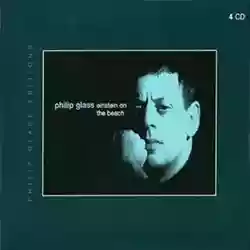
Born from the collaboration between Philip Glass and theater director Robert Wilson, the opera in four acts "Einstein on the Beach," whose music Glass composed in 1975. Listening to the record edition in 4 CDs (duration: 2 hours and 45 minutes in the Sony Classical edition, 3 hours and 10 minutes in the Nonesuch version), it's important to keep in mind that there exists a visual and scenic component to this work, with three recurring images: a train, a trial, a spaceship, each linked to a musical theme. And then there's Einstein, of course, a character who lingers on the periphery of the stage action, strumming a violin (as the real Einstein used to do to relax).
The three recurring images allude to the theory of relativity and its implications: the train as an example of the relativity of movement; the trial as a metaphor for the consequences of that theory (primarily the path opened to atomic weaponry) for which Einstein here seems to stand accountable; the spaceship as an example of the relativity of time (reference to the "twin paradox"). These images primarily serve Robert Wilson to allude to the themes of this work, replacing the plot and narrative development of traditional opera.
The title refers to Nevil Shute's novel, "On the Beach," which deals with nuclear catastrophe. The ensemble includes 4 main actors, 12 singers, a violinist in addition to the amplified ensemble that constitutes Philip Glass's trademark: electric organ plus other electric keyboards, a small wind section, and voices, in this case also soloists or used as reciting voices. On stage, everyone is dressed as Einstein.
In these three hours of music, one passes through phases and very distinct moments: the binding agent is that of minimalist technique which makes the obsessive repetition of short sound cells its delirious creed. The very fast tempo of certain passages creates a genuine bubbling of electric keyboards in the background (forcing the performers into an exhausting tour de force). As already happened in the previous "Music in Twelve Parts", the rhythmic structure that derives from this technique is the most evident characteristic of this music, but in "Einstein," Glass tries to merge it with the harmonic structure creating sound planes in continuous mutation and subject to periodic adjustments.
The music is not difficult to follow but requires attention to embrace it in its overall design: the division into four acts helps, each organized in two scenes (except for the last act which has three scenes) and the presence of five "Knee Plays" (at the beginning of the work, between the acts and at the end) which, like the knee in the human body, function as joints in this very complex musical organism. The sung parts also help which consist of the pronunciation of numbers, to represent the rhythmic structure of the music, or the names of notes (those used in solfeggio, for example, la-si-do-si-la), to represent pitches: it is thus a description, along the way, of the music itself. For the rest, reciting voices declaim texts of very varied nature and inspiration.
"Einstein on the Beach" is now a mythical piece: it was a great success from its first performances, in Europe (at the Avignon Festival and in other cities) and then in New York. Rightfully so, this opera has become a classic of our time.
Loading comments slowly
Summary by Bot
Philip Glass' Einstein On The Beach is a groundbreaking minimalist opera, combining music and visual themes inspired by the theory of relativity. The opera’s structure, repetitive yet evolving musical patterns, and innovative staging mark it as a modern classic. The review highlights the collaboration with director Robert Wilson and explores the symbolic imagery linking science, music, and theater. The piece remains a significant and influential work in contemporary classical music.Tracklist
Philip Glass
Philip Glass (born 1937, Baltimore) is an American composer and key figure of musical minimalism. Founder of the Philip Glass Ensemble, he is known for operas (Einstein on the Beach, Satyagraha, Akhnaten), landmark concert works (Music in Twelve Parts, Glassworks) and film scores (Koyaanisqatsi, Mishima, Kundun, The Hours). He studied at Juilliard and with Nadia Boulanger; Indian rhythmic concepts via Ravi Shankar deeply influenced his style.08 Reviews
