
 •
Rating:
•
Rating:
THE REVIEW
Take any copy of the New York Times, and you will find in the top left corner of the front page a seven-word slogan. "All the news that's fit to print" is not simply a motto; it is truly the emblem of American journalism. Look it up on Google, and the first result will tell you that the famous slogan first appeared in 1896, under the direction of Adolph Simon Ochs.
Ochs. That surname sounds familiar.
It is 1964, at the height of the Cold War and less than a year after President Kennedy's assassination. The United States, weaving the web of economic imperialism around the entire globe, finds itself trapped in situations of futile belligerence (of which the Vietnam front is a blatant example), while fear of nuclear holocaust spreads increasingly. It is largely in such gray and seemingly hopeless environments that art flourishes as an attempt to subvert a pathologically flawed system; and, as is well known, never more so than in the Sixties did music, of all the arts, aim to give voice to a wholly new ideologically-driven generation.
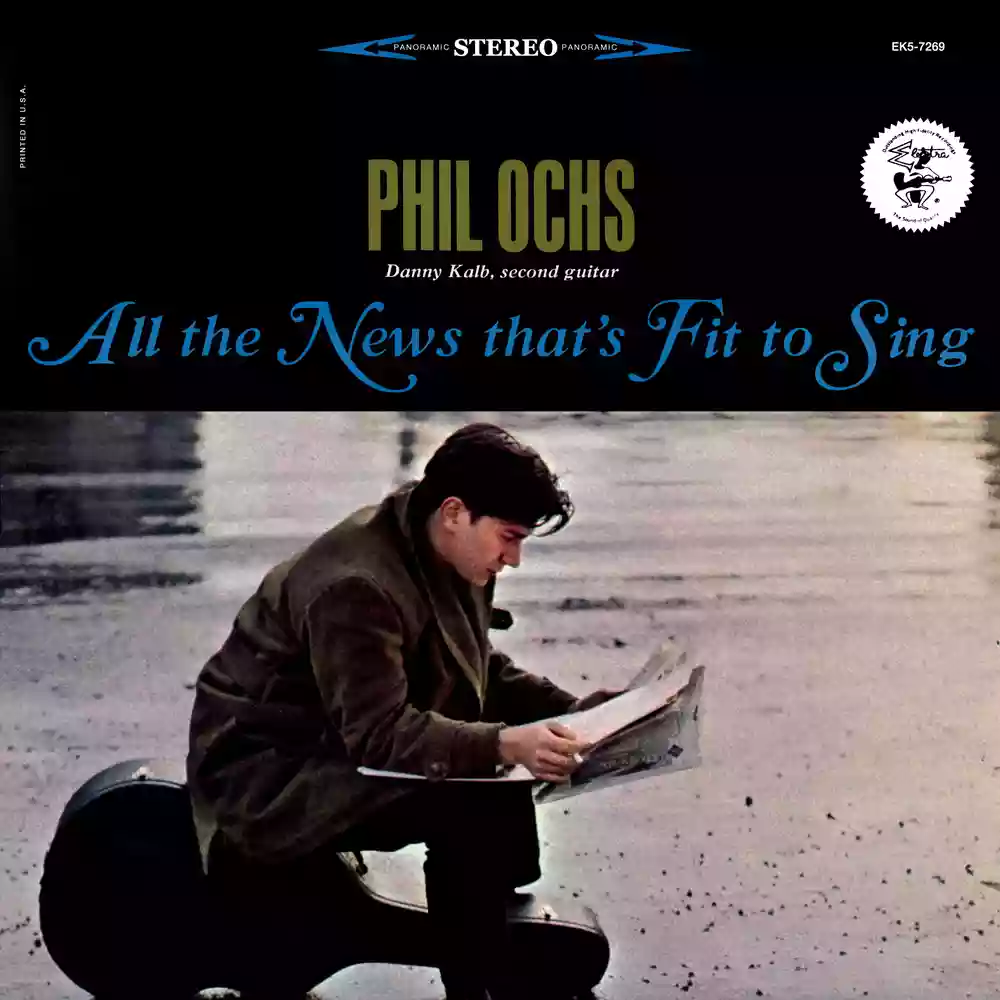
This is how the protest folk of Woody Guthrie and Leadbelly's school is reborn, ultimately enshrined by Bob Dylan; Greenwich Village is buzzing, folk clubs overflowing with new singer-songwriter talent. In this environment, a young militant journalism enthusiast operates almost in the shadows: he's not great at playing the guitar (music critics a few years later will scornfully call his technique "flipper-fingered"), yet his talent is undeniable. Phil Ochs, a Texan born in 1940, quickly becomes noted for his radical views and sarcasm, to the point of being invited to perform at the Newport Folk Festival in 1963 shortly after moving to New York. The times are ripe and Phil, the following year, records his first album. Being a journalism devotee as he is, he already has decided on the title of his work: thus, despite having no familial ties to that famous Ochs mentioned earlier, the slogan becomes "All the news that's fit to sing". It is a manifesto of journalistic songwriting that will characterize his entire career.
A single playthrough of the album is enough to form a clear idea. Phil is in peak inspiration, already recording some of his best songs at debut. The stinging "One More Parade" opens the curtains: it is a fierce critique of war ("when they march together they all look the same / so you can't blame anyone"), punctuated by the beat of a real military march. "Talkin' Vietnam Blues" and "Talkin' Cuban Crisis" delve into the talking blues vein already explored by contemporary Dylan, analyzing the more contentious aspects of the Cold War; "Automation Song", incredibly prophetic, attacks technology advancement tainted by utilitarianism ("I walk down a road with no work / and tell me, where should I go?"); "Too Many Martyrs" is dedicated to Medgar Evers, an activist and politician assassinated the previous year; "Bound for Glory" is a tribute to Woody Guthrie, the songwriter's main influence. Additionally, there is a nod to American literature: "The Bells" is a poem by Edgar Allan Poe, set to music with originality and flair.
However, it is with "Power and the Glory" that the zenith is reached: the song, a Guthrie-like patriotic anthem, was described by Ochs himself during its composition, addressing his sister, as the best song he would ever write. It conveys a form of patriotism that highlights the most alienating paradoxes of one's nation, an invitation for the entire American public to reflect. Every critique of his homeland ("although as rich as the poorest of the poor / free as the locked door of a prison") resolves in the extraordinary chorus, where America is idealized in simple words without any rhetorical flourish, typical of journalistic style ("here is a land full of power and glory / of beauty words cannot describe").
Phil's lacking guitar technique is well concealed by the second guitar of Danny Kalb, a seasoned blues guitarist and already a friend and colleague of Dave Van Ronk. The result is a homogeneous protest album, well-executed and pleasant to listen to, worthy of comparison to Freewheelin' Bob Dylan; a true masterpiece indispensable for fully understanding a dark page of contemporary history.
Loading comments slowly
Summary by Bot
Phil Ochs' 1964 debut album ‘All the News That’s Fit to Sing’ stands out as a seminal protest folk record. Despite modest guitar skills, his sharp, radical songwriting vividly addresses Cold War tensions, war critiques, and social activism. Songs like ‘Power and the Glory’ and ‘Talkin’ Vietnam Blues’ exemplify his journalistic approach to songwriting, setting him apart in the vibrant Greenwich Village folk scene. The album remains a critical historical and musical document of its era.Tracklist Lyrics
Phil Ochs
Phil Ochs (Philip David Ochs), born 1940 in the United States, was an American singer-songwriter best known for 1960s protest songs and sharp political lyrics; active primarily in the 1960s–1970s, he recorded seminal albums including All the News That's Fit to Sing (1964).02 Reviews
