
 •
Rating:
•
Rating:
THE REVIEW
"Press To Play" appears in McCartney's discography as a sort of large and cumbersome evaluation problem. It is indeed not easy to describe an album that is systematically criticized, reevaluated, and then forgotten again. Nonetheless, it is an extremely complex work, overproduced, played by many musicians of extraordinary value, with Phil Collins, Jerry Marotta, and Eric Stewart leading the roster. However, the final product must be taken with caution. Paul McCartney puts together a work perfectly in tune with the times, the second half of the '80s, which coincidentally is produced by a certain Hugh Padgham, a specialist in the sound reconversion of rock giants, Genesis, for one notable example. In 1986, it was well-received, but today the sounds are considered outdated; however, excessively negative evaluations are circulating, which do not do justice to an album boasting some decent moments.
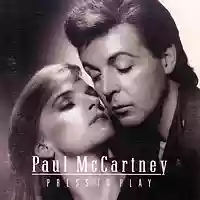
It starts with "Stranglehold," a good pop-rock reinforced by the saxophone, until the second track, the reggae "Good Times Coming / Feel The Sun," the album is good, a great step forward compared to the trivialities of "Pipes Of Peace." It's with "Talk More Talk" that the electronic drums, synthesizers, typical of the period, explode for a track that is easily forgotten. The collaboration with Eric Stewart produces the acoustic ballad "Footprints," the absolute experimentation of "Pretty Little Head," boldly released as a single, and many tracks with very little inspiration, where it is McCartney who fails to provide adequate support to his partner; the lyrics are very banal and the music overly reinforced. Even the piano ballad "Only Love Remains" disappears among the cumbersome synthetic sounds of "Press." Amidst such modernization, the cover intrigues, photographed with a film from the 1930s, too sentimental, competing for the first overly sentimental spot with Lennon's "Double Fantasy." Linda's collaboration is also marginal, with some backing vocals and the spoken part on "Talk More Talk," along with their son James. This is quite a strange choice, as Lady McCartney had collaborated on all previous albums with significant parts, and perhaps this is one of the key points in the interpretation of the work. Indeed only Linda could tell Paul what was right and wrong, guiding even minimally her husband's overwhelming (and extravagant) ideas.
"Press To Play" is the least sold album in his catalog, no one remembers a song anymore, and McCartney himself probably has a vague memory of recording it, and as he himself has stated, he is embarrassed by it.
Loading comments slowly
Summary by Bot
Paul McCartney's 'Press To Play' is a complex and overproduced album from the mid-80s featuring prominent collaborators like Phil Collins. Though initially well-received, its sound now feels dated and the album suffers from mixed critical reception. Some tracks stand out positively, but many lack inspiration. Linda McCartney’s minimal contribution may have influenced its unevenness. It remains one of McCartney’s least sold and most forgotten records.Tracklist Lyrics Videos
Paul McCartney
English singer-songwriter and multi-instrumentalist, co-lead vocalist and bassist of the Beatles, later leader of Wings and a prolific solo artist with a decades-long career and numerous acclaimed albums and live shows.65 Reviews
