
 •
Rating:
•
Rating:
THE REVIEW
What is love but an unfathomable, indecipherable, unclassifiable mystery.
You lost yourself in your thoughts, while trying to find effective harmonic solutions, enriching the sound palette with clusters, triplets, sextuplets, glissandos, ostinatos... Nothing, you couldn't succeed.
Then suddenly, the illumination: you turned for a moment, it was Annette who brushed you with her hair as she passed behind you.
Finally, a single glance, sideways, leaning from the piano stool, and there is the poetry: she tilts her head, the room's reflection of light illuminating her from the side, then a smile, just for you.
Here it is, in its dazzling beauty, the mystery of love.
“Closer”, or, more closely.
Looking at those God-drawn cheekbones, that so imprecise line tracing the ivory face and the eyes, those eyes.
Few, meaningful notes in the mid-range of the piano, with myriad spaces and silences together and around the melody, full and empty, between the piano's black and white keys.
This is how I like to imagine the genesis of this album: Paul’s love for Annette Peacock, on a warm summer afternoon.
Paul Bley's pianism is this: partial, a marvelous synthesis of European cultured music and contemporary American jazz, with an ear towards the avant-garde. “Ida Lupino” seems like a Lieder by Schumann, as if played by Schoenberg.
The Title track, a clear demonstration that less is more, at the opposite end of the intricate all-piano melodies of Bill Evans or the titanic tour de force of Cecil Taylor.
Paul Bley is a leaf that softly rests on the asphalt, a sweet fiber of the universe.
The notes of his piano gently traverse space-time, like a small star, which from a yellow dwarf becomes a red giant in an instant, then explodes into a thousand dust particles and debris in the multiverse of emotions.
The track analysis could end here because it’s unnecessary.
“Open, to love” is a singularity, navigating through the folds of the unspeakable, openly confessing the fragility and transience of man in the face of the mysteries of creation.
"The love that moves the sun and the other stars," quoting the supreme poet, the surrender to the feeling that creates and destroys all, articulated through the jazz vernacular and the sensitivity of a pianist out of time.
“Open, to love” should be listened to with headphones, in perfect solitude, perceiving the breaths and murmurs of Paul Bley, as he draws an arc in the sky.
Beyond the stars. Salût.
Loading comments slowly
Summary by Bot
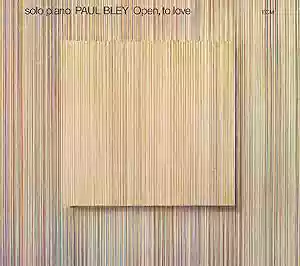
Paul Bley's 'Open, to Love' stands out as a definitive jazz piano album celebrated for its inventive and emotive performances. Released in the 1970s on ECM Records, it showcases Bley's unique improvisational style and intimate expression. The review praises the album's timeless quality and Bley's subtle virtuosity, making it essential for jazz enthusiasts.Tracklist Videos
Paul Bley
Paul Bley (1932–2016) was a Canadian jazz pianist central to free and avant‑garde jazz. Across more than six decades he recorded extensively, led key solo piano albums on ECM, and collaborated with figures including Charles Mingus, Ornette Coleman, Jimmy Giuffrè, Sonny Rollins, and Chet Baker.06 Reviews
