
 •
Rating:
•
Rating:
THE REVIEW
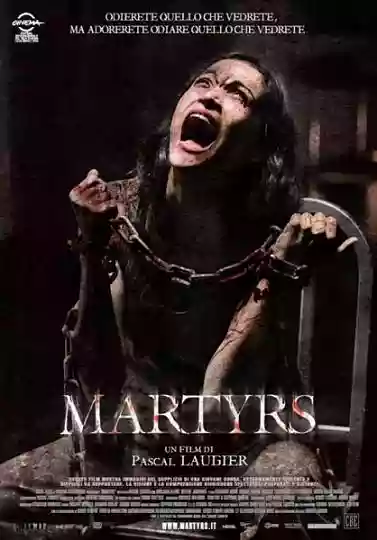
Martyrs is one of the most famous films of the so-called French torture porn genre, which in the past decade was very successful among experts and enthusiasts. This film in particular, is one that has shocked many, but in every respect, it is much more than just a simple torture film.
To talk about such a controversial film, however, I’ll first mention an important reflection by René Girard regarding The Passion of the Christ by Mel Gibson. In my opinion, this reflection also applies well to a film like Martyrs:
"To cinematographically depict the Passion and Crucifixion, it is quite obvious that simply mentioning Christ's agony textually is not enough. This agony, these sufferings must be represented. In Greek tragedy, it was forbidden to directly represent the hero's death; it was the task of a messenger to announce to the audience the outcome of an event that was barely hinted at. Cinema does not allow the possibility of avoiding the essential. Omitting the scourging or the crucifixion, for example, would mean turning a blind eye at the most crucial and important moment. These horrible details must be represented as if we were there. Should we be outraged if the result is not exactly a Pre-Raphaelite painting?"
Exactly. Martyrs is the quintessential unhealthy and disturbing experience, and it also leads to a renewed reflection on the limits (theoretical and potential) of the showable and representable. But the violence in Laugier's work is never gratuitous for this very reason: when you want to represent something as powerful as the martyrdom of a human being, you cannot simply suggest to convey what you want to convey. But the film never becomes morbid by superficially lingering on the most scandalous details of the story, slipping into banal voyeurism. Everything is, instead, as carefully planned and studied as possible, and Laugier's gaze is quite focused on this kind of bold poetic experience: showing transcendence of and in pain, leaving one's body as the ultimate and extreme defense against suffering, along with the central and final reflection on humanity's ancient obsession with the afterlife. But the mystery will always remain unsolvable or at least never revealable.
Martyrs is a deep and complex work, extreme and shocking, disturbing but also cathartic, as it exorcizes the purest and most radical horror, and few other films will be able to disturb in the same way after this one. The viewer's awareness will be profoundly altered. Martyrs is a cinematic experience.
Yet every question remains unanswered, every issue unresolved, no answers are offered. And this, undoubtedly, is the hallmark of authentic works of art.
A fundamental film in every respect.
Loading comments slowly
Summary by Bot
Martyrs is a landmark French horror film known for its shocking and disturbing depiction of violence. However, it transcends mere torture porn by offering a poetic and profound exploration of martyrdom, pain, and humanity’s obsession with the afterlife. The film challenges viewers with its raw honesty and leaves profound questions unanswered, making it an authentic work of art and a deeply cathartic cinematic experience.
Pascal Laugier
Pascal Laugier (born 1971) is a French film director and screenwriter known for the extreme, philosophically charged horror of Martyrs (2008), the debut Saint Ange (House of Voices) (2004), The Tall Man (2012), and Incident in a Ghostland (2018).03 Reviews
Other reviews
By ZiOn
The only way out of horror is then asceticism, achieved with difficulty after torture, beatings, and ultimately, a flaying that seems to strip the young woman of everything yet gives her the deepest good.
From the macabre waltz of blood, the viewer emerges shaken, disoriented by continuous changes of perspective and fast, disturbing shots that spread an unsettling sense of realism.
