
 •
Rating:
•
Rating:
THE REVIEW
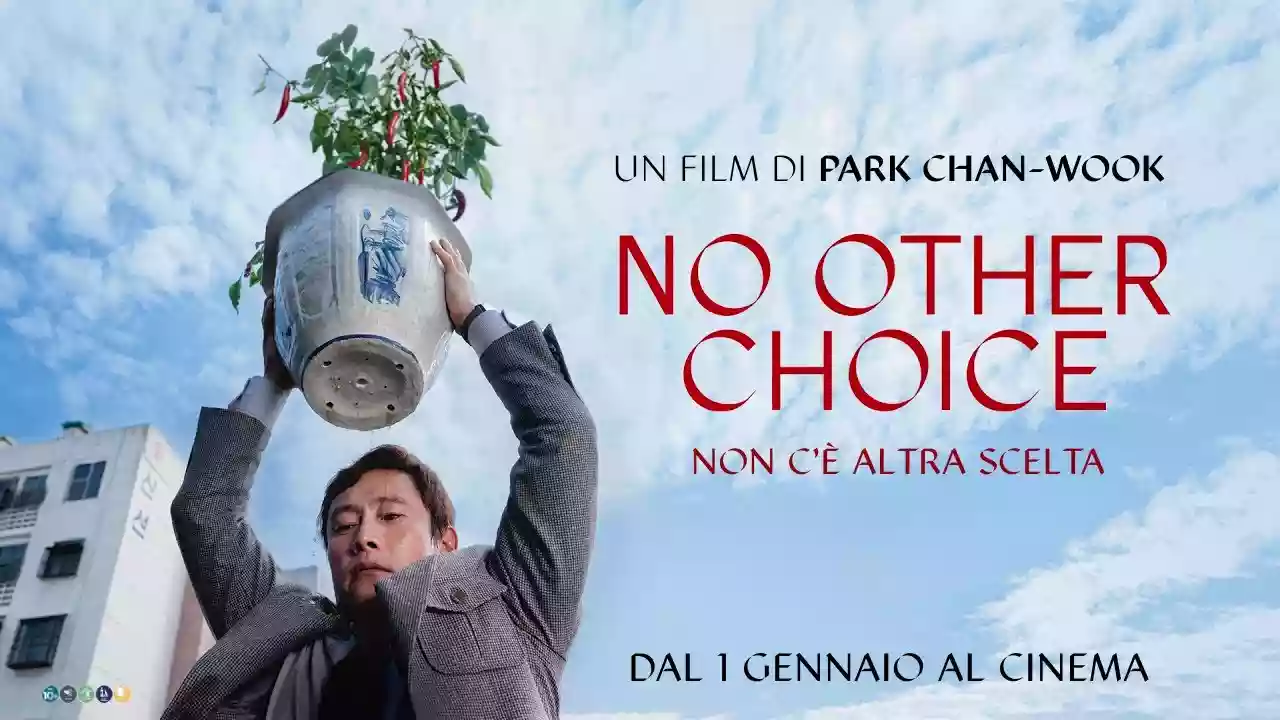
Watching “No Other Choice” by Park Chan-wook, I feel a kind of frenzy and envy. I am excited and amazed by his artistic freedom, his sharp social vision, I admire the narrative richness, am struck by the depth of the psychological layering. In short, I wish that films like this were more present in our Western cinema as well, but every time I watch Eastern productions, Japanese or Korean, I find that there is a clear gap.
The gap between the artistic honesty of a director who truly wants to communicate something, expressing himself at his highest level, and a cinema that, instead, is far more worn out, funnelled onto more standard tracks. You need to see directors like Park Chan-wook, Bong Joon-ho, Hirokazu Kore'eda and who knows how many others, to realize how our (cinematic) conversations in the West are becoming less and less free, less irreverent, and more distant from reality. It seems that Eastern filmmakers look more at the world, and less at predetermined genres, and use the stylistic traits of genre to amplify their messages and their visions.
Genres
Park blends drama and farce, comedy and tragedy, sentimentality and thriller. There is a bit of everything, but it’s not a cold syncretic game. Every texture serves to explain content, to add another layer of meaning. Thus, the protagonist is a victim of a social drama, but he is also the perpetrator in an absurd thriller; he is a caricature, a jealous husband, a caring but absent father. The director has no mercy on him, exposing him to every criticism, showing his endless contradictions and pettiness. Introducing comedy inside a murder scene, for instance, is not a mere aesthetic game: the director reveals the tragic comedy of these people waging a war among the poor, the director’s touch amplifies the meanings.
Aesthetics
Park uses every sequence as a canvas. The minutes never pass by uselessly, merely to narrate a story prosaically. Every shot (or almost) has an artistic connotation, an aesthetic play that is often far from trivial. Metaphors, symbolism, visual interference, geometric compositions, moving shots. It’s like the finest fabric crafted by a skilled embroiderer. The viewer’s eye notices, sees through the director’s gaze the amplified concepts, the shifting perceptions, the human panoramas. This makes a huge difference, because seeing a story in this way renders it intimately different. It stretches it, extends its breath. The music then adds as yet another alienating filter, telling us that this is a tragedy—perhaps the tragedy—but also and above all, a farce. The class struggle (or rather, to maintain one’s social class) in the age of rampant capitalism, something not to be taken too seriously.
Ethics
One of the colossal strengths of this film lies in uniting the sociological narrative (think Ken Loach, but: it’s nothing like that) with the most ramshackle, distorting fiction. There’s a realistic starting point, the protagonist losing his job, there’s psychological-practical development (the family’s reactions, interviews, therapy sessions), and then there’s the genre delirium (deceit, murder, investigation) which, miraculously, manages to hold together the realistic demands and the grotesque degenerations, the sociological content and comedic overtones.
Within all this, a progressive ethical reversal emerges in the protagonist’s family. He, from victim, tries to become a perpetrator by adopting the cannibalistic impulses of the most unbridled capitalism, which in fact pits the individual in a fierce battle, “mors tua vita mea”. The family witnesses and participates in this evolution, as more or less ethical observers, with their various initiatives, small or large interferences, always on the ethical threshold between obstructing the father’s criminal action or supporting it, pretending not to see.
A metamorphosis of values entirely dictated by the dominant demands of society, that is: appearances, having a big car, a house with a large garden, dogs, tennis lessons. Man-su’s struggle is above all a struggle for his own ego, his social status. He doesn’t want to end up working as a shop assistant, doesn’t want to sell the long-coveted mansion. Crime seems more congenial to him than a lowering of personal prestige. And over time, even his family seems to adapt to this situation: well-being and others’ envy come at a high price, you have to be ready for anything.
Choral Nature
In just over two hours, Park manages to construct a story with solid foundations, jagged developments, moral consequences, a broad finale. But not only that. He allows himself the luxury of digressions. In striking brevity he tells us the stories of the victims, the wife’s sentimental lures, the son’s bizarre criminal plans, the daughter’s talent and idiosyncrasies. He explains the mistaken police investigations, lets us see a marriage stretched to breaking in a maze of blatant lies, crafts a counterpoint of crystalline purity that echoes in the notes of the youngest daughter’s cello.
And in all this, there is a thriller that unfolds and works very well. Fears, doubts, mistakes, investigations close at hand, real guns and toy guns, the family’s complicity or lack thereof, and finally a murder technique that gets more refined. Man-su becomes increasingly cunning, ruthless, in crime and in life, and from sacrificial victim of the economic system he becomes a bloodthirsty predator, willing to accept the ruin of everyone else in order to preserve his own dream of glory.
In his brilliant and terrible contraption, Park shows us that the protagonist’s triumph—evident victim from the outset—does not amount to a morally positive outcome. Quite the opposite. In fact, no one wins; we all lose. Man-su is just a salmon swimming upstream, prolonging his existence a little, but he too is destined to perish. There is no other choice, eat or be eaten.
We remain in suspense, in the finale, waiting for justice to run its course: we want more than ever for him to be caught, because we hate him. He disgusts us. Obviously, I won’t reveal the ending, but in the end, little changes for the system. Another will take his place, other workers will be laid off, because now artificial intelligence will do their jobs instead.
Loading comments slowly
Summary by Bot
The reviewer praises Park Chan Wook's 'No Other Choice' for its gripping direction and storytelling. Enthusiastic approval is shown through a perfect rating. The film's visual style and emotional intensity are highlighted. The review positions the movie as a high-quality work of modern cinema. It's recommended as a must-see for fans of thriller and Korean films.
Park Chan Wook
Park Chan-wook is a South Korean film director and screenwriter known for the Vengeance Trilogy (Sympathy for Mr. Vengeance, Oldboy, Lady Vengeance), The Handmaiden, Thirst, and Decision to Leave. He won the Grand Prix at Cannes 2004 for Oldboy and Best Director at Cannes 2022 for Decision to Leave.07 Reviews
