
 •
Rating:
•
Rating:
THE REVIEW
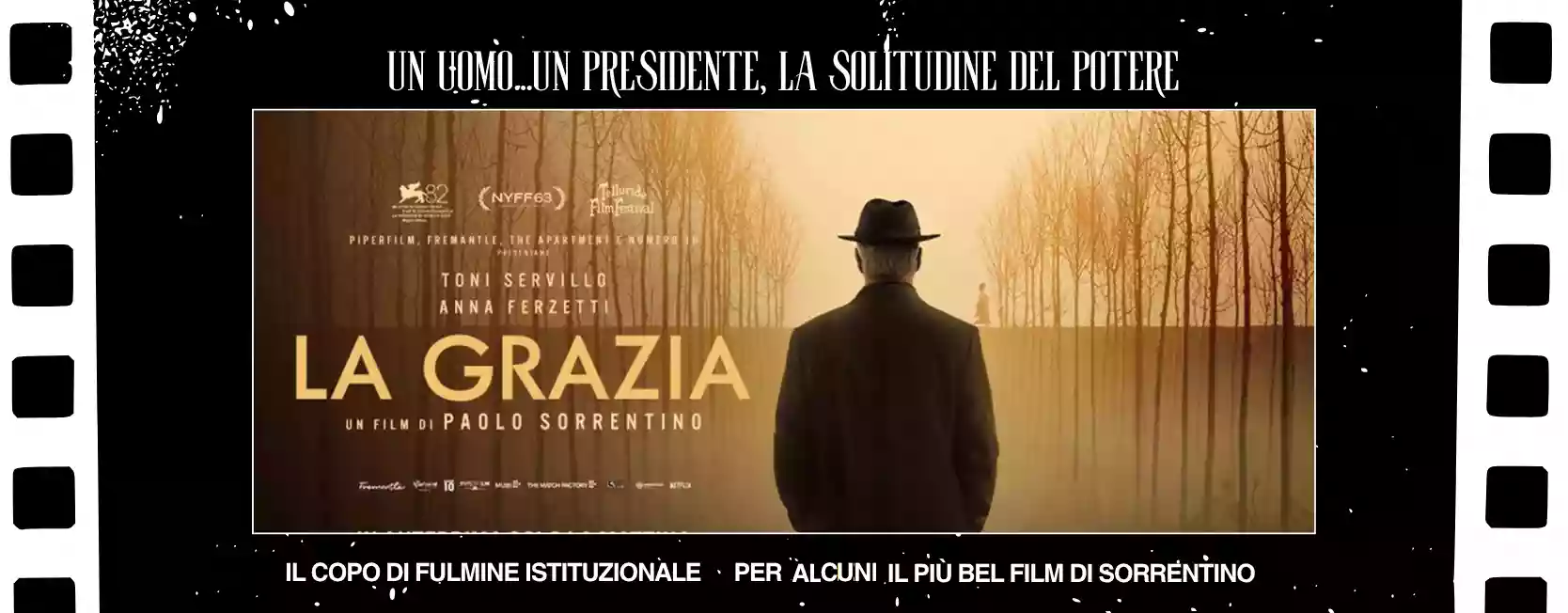
Once again, the director delivers a page worthy of Cinema with a capital C, as if there were still any need to prove that Paolo Sorrentino was, is, and will remain a shining jewel in the annals of Italian and, of course, international cinema.
Part of the plot could not be more relevant, especially in light of the most recent pardons granted by the President of the Italian Republic in mid-April, including the one to Nicole Minetti, which has stirred and continues to stir much debate.
Yes, because the events narrated here are inspired precisely by a pardon that Sergio Mattarella granted in February 2019 to a man guilty of murder and convicted for killing his wife who suffered from Alzheimer's disease.
The term “grazia” (pardon or grace), besides meaning “forgiveness” , has various meanings, and in the film, one can observe different types of grazia aside from the main one: such as the grace of poise, grace in dance, the grace of intelligence, the grace of doubt, grace in the absence of gravity, the grace of truth, the grace even inherent to commercial music or rap (here represented by Cosimo Fini a.k.a. Guè Pequeno).
The themes addressed by Sorrentino are diverse and surprising, first among them being grace as remission of penalty, but also the painful issue of euthanasia—not only human, and those who see it will understand—the theme of the Black Pope (a great friend of the President) with its religious undertones, the theme of marital betrayal, the theme of parenthood with its implications, misunderstandings, and indissoluble emotional bonds.
An underlying question remains, expressed several times during the narration: whose are our days?
Usually, I don't give spoilers, but this time the temptation is too strong, so do not read further if you don't want to know how it ends: the movie closes with these five words, “Non rompere il cazzo eh...” uttered with a certain “mala” grace by a lady very close to the President (masterfully portrayed by Marco Antonio “Toni” Servillo, and there could have been no other, awarded at the Venice Biennale with the “Coppa Volpi for Best Actor”).
PS comments from the director declared at the Venice Biennale that I consider worthy of being included here:
-
It is a love film, this inexhaustible engine that generates doubt, jealousy, tenderness, emotion, understanding of the things of life, and responsibility.
-
my President of the Republic is plausible but strictly fictional—behind his serious and strict appearance, he is a man of love.
-
it is a film about doubt and the necessity of practicing it, especially in politics, especially today, in a world where politicians too often present themselves with their dull package of certainties that only cause harm, friction, and resentment, undermining collective wellbeing, dialogue, and general tranquility; this my President is a man moved by doubt.
-
it is a film about a moral dilemma—whether to sign or not sign, as a Catholic, a difficult law on euthanasia—I felt the need to make it at a historical moment in which ethics sometimes seems optional, elusive, opaque, or in any case, too often invoked only for instrumental reasons. Ethics is a serious matter; it keeps the world afloat and this my President is a serious man.
Loading comments slowly
Summary by Bot
This review highlights 'La Grazia' as a standout achievement by Paolo Sorrentino. The film receives a perfect score for its artistry and narrative depth. The reviewer praises its emotional resonance and visual beauty. 'La Grazia' is depicted as a new milestone in contemporary Italian cinema. The review strongly recommends it to fans and cinephiles alike.
Paolo Sorrentino
Paolo Sorrentino is an Italian film director and screenwriter from Naples. He is known for visually distinctive, character-driven films and a long-running collaboration with actor Toni Servillo. Sorrentino won the Academy Award for Best Foreign Language Film with La grande bellezza (2013), and his Il Divo (2008) earned the Jury Prize at Cannes.24 Reviews
