
 •
Rating:
•
Rating:
THE REVIEW
Can a Conte album be different from the others? Can it be considered "unclassifiable" in terms of time, arrangements, compositional structure, both musical and literary, and finally in the fundamental yet indeterminable element of atmosphere…? If such an album exists, it is certainly "Parole d'amore scritte a macchina," an anomalous work in every way, which opens the 1990s for the singer-songwriter and lawyer from Asti. Let's examine the elements with the necessary minimum of analysis, trying not to appear boring or pedantic.
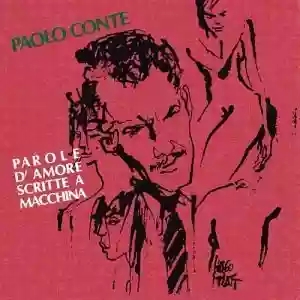
The cover. In the era of mp3s, this is unfortunately becoming an absolutely secondary element of the work as a whole. But a casual glance at the history of so-called light music covers is enough to understand that it is certainly not a negligible element. Here, Conte chose a portrait of himself by the ever-excellent Hugo Pratt, depicting him, in black sketch on an orange background, lost among the women of his fantasy and music. An absolutely ethereal cover for an album that is absolutely so.
The composition. Paolo Conte was then fresh from what is commonly regarded by everyone (including myself) as his real and unrepeatable golden period, which ranges from "Un gelato al limon" to "Aguaplano." A golden moment especially for the brilliance of the lyrics, for that ability to write seemingly simple melodies on often difficult harmonic structures. Here, everything changes in the name of the purest minimalism. The lyrics may seem (and undoubtedly did seem at the time) sparse and less inspired. In reality, it's just a different approach, completely aimed at emotion and atmosphere, and in this goal, the Artist succeeds as perhaps never before. The range goes from typically Conte-styled songs ("Colleghi trascurati") to others absolutely atypical in the singer-songwriter's compositional panorama ("Dragon," a pseudo-blues on a pleasantly obsessive electronic base), from brilliant ideas that dig deep ("Il Maestro"… and any explanation would be rhetorical and especially useless…) to amusing jokes wonderfully pointless ("Happy Feet"). An album, therefore, compositionally with an apparent poverty and unquestionable depth, which can only be a result of careful and mature listening.
The arrangements. Here too, Conte was fresh from the golden period, the one of collaborations with (more or less) the same group of Musici of Guccini (and obviously of the Fantini stable), those, in summary, where the best Authorly strokes came from the fluid drumming of a Bandini or the tempered hard bop improvisations of Marangolo's sax. Here, while the production remains unchanged, the group changes in all its members. Musicians undoubtedly more academic and less skilled, but who in the ethereal atmosphere of the Monferrato studio render the now and forever unfiltered ideas of the Author very well. In the last track, Daniele Di Gregorio, a drummer of rare woodiness and limited musical lust, fortunately without causing harm, makes an appearance with light percussion, causing many damages (at least in the opinion of the writer…) in the years to come, especially in live albums (compare Bandini's part and his in "Alle prese con una verde milonga" in the 80s live and the last "Arena"…). But when talking about arrangements, one must notice the true element that makes this album absolutely unique in its genre, namely the total absence of the drums. To hear the same tracks with drums, one will have to wait for the numerous live albums (three doubles, since then…), and the result will be surely inferior to the studio model. Here Conte seems to pay tribute to the early jazz/blues, where the rhythmic part was left to the guitars, which also in this album assume every rhythmic burden, almost losing the sensation, often, of the chord they are playing. Almost as if the "scratch" were more important than the chord. A choice also seemingly questionable, but in the result characterized instead by undeniable strength. The tracks of "Parole d'amore…" are absolutely ethereal, as if they were suspended at an indefinable point in space and time.
An album that, evaluated retrospectively, would certainly be difficult to define and date, and for this reason also beautiful. Then Paolo Conte would return to earth, with very beautiful albums ("900," "Elegia"), other simply more than good ("Una faccia in prestito") others absolutely negligible (the missed dream of "Razmataz") and, as I said, too many live albums and compilations. However, all pleasantly usual, normal products, even in a Conte perspective. "Parole d'amore scritte a macchina" instead stands out there, embellishing the limited yet splendid array of "strange" albums.
Loading comments slowly
Summary by Bot
This review explores Paolo Conte's album 'Parole d'amore scritte a macchina' as a unique and ethereal work that diverges from his usual style. Marked by minimalism, sparse yet deep lyrics, and the notable absence of drums, the album creates an emotional atmosphere reminiscent of early jazz and blues. The cover by Hugo Pratt complements its mystical vibe. Positioned in Conte's 1990s era, the album stands out as a mature, unusual masterpiece within his discography.Tracklist Lyrics Videos
Paolo Conte
Paolo Conte (born January 6, 1937) is an Italian singer-songwriter and pianist from Asti, known for jazz- and chanson-inflected songs, cinematic lyrics and a smoky baritone. He began his career as a songwriter in the 1960s and released his first solo albums in the 1970s; his best-known records include Paris Milonga and Aguaplano.44 Reviews
Other reviews
By Silla
Words of love written on a typewriter.
I fell in love with it after three seconds of listening.
