
JonatanCoe
29 apr 21
DeRank ™: 14,52
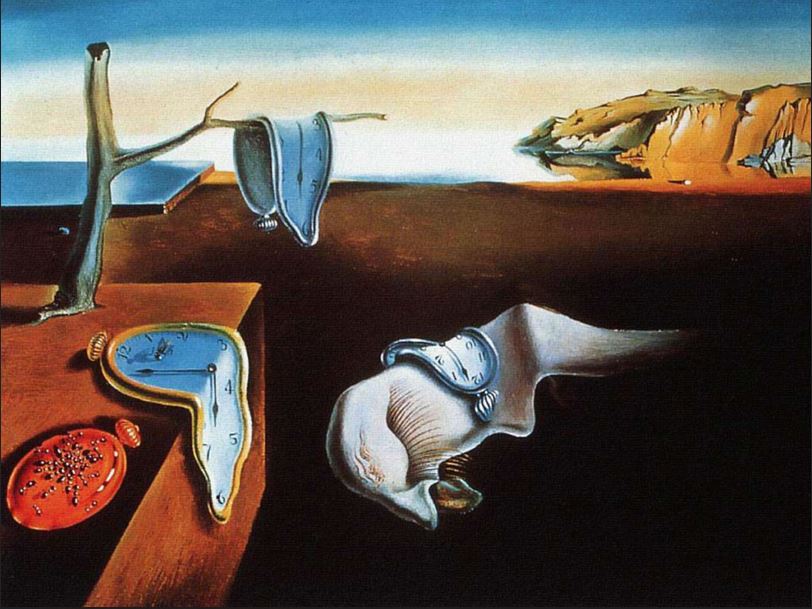
Picazzo, the crazy painter!
[a.k.a. the man who painted music while listening to the paintings] [29 of 40]
Preview
The Persistence of Memory - Salvador Dalí (1931)
"The Persistence of Memory" is a painting created in 1931 by the Catalan artist Salvador Dalí. The scene is set by the sea, on the Catalan coast. The beach appears deserted. There are no recognizable human presences, except for the strange shape lying on the ground at the center of the work, which likely reproduces the artist's silhouette. The protagonists of this painting are some soft clocks that seem to be made of fluid material. The first clock hangs from the edge of a square volume resting on the ground in the foreground to the left. The second is hung on an olive branch that rises from the parallelepiped. The third is draped over a face lying on the ground with its eye closed and long eyelashes. A fourth clock, which unlike the others is closed and retains its traditional shape, is beset by a swarm of crawling ants, insects for which the artist has a phobia dating back to his childhood. In the background of the canvas, the cliffs of the Catalan coast can be seen, where Dalí spends much of his summers. The contrast between soft forms and hard forms has always been a point of interest for Dalí. The artist claims to have created the painting after a dinner featuring camembert. After falling asleep post-dinner, caught between sleep and wakefulness, he conceived the image of the soft clocks, suggested to his mind by the texture of the cheese he had just eaten. Thus, he incorporated the soft clocks into the landscape he was painting during those days. However, the painting also lends itself to other interpretations. The image of melting clocks evokes a reflection on time. The clock, a tool that claims to measure time objectively, yields to the subjectivity of perception and the uncontrollable mechanisms of memory. For this reason, the painting has become an icon of the twentieth century: a century that began with discoveries such as relativity in physics and the unconscious in psychology, which undermine the certainties of the nineteenth century. The Persistence of Memory is located at the Museum of Modern Art in New York.
[source ovovideo.com]
Associated LP from 1973

DeBaser says
right now