
JonatanCoe
28 apr 21
DeRank ™: 15,98
Picasso, the mad painter!
[a.k.a. the man who painted music by listening to paintings] [28 of 40]
Preview
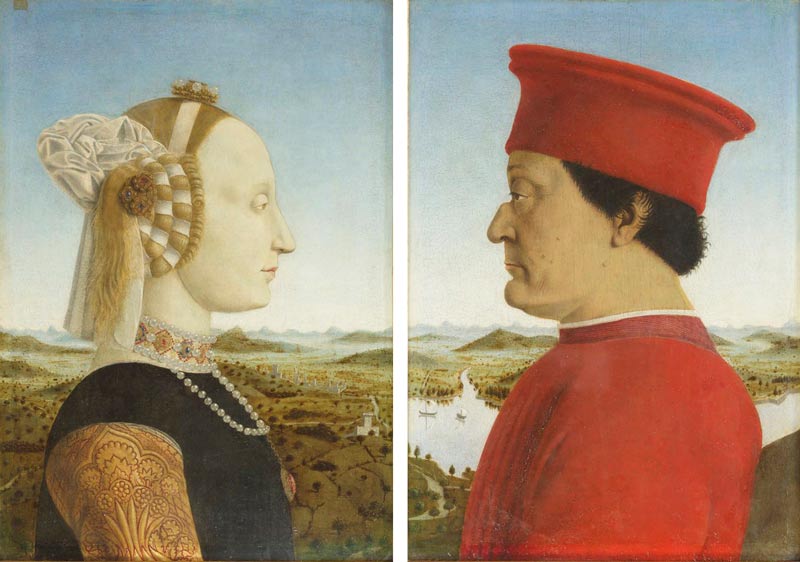
Double portrait of the Dukes of Urbino - Piero della Francesca (circa 1465-1472)
Among the most famous portraits of the Italian Renaissance, the diptych depicts the rulers of Urbino, Federico da Montefeltro (1422-1482) and his wife Battista Sforza (1446-1472). In accordance with the 15th-century tradition, inspired by ancient numismatics, the two figures are represented in profile, a cut that ensured remarkable likeness and precision in the details, without revealing their emotional states: the Dukes of Urbino appear indeed immune to turmoil and feelings. The couple faces each other, and the spatial unity is suggested by the light and the continuity of the hilly landscape in the background – the Marche landscape over which the Montefeltro ruled. The chromatic contrast between Federico's tanned complexion and Battista Sforza's very pale one stands out, a pallor that, apart from adhering to the aesthetic conventions of the Renaissance, may allude to the premature death of the duchess, who died young in 1472. On the back of the panels, the dukes are depicted being triumphantly carried on chariots, accompanied by Christian Virtues; the Latin inscriptions praise the couple's moral values. The presence of paintings on the back suggests that the two paintings, now placed in a modern frame, may have originally constituted a diptych.
Among Piero della Francesca's most famous works, the double portrait fits within the established relationship between the painter and the Dukes of Montefeltro, at whose court Piero repeatedly stayed, finding himself in contact with a cultured, refined environment that quickly became one of the most important cultural and artistic centers in Italy. The master reconciles the rigorous perspective learned during his Florentine training with the lenticular representation of nature characteristic of Flemish painting, achieving extraordinary and unparalleled originality. [source uffizi.it]
Associated LP of 1977

DeBaser says
right now