
 •
Rating:
•
Rating:
THE REVIEW
"I like bands making punk rock music" confessed Mike Kinsella candidly, responding to one of my questions in English that was borderline embarrassing. It happened during an interview I conducted, in the DeBaser-style of 5 questions, which, I confess, I've never had the courage to publish. It was a warm early summer evening in June 2007, and Mike and I were sitting on a wall in Saint Feliu, a small town on the Costa Brava, facing Casa Irla, a cultural club where he was about to perform for around thirty fans.
I followed Mike for three nights of his European tour and was amazed at the simplicity and availability of a character mostly unknown to the Italian public: drummer for Joan of Arc (with his brother Tim and cousin Nate) and the Owls, drummer and vocalist for Cap'n Jazz, bassist and vocalist in the short-lived yet successful "minor" project called American Football, and more. Since 2001, Mike has, in my opinion, expressed all his talent in the one-man-band named Owen. Among my five questions, I forgot to ask him if he happened to like Take That as well. I don’t think so.
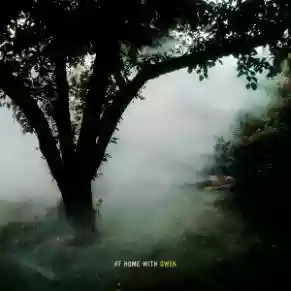
"At Home With Owen" is his latest album, released in 2006 by the family-operated label, Polyvinyl Records. And it has nothing to do with punk. Nor with Take That, luckily. Eight songs enclosed in a box with a cover that is both bucolic and unsettling. Eight tracks where all the instruments are played by him, confirming the versatility of this guy who, among other things, has tattoos on the knuckles of his left hand that can’t be seen.
Mike dilutes his thoughts and the stories of a lifetime, which saw him grow up among relatives who were musicians to emulate, crowded bars in Chicago, good books ("The Sad Waltzes of Pietro Crespi" references Gabriel García Márquez's One Hundred Years of Solitude), punk music, and acoustic guitars, into an elegant and varied melodic folk. Take That no. Fingerpicking, slap, and open tunings are, in this case, the common denominator of a fascinating and original repertoire, accompanied by a voice that is not exceptional but used for what it is and what it can convey. Without straining. Without self-indulgence. Mike smiles when he plays. I've always appreciated those who know how to express joy in doing a job they love. Especially those artists who are not in a position to bend their work to commercial logic. And have no desire to. The judgment of people, of course, is a matter of taste. For me, for example, Owen reignited my passion for playing my Gibson. In America, however, young girls go crazy and crowd his concerts. He is now married and feels almost like an old man. He repeated it often to me, even though he's just over thirty. It seems he doesn't appreciate the hordes of talkative, autograph-hungry teenage girls, and more. And he won't take advantage of it.
I remember special evenings in his company during that summer spent lazily chasing him across Europe, mixing a brief holiday moment with his music. Like when he explained to me, guitar in hand, in a corner of the stage, after the show, some obscure passages of one of his most famous songs, "Breaking Away". I also remember that, though thousands of kilometers away, Trell was there with me. Sharing through texts and calls my funny and childish enthusiasm for an encounter I never imagined would be so pleasant. It was also because of that that one day the strings of my guitar vibrated for her, to the notes of Owen.
Hi Malacchia, I know Owen was too soft for you. But I also know you did it for me.
Thank you.
Loading comments slowly
Summary by Bot
The review explores Mike Kinsella’s album At Home With Owen, highlighting his versatility and intimate folk style. It shares personal insights from a small European tour that revealed Kinsella's humble character and musical passion. The album’s acoustic melodies and genuine performances evoke a sense of warmth and simplicity. Despite modest vocal delivery, Kinsella’s songs express authentic emotions and joy for music. The review conveys admiration for an artist dedicated to his craft beyond commercial trends.Tracklist Lyrics Videos
