
 •
Rating:
•
Rating:
THE REVIEW
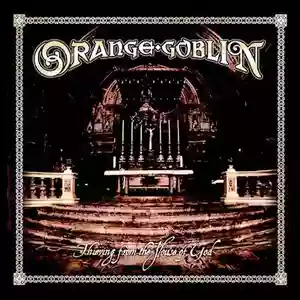
Perhaps from a band like Orange Goblin, one might not expect more than what they actually offer: sandy riffs, “small-town festival” style burger and beer choruses, rocking rhythms, some belching, some space travel. It's hard to find in their offering a message even just “thematic” that is deeper than mere musical entertainment. A "behavior" that fans of Ben Ward & Co. have learned to accept: after all, it’s the very "creed" of the London band not to be precisely original and deep, given that OG have borrowed, made their own, and re-proposed on English soil what Kyuss had made explode a few years earlier in California: our Goblin sniffed the air, occasionally varying the general lines of their music. This is partly what happened in “Thieving from the House of God,” a work released in April 2004.
To better understand the path that led to the conception of this platter, it’s good to take a small step back: their early works, particularly “Frequencies from Planet Ten” and “Time Travelling Blues,” albeit with slight contaminations (especially psychedelic in the latter), were smelly, ungraceful stoner albums, deeply indebted to the creation of Josh Homme and John Garcia. This narrative began to change with the CD “The Big Black,” darker, more doom and at the same time more inclined towards a “dirty” and personal hard rock. Recurring elements also in “Coup de Grace” (2002) and also present in TFTHOG. In particular, a slight departure from primordial stoner in favor of more canonical hard rock is perceived, although characterized by the usual raw attitude of the English. But it is precisely the more rock and less “metal” tracks that are the least convincing, as if the band found itself on hot coals, dealing with something that doesn’t entirely belong to them: such is the case with tracks like “You’re Not The One” and “If It Ain’t Broke, Break It” which appear flat, lacking luster. Other small problems of this work are found in the production and Ward’s voice. Orange Goblin, at least in their early works, have always focused on sonic roughness, without worrying too much about cleanliness. That’s how they have come out with records that from the point of view of “sonic cleanliness” have never been thrilling. However, “Thieving from the House of God” seems to exceed in this characteristic, so the final result appears many times confusing. The other small problem concerns Ben Ward: not that his voice has suddenly become unbearable, but this fifth work at times seems almost like a solo CD of the singer, given his absolute dominance within the structure of the pieces.
More or less evident flaws that are somehow “smoothed out” by the usual seismic charge of the Londoners, capable of slightly dampening their desertic verve, but at the same time of sounding angry and convincing as always: “Some You Win, Some You Lose,” “Lazy Mary,” and “One Room, One Axe, One Outcome,” with its dark intro governed by Martyn Millard's bass, are compositions that emphasize what has just been said. Heavy metal that blends with a stoner rock loaded with pathos and energy: a non-original formula, but expertly crafted by the OG.
“Thieving from the House of God” is the classic “intermediate” CD of a band: it serves somewhat as a vehicle to try something else after having expressed themselves through a well-codified genre. We are talking about one of the minor works in the Goblin's career, but overall it is an acceptable chapter, more than other “intermediate” experiments attempted by entities with a name even much more “heavy” than that of Orange Goblin.
1. “Some You Win, Some You Lose” (3:19)
2. “One Room, One Axe, One Outcome” (5:28)
3. “Hard Luck” (2:30)
4. “Black Egg” (5:04)
5. “You’re Not The One (Who Can Save Rock n’ Roll)” (2:20)
6. “If It Ain’t Broke, Break It” (5:25)
7. “Lazy Mary” (3:17)
8. “Round Up The Horses” (5:32)
9. “Tosh Lines” (1:21)
10. “Just Got Paid” (3:31)
11. “Crown Of Locusts” (9:23)
Loading comments slowly
Summary by Bot
The review of Orange Goblin's 2004 album 'Thieving from the House of God' acknowledges the band's characteristic stoner rock and hard rock blend with clear Kyuss influences. While praised for energy and standout tracks like 'Some You Win, Some You Lose,' the album suffers from less inspired rock tracks, over-dominant vocals, and production issues. Overall, it's seen as an acceptable but minor work in the band's career, reflecting an experimental phase.Tracklist Videos
Orange Goblin
Orange Goblin are a British stoner metal band formed in London in 1995 (originally as Our Haunted Kingdom). Fronted by Ben Ward, they fuse stoner, doom and hard rock into loud, live-tested albums and tours.09 Reviews
