
 •
Rating:
•
Rating:
THE REVIEW
"The sleep of reason produces monsters," painted Goya...
"Shining" by Kubrick perhaps represents the greatest apotheosis on which this expression plays, where the human being tends to go mad when, in conditions of social isolation, and without leisure inputs as an alternative to routine, he unconsciously gives more and more absolute and incorruptible value to his actions, gradually trying first to counter and then suppress what does not agree or opposes his actions and his will.
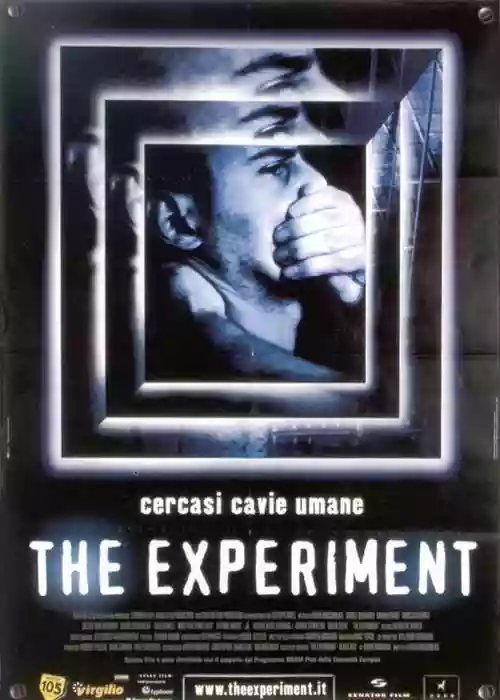
This "The Experiment," which became a cult in its German homeland but did not gain equivalent acclaim abroad, seems in part to replicate the formula by replacing the hotel with an underground bunker. A prison life is simulated with ordinary people who, divided into guards and prisoners, and under compensation, must adhere to the strict rules of prison for 2 weeks, monitored. Some participate out of financial need, some for pleasure, and there’s the spy soldier. Conceptually, it is a psychological treatise on how man manages to convince himself that his actions, fulfilling a very specific role, not representing himself, must subordinate any rational conception of existence.
The film, while containing a screenplay and some plot contrivances (after the professor’s departure, a loss of self-control is to be expected!) that do not evoke a miracle, is enhanced by both masterful cinematography, claustrophobic, that throws the viewer into the depths of tension (and acts as the spokesperson of the psychological disturbances leading to the "monsters" of the last half hour) and 2 masterful performances, that of Moritz Bleibtreu (Tarek) protagonist/prisoner guinea pig, with a subversive and altruistic character, who attempts to establish an anarchic climate in the experiment, and Justus von Dohnányi (Berus) antagonist/guard guinea pig, cold and calculating (predictable?), whose perverse para-philosophy will tend to influence the oppressive attitudes of the other guards, who feel increasingly challenged by the organizing system, which find no reason for continuation except to fuel their own neurosis through a growing desire for suppression and annihilation, the only reason that must, apparently, fill the gaps left by the existential question of the film: Do we really have to obey the laws imposed from above, considering the slightest form of corruption and disobedience as a stain on human morality?...Or perhaps, instead, should we hesitate, think?... If one goes beyond the spatiotemporal limits that 2 hours of film can offer, the parallels with the SS, especially in the cognitive formation-shipwreck processes, are countless...
In short...in today's world, the slightest form of coexistence/self-management among individuals or different factions over prolonged times is unthinkable, even in small things, because everyone thinks and does as they please...decline is inevitable. Four and a half stars for the not negligible flaws, but the involvement, the sensation of "being there" is enormous, and it is something that only a few films are able to provide nowadays...5 and curtains. SEE IT.
P.s. based on a true story.
Loading comments slowly
Summary by Bot
Oliver Hirschbiegel's The Experiment masterfully depicts a simulated prison scenario where ordinary people become guards and prisoners, revealing deep psychological and moral conflicts. The film's claustrophobic cinematography and strong performances by Moritz Bleibtreu and Justus von Dohnányi create intense tension. Despite some plot flaws, it powerfully explores obedience, power, and human nature. Inspired by true events, this cult classic remains a compelling watch.
Oliver Hirschbiegel
Oliver Hirschbiegel is a German film director known for Downfall (2004) and The Experiment (2001). He also directed The Invasion (2007), Five Minutes of Heaven (2009), Diana (2013), and 13 Minutes (2015).04 Reviews
