 •
Rating:
•
Rating:
THE REVIEW
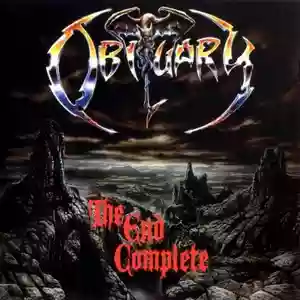
After the historic Slowly We Rot and Cause Of Death, the "living dead" return in 1992 with The End Complete. The band from Tampa comes back to the studio with the same line-up from their rough debut: thus, the talented James Murphy leaves, usually wandering with his six-string from one band to another, and the name of guitarist Allen West reappears in the "obituary list." In the director's chair, obviously, sits the "deus ex machina" Scott Burns, and it shows: the production of The End Complete is indeed remarkable, perfectly highlighting the gritty and thick tones of the guitars.
With the introductions over, somewhat brief due to the band being one of the most famous and seasoned in death, we move straight to the album analysis.
The excellent "Killing Time," "Dead Silence," "Corrosive," and generally all tracks from the album present a rather simple dynamic: we find medium-slow rhythms mixed (sometimes a bit predictably) with decidedly faster but still pretty thrash-inspired tempos. The classic "Obituary-style" we were accustomed to from previous works, then. It should still be noted that these rhythmic variations, however simple, have indeed served as a true manual for many other bands: the importance of Obituary is undeniably out of the question. Decadent solos and instrumental portions are not missing (the obsessive length of the outros, like that of the title track, is surprising), but it is the parts where John Tardy's growl rages that truly delight the deathster, gaining many points in expressiveness and ferocity when the tones become less sustained: the agonizing verses of "In The End Of Life," for example, are the perfect sonic backdrop for the unhealthy vocal lines of the "Living Dead." Tardy's growl is supported by the guitars, engaged in fast death phrases and massive doom-derived power chords; many grooves are also effective (see the first ninety seconds of "Killing Time") which contribute to making the riffing more heterogeneous, even if not completely averting a certain underlying repetitiveness.
Listening to The End Complete it thus becomes evident that Obituary favors a direct and sharp death metal that relies heavily on impact force (and less on technical quality, it must be said), on emotional rather than cerebral engagement. Precisely for this reason, the mood becomes very important: let's be clear, Obituary certainly does not reach the levels of morbidity and sonic terror of other bands, but they still manage to create an atmosphere in their own putrid and deathly way. An atmosphere, moreover, that is a worthy soundtrack of lyrics devoted to the blackest pessimism, tackling themes such as pain (the emblematic "I'm In Pain"), body corruption, and, naturally, death, whether at the hands of improbable serial killers or due to natural causes.
In summary, The End Complete is a work that coherently continues the discourse started by the Tardy brothers & co. back in 1989. A good album, yet it cannot be awarded top marks: the simplicity of the songwriting, sometimes almost coarse, the decent but nothing more technical expertise, and the pedantic repetition of certain stylistic elements indeed risk making the listening somewhat uninteresting in the long run, especially for those who are fans of extreme but more intricate and technical sounds. In any case, The End Complete remains one of the fundamental albums of "original" death metal.
A final piece of advice: given that Obituary's offering is, at least based on my experience, one of the most "accessible" in the death realm (at the time, TEC sold the "beauty" of 200,000 copies), I feel I can recommend this album, or even the previous two, to those who wish to explore the extreme territories of metal. Listen and judge.
Loading comments slowly
Summary by Bot
Obituary's The End Complete marks a significant release in the death metal scene, showcasing their trademark gritty riffs and John Tardy’s expressive growls. Produced by Scott Burns, the album emphasizes emotional intensity over technical complexity, blending slow and mid-tempo rhythms with thrash-inspired fast sections. Though its songwriting is straightforward and sometimes repetitive, its influence and accessibility make it a key album for fans new and old. The themes center on pessimism, death, and body decay, fitting their dark aesthetic perfectly.Tracklist Lyrics Videos
Obituary
Obituary is an American death metal band from Florida, widely cited as a foundational act of classic death metal, known for John Tardy’s distinctive vocal style and a heavy, often slower and obsessive approach.17 Reviews
