
 •
Rating:
•
Rating:
THE REVIEW
"When I began to think about Cenerentola the cat, I spontaneously thought of a melodrama: a new and old melodrama at the same time as new and old are the tales at the moment they are told. A melodrama like a fairy tale where one sings to speak and one speaks to sing or like a fairy tale of a melodrama where everyone understands even what cannot be understood with words alone". (Roberto De Simone)
The master surpasses himself.
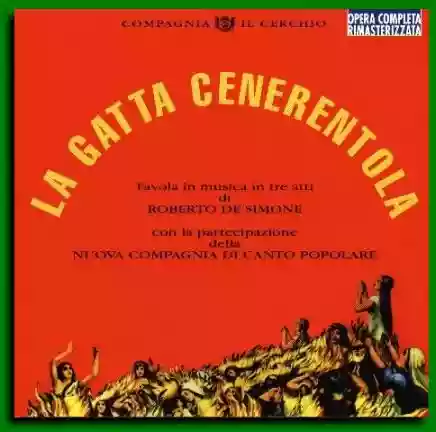
After the excellent artistic collaborations with the Nuova Compagnia di Canto Popolare, Roberto De Simone decides to compose his own theatrical-musical work. And this time he directs the NCCP. In 1976 he writes and stages "La gatta Cenerentola". The theatrical work is composed of three acts and is a reinterpretation of the homonymous fairy tale (original title "La gatta Cennerentola") by Giovan Battista Basile, composed in the 1600s and contained in "Lo cunto de li cunti".
In composing the work, De Simone also draws inspiration from other versions, written or oral, of the same fairy tale in the Neapolitan tradition.
The result is a majestic work, perhaps the Neapolitan theatrical masterpiece par excellence, which skillfully mixes acting with music, embedded with the typical ingredients of the reality that is Naples. The text is entirely in Neapolitan, but a pure, perfect Neapolitan, that remains immortal over time.
The story indeed narrates the events of Cenerentola, from which Perrault will draw inspiration for his novel. In fact, there are differences between Basile's writing and that of the Frenchman, just remember that in the original work Zezolla (or Cinderella) kills her stepmother, only to find herself with an even more wicked one.
The story takes place in baroque and 17th-century Naples, dominated by the Spaniards, and is surrounded by the music created by De Simone, perfectly successful and fitting in the context.
"La gatta Cenerentola" is the encyclopedia of traditional Neapolitan music, because it consists of all the stylistic solutions dating back to that period, namely villanelle, tarantelle, moresche, tammorriate, and so on. It seems superfluous to mention the splendid musical performance of the NCCP, in which the sounds of classical instruments blend and intertwine with those of popular ones, making this unique work.
De Simone's masterpiece, however, especially paints the situation of the city of Naples, the true and only protagonist of "La gatta Cenerentola", which is dominated by an oppressive and foreign "stepmother".
If it had been composed in the 1600s-1700s, today we would talk about it as a fundamental composition from a historical-musical point of view. Instead, it was composed in 1976 and remains an important testimony of Neapolitan cultural roots.
Loading comments slowly
Summary by Bot
Roberto De Simone’s 1976 theatrical-musical work La Gatta Cenerentola is a powerful reinterpretation of the 17th-century Neapolitan fairy tale by Giovan Battista Basile. The production blends classical and popular music styles in perfect harmony, underpinned by a pure Neapolitan dialect. This masterpiece highlights Naples as the true protagonist, skillfully depicting its historic and cultural background. The Nuova Compagnia di Canto Popolare’s performance elevates the work to a timeless cultural testimony of Neapolitan roots.Tracklist
01 Jesce Sole (05:18)
02 È nata (03:54)
03 Villanella di Cenerentola (02:06)
04 Canzone dei sette mariti (03:22)
05 Canzone delle sei sorelle (03:22)
06 Duetto (03:35)
07 Rosario (04:34)
08 Canzone del monacello (01:51)
09 Villanella a ballo (02:13)
10 Moresca (01:55)
11 Madrigali (05:01)
12 Tarantella (02:04)
13 Coro dei soldati (03:52)
14 Primo coro delle lavandaie (05:06)
15 Secondo coro delle lavandaie (06:30)
16 Canzone della zingara (03:02)
17 Il suicidio del Femminella: Jesce sole (08:59)
18 Scena delle Ingiurie: Finale (07:54)
Nuova Compagnia di Canto Popolare
Nuova Compagnia di Canto Popolare (NCCP) is a Neapolitan folk ensemble founded in Naples in 1969. Under the artistic direction of Roberto De Simone and with key members including Eugenio Bennato, Giovanni Mauriello, Peppe Barra, Fausta Vetere, Nunzio Areni and Patrizio Trampetti, the group revives Southern Italian traditions through ethnomusicological research and theatrical performance. They rose to national prominence after the Festival di Spoleto in the early 1970s and remain active.04 Reviews
