
 •
Rating:
•
Rating:
THE REVIEW
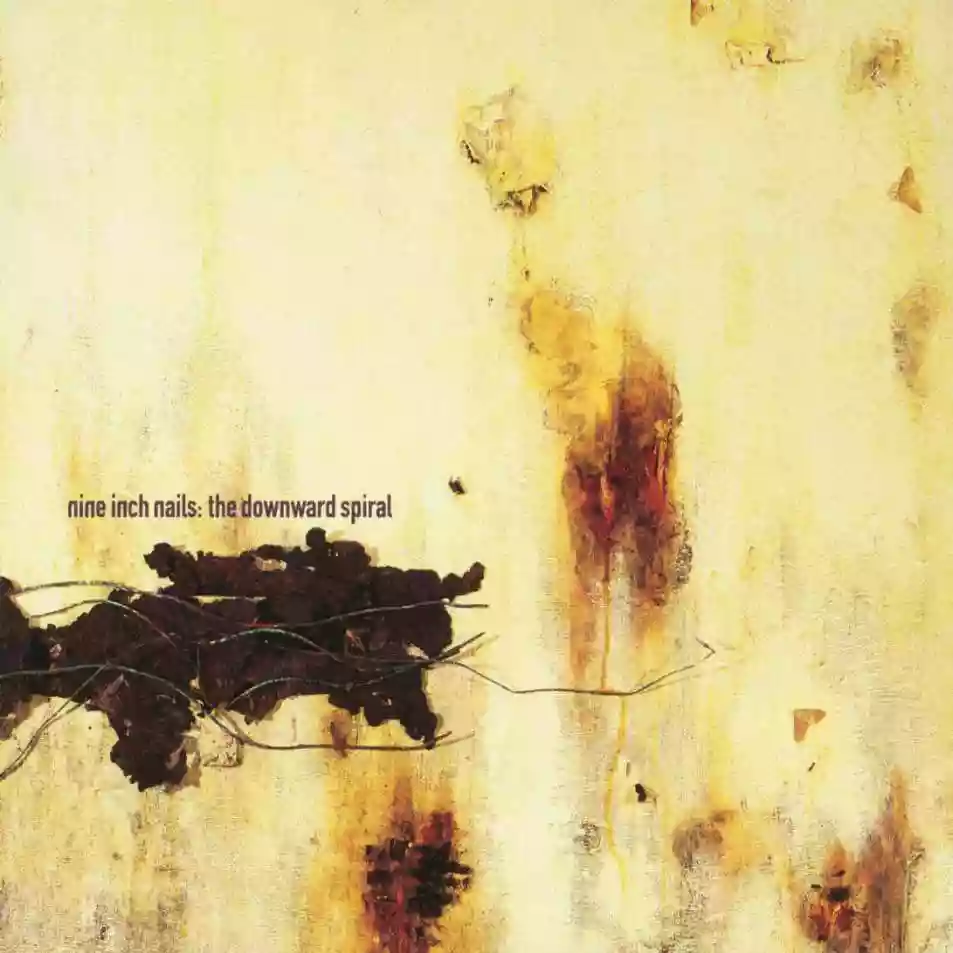
It's been almost a year since I last posted a review on the site. Published or not, I haven't written one, which means my absence is due to this "reviewer's block" of mine. To come back in a state of grace and ensure some thumbs up, I should write a truly original and objectively beautiful review. Unfortunately, today I don't want to talk about a dark album, recovered from the depths of the Musical Ocean. The album I want to share my thoughts on, and which gives me the opportunity to bare my soul, is well-known—at least among true music enthusiasts, not the average neighbor. Considered a milestone (rightly so), an involuntary manifesto of an era, a masterpiece of that hybrid genre known as industrial rock, a term that Trent Reznor, the one-man band, detests and does not recognize as his own, today I want to talk to you about "The Downward Spiral" by Nine Inch Nails.
I think there are few albums capable of causing such strong upheaval in the listener's soul as "The Downward Spiral." Fourteen tracks, a thousand emotions. A massive electric shock to the brain, a white serpent that crawls, naked, towards you from behind, catching you by surprise; from the very beginning you feel the discomfort, the venom that promises to enter your flesh sooner or later. The serpent approaches, but slowly, unhurriedly. Inside you, millions of thoughts form; the music accompanies you in retrieving traumas. The punches inflicted by the climaxes and the artificial sounds blasted at high volume remind you that you are alive, and that pain exists: it's the only true thing.
Self-destruction begins with "Mr. Self Destruct," conceptually opening the story of a nihilist angry at everyone and everything. The listener doesn't know what to expect as their ears welcome what sounds like a man beaten to a pulp. They become faster, more urgent. And then the first electric shock. You have entered the spiral too! "I am the voice inside your head, and I control you/I am the lover in your bed, and I control you/I am the sex that you provide, and I control you/I am the hate you try to hide, and I control you." Voice, lover, sex, hate… a crescendo of passion, repressed, that then explodes in the chorus where Mr. Self Destruct asserts his role decisively. But there is calm after the storm. Or at least so it seems. Reznor whispers verses, languidly, as if addressing the most intimate part of you. And when you think the violence has dissolved in favor of an unsettling, though almost reassuring, finale, the machine that grinds you starts again, grinding you who are the accused, like the anti-hero of the album.
After the first immense act, which lasts only four minutes, follow, without discontinuity, songs increasingly suggestive, more insinuating and malign. The thread that connects much of the album is the simple and lapidary phrase "Nothing can stop me now," which reaches its peak in "Big Man With a Gun," a fast and relentless scream, emitted with full lungs, that tears the air, not caring about surfaces, to push further. In between (between the incipit and "Big Man"), one episode is more beautiful than the next: "Heresy" as a devastating denunciation, as a declaration of independence, addressed to those who want to indoctrinate everyone. By the way, another word that often recurs, especially in the first part of "The Downward Spiral," not by chance, is "pig." It alludes to the writings on the doors and walls of the Polanski/Tate couple's house, the latter killed by Charles Manson's Family in 1969. Yes, because Reznor is deeply connected to this story, it fascinates him so much that he chose the old crime house to set up his recording studio, specifically for the colossal creation he had in mind. A quarter of a century after the tragedy, a young man from Pennsylvania enters the story to create another, to "revive" the place. The atmospheres that "The Downward Spiral" benefits from are also explainable through this choice by Reznor, which led him to record what most claustrophobic and alienating could be conceived. There's sex, there's violence, there's animality. "I wanna fuck you like an animal, I wanna feel you from the inside," Reznor sings with a voice nothing short of terrifying, while the music becomes more paranormal, "psychedelic." I challenge anyone not to get chills listening to the main synthesizer melody, which in the tail end of the track dissolves into an even more suffocating melody, culminating in those few piano bars, disturbed only by some industrial noise.
With "Closer," a chapter seems to close, promptly replaced by a central section with no holds barred, equally oppressive, if not fatal: the character in the story is now inside the vortex, the spiral, mortifying himself more and more, destroying himself not to feel like an object, but as an author. The Ruiner's disorder-maker is afraid, but to hide it, he hurts himself, shouting his title, indeed, of ruiner. But it's not just about this: the spiral forces him to change. He must become something else, rejecting the past. Never a slave again, never compromises again! "I beat on my machine, it’s part of me, it's inside me/I'm trapped in this dream, it’s changing me, and I’m becoming / The me you know had some second thoughts / He’s covered with scabs, he is broken and sore / The me you know doesn’t know what it's like / That part of me isn’t here anymore." The only thing the character of the album agrees to change is his inclination to change his mind to please others. So, he humiliates himself, destroys himself, because the noise in his head wants him dead. But at some point, he has second thoughts, says to himself "I don't want this," but it's useless, because his alter ego brings him back to "madness," in "Big Man With a Gun," which, as mentioned above, acts as a desperate scream of madness following the noise, the voice in his head, telling him to shoot, shoot, shoot.
A brief instrumental anticipates the chilling "Eraser," in which the anti-hero begs to be eliminated, erased from the face of the earth. The serpent has never for a moment stopped approaching his trembling, alienated body cut off from the rest of the world. "Reptile," one of the most dramatic pieces in music history, is the last resort, beyond which there's no hope. The memory of a she, whose entrails are fed by the seed of a thousand other men, delivers the final blow to the protagonist, who, finding himself alone, humiliated, discovering he lived a lie, acknowledges his own impurities, deciding to annihilate them in the only possible way, in the only way he conceives: suicide. "Never thought it would be so easy / He pulled his gun to his face / Bang! / (so much blood from such a small hole)." At death's door, the anti-hero, broken by existence, broken by indifference, releases his last confession: "I hurt myself today / To see if I still feel / I focus on the pain / The only thing that's real." "Hurt," the summation of the entire album, after thirteen tracks of pure violence (except "A Warm Place") that have devastated the listener deeply, catches one off guard, leaves them puzzled, even more exhausted, like after a painful orgasm. The unnatural calm of the arpeggio on which "Hurt" is based is the essence of everything. Some reverberations of the dark past just dissolved make way for the strangled, tearful cry of a man leaving everything, his empire of filth. The serpent is now ready to swallow him, and the last, unexpected, electric shock marks this step, its leap.
"The Downward Spiral," released in 1994, is perhaps the last great concept album in rock history, the last intense effort of a struggling generation. Woodstock '94 will establish Nine Inch Nails as one of the most seminal, visceral projects of the end of the millennium. Reznor would never again manage to compose a work of such intensity. Only the subsequent "The Fragile" can be considered a classic, along the same lines, though still a small masterpiece. As far as I'm concerned, when I listen to "The Downward Spiral," I have little faith, both in humanity, and in the fact that Reznor will one day create something that matches its greatness. Few works are so true, pure in their glaring impurity. The machine that unites with the man, a perfect union materializes in the grooves of "The Downward Spiral."
Loading comments slowly
Summary by Bot
The Downward Spiral by Nine Inch Nails is hailed as a seminal industrial rock concept album. It powerfully explores themes of pain, self-destruction, and inner turmoil through intense, atmospheric music and evocative lyrics. The reviewer highlights the album's emotional impact, storytelling, and Reznor's visionary artistry. This 1994 release remains a milestone in rock history and a profound listening experience.Tracklist Lyrics Videos
Nine Inch Nails
Nine Inch Nails is an American industrial rock project founded by Trent Reznor in 1988. Reznor is the primary creative force (songwriter, producer, multi-instrumentalist). The project is known for landmark albums such as The Downward Spiral and The Fragile.40 Reviews
Other reviews
By Vic Sorriso1
Self-destruction hides in what you most desire because it is what holds true power over you.
"Hurt" transcends personal pain and becomes an indictment of all modern society as an "empire of dirt."
By CycoCiccio
Trash of this nature, where technology is posed as genius, noise as sound, and personal neurosis as inspiration.
This monstrosity of disjointed cacophonies... struggling to listen to the whole thing again.
By alCOOL
I hear a reverberation in the hole where my head should be, a blow, like a hammer breaking my eardrums, and a voice that doesn’t belong to me… it is PAIN.
Making a “normal review” of “The Downward Spiral” would have been like enjoying a plate of pasta using a pitchfork.
By TheFragile
Never again has the genius of Trent Reznor reached the heights he achieved with "The Downward Spiral".
"Closer" is not simply a song: it is the fiery embrace of two lovers, it is irresistible lust in the atmosphere.
By Uomodimerda
It was calling me, offering me knowledge, pain, violence, the end.
Listen to this album only if you are in the mood to indulge in many, many mental jerks until you become blind to any emotion.
