
 •
Rating:
•
Rating:
THE REVIEW
Eunice Waymon became Nina Simone, a persona that over the years would eclipse her birth name and enter history. Nina for "nina," "la môme," the nickname given to her by a Latin boyfriend of whom nothing is known. Simone for Signoret in "Casque d'Or," a film the pianist had seen in a Philadelphia cinema that left a strong impression on her (David Brun-Lambert, Nina Simone: Une Vie, Editions Flammarion, 2005, p. 53).
In an effective biographical scan, Kerry Acker (in Nina Simone (1963-1966); Chelsea House Publisher, Philadelphia, 2004) distinguishes and identifies her life's phases as: the prodigy (1933-1944); the piano concert performer (1944-1954); the "chanteuse" (1954-1959); the star (1958-1962); the activist, "The high Priestess of Soul," which I would translate as the sublime priestess of Soul (1967-1968); the expatriate (1970-1978); the diva (1978-2003). Perhaps in this last fragment of the life cycle, I would also identify the decline of old age. A harsh old age, truly outrageous for this wonderful creature.
When her first record was released in 1957, Nina had already been singing and playing for 3 years during the summers at the Midtown Bar & Grill in Atlantic City. That is where her story begins. She was then 21 years old. Word quickly spread through the streets (today, it would be on blogs and DeBaser): "there's a young black musician in town and what she sings is unique".
21 years old, yet the character tempered during childhood and adolescence was already fully defined, complete and intact within the behavioral range that went from unbearable acerbity to exquisite grace:
"when she reached the piano chair, silence fell around. In a second-rate bar, in the heart of a city burned by insomnia, she managed to silence everyone from the first note. Nothing like it had ever been seen here" (David Brun-Lambert, op.cit., p. 52)
Three years of such internship, also learning the relationship with the audience. Songs stretched over long times. She and the piano. The piano and her. She with herself, she with the people of her kingdom.
When the opportunity to make her first record presented itself, it came as no surprise that it took her only 24 hours to prepare and complete it.
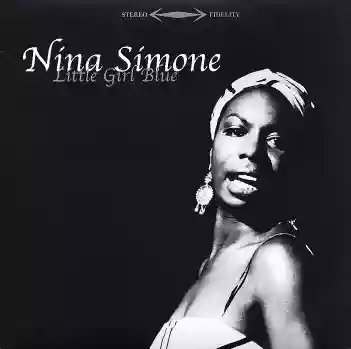
1957: 14 musical tracks, all successful on the first try, which placed her in history. All the talent she would show in the following years was already concentrated in that record. Her uniqueness, her "individuation" is readable yesterday and today in those 14 perfect, enduring, classic tracks.
I'll stop here. Dear reader, you must have realized by now that Nina Simone is one of my many weak points. With her, I become fragile and exposed to emotion. I get lost, and I feel happily lost, only to recover and start listening to her again. Yes: it is an addiction. A Ninaddiction.
I'll talk about the entire album another time.
Today, I just wanted to say that there you can hear the ballad "Little Girl Blue" by Richard Rodgers and Lorenz Hart.
"Sit there
And count your fingers
What can you do
Old girl you're through
Sit there
Count your little fingers
Unhappy little girl blue
Loading comments slowly
Summary by Bot
This review celebrates Nina Simone's groundbreaking debut album Little Girl Blue, highlighting her unique talent and emotional depth. It traces her early career and the significance of the 1957 record, emphasizing the timeless quality of its 14 classic tracks. The reviewer expresses a personal, heartfelt connection to Simone's artistry.
Nina Simone
Nina Simone (born Eunice Kathleen Waymon) was an American singer, pianist, songwriter, and civil-rights activist. Blending jazz, blues, gospel, and classical training, she earned the moniker “High Priestess of Soul.” Her recordings and performances became cornerstones of 20th‑century music and social commentary.04 Reviews
