
 •
Rating:
•
Rating:
THE REVIEW
The importance of being Nina Hagen: curiosities, extravagances and other wonderful anomalies, chapter I.
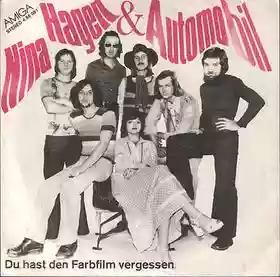
An unknown Nina Hagen to most, a few years before 1978, her departure from east to west and before becoming the Diva Nina, queen of the Neue Deutsche Welle. At that time, she was little more than a teenager, about to become the number one pop star of the DDR, launched into orbit by the success of her first single "Du Hast Den Farbfilm Vergessen", released by Amiga, the historic state label now absorbed by Sony BMG. Voice, stage presence, charisma, and overwhelming colors were almost borderline for the regime's narrow views, and Nina Hagen & Automobil, the name of her first real band, never got to record an LP, limiting themselves to another couple of singles and various recordings never officially released; Nina left before, for her own good and for the sake of art, thus concluding this first taste of celebrity. These thirteen songs all dating back to the period 1974-1975 remain, probably the complete repertoire of Nina Hagen & Automobil, a godsend that would delight any nostalgia seeker, collector of musical memorabilia or curious in general.
This obscure compilation, probably something relatively common in the "everything for 2 Euro" bins or in German rest stops, is in fact the first, true debut album of Nina Hagen, a document of great historical value, a fragment of a past that should not be forgotten but also a truly pleasant listen. If you know the first ABBA album, "Ring Ring", know that this pre-historic Nina roughly follows the same stylistic coordinates, offering a youthful, cheerful, lighthearted bubblegum pop, sometimes with blatantly parodic tones, with that unmistakable voice as an added bonus. Besides the subtle satire of "Du Hast Den Farbfilm Vergessen" with its fresh swing, the most well-known song of the lot, the other singles released by the group in its brief existence are also present, namely a "He, Wir Fahren Auf's Land", an amusing march with prominent bass and brass, and the vaudeville of "Hatschi-Waldera", where Nina showcases her extraordinary entertainer and theatrical qualities flawlessly simulating a cold, to which this hilarious little song is dedicated. Among the highlights are also "Wir Tanzen Tango", of which the title alone gives the idea, and the charming orchestral ballad "Honigmann", remarkable rockabilly influences including "Rangehn", which will be revisited with not too many changes in "Nina Hagen Band", a clear demonstration of coherence and pride in her origins, the flamboyant "Mama" and "Was Denn", which have nothing to envy of "Crazy Little Thing Called Love" by Queen, and "Komm, Komm", an almost surprisingly mature blues rock.
Other songs instead move along the coordinates of a 60s orchestral pop, the sentimental ballad "Wenn Ich An Dich Denk", almost epic and classical in its tremendously outdated but effective arrangement, the funny and sparkling "Ich Bin So Alt" with its carefree whistling piano and trumpet, and the harmless and easy-listening little rocker "Ich Bin Da Gar Nicht Pingelig", while "Das, Weil Ich So Schon Bin" shows a certain ambition, an attempt to mix things up by combining orchestrations, choirs, and piano with much sharper guitars (for the average work) and a more aggressive singing style, a prototype of the more classic Nina Hagen style, still hybrid and uncertain but already recognizable. This was Diva Nina at her beginnings, a fresh-faced girl with a wonderful cheeky grin of a likeable rascal printed on her face. A bit campy, sugary, and kitschy to the extreme and seemingly naive, yet I often find myself humming these outdated tunes; it might be because Nina Hagen sings them, but here you can already feel the seed of greatness destined to bloom, and Nina herself has never disowned these bubblegum pasts, no, she is not a prostitute who sells for a pittance, and after getting to know this side of her vast personality thoroughly, everything is clearer to me, now I perfectly understand what pieces like "Wenn Ich Ein Junge War" or "Fall In Love Mit Mir" are doing in an album like "Unbehagen."
Loading comments slowly
Summary by Bot
This review explores Nina Hagen's first real band, Automobil, and their 1974-75 bubblegum pop recordings, highlighting their historical importance as Nina’s debut work. The album blends lighthearted 60s orchestral pop with playful satire and early signs of Nina’s unique style. Though kitschy and cheesy at times, the songs reveal the roots of Nina’s later musical evolution and charm. This compilation is a must-listen for nostalgia fans and collectors, offering insight into a young diva’s formative years.Tracklist Lyrics Videos
Nina Hagen
Nina Hagen is a German singer and performer from Berlin whose theatrical voice and irreverent persona made her a seminal figure of punk and Neue Deutsche Welle. Breaking through in the late 1970s, she built a career of constant reinvention across punk, new wave, pop, spiritual music, and big‑band standards.05 Reviews
