
 •
Rating:
•
Rating:
THE REVIEW
Nikolaj Maslov is not young, not elegant, not famous. He is not a professional designer, not a trendy illustrator, not a star.
Nikolaj Maslov is a Siberian farmer.
Stocky, shy, about forty-five years old, he shows up one day in 2000 at the door of the French bookstore-publishing house Pangloss with a stack of pencil drawings. He pretends to browse books for an hour before finding the courage to introduce himself.
His drawings are remarkable, but he is not looking for compliments. He wants to be financed, to leave his job as a night watchman and dedicate himself to finishing his work. For a small publishing house, such a request is akin to a joke, but after seeing the drawings, the owner, Emmanuel Carrère, agrees.
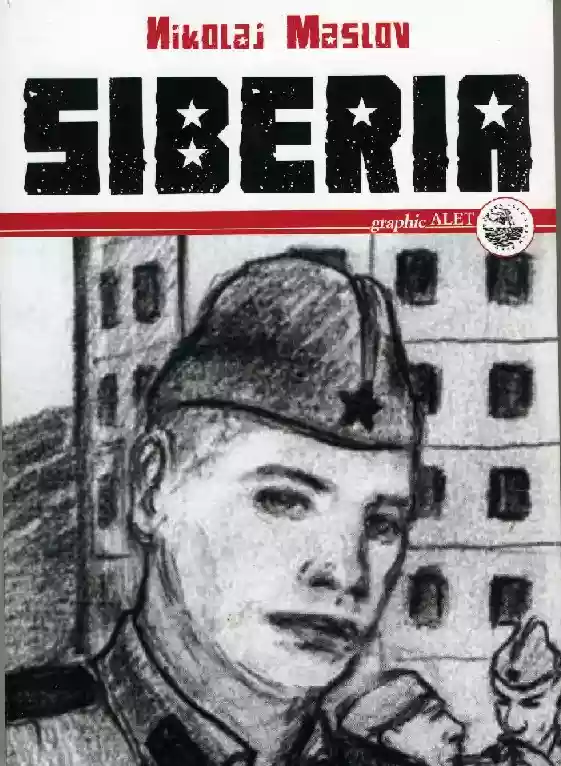
This is how the graphic novel "Siberia" was born, released in 2004 and becoming a small cult object for enthusiasts of that "terra incognita" halfway between illustration, novel, and comic frequented also by people like the gloomy Zezelj or our own Gipi (to mention just the first that come to mind).
"Siberia" tells what its author knows best: himself and his country. His childhood in the coldest and most desolate region of Russia, the military service, the history of his life from the gray and impoverished Soviet 70s to the advent of the glitzy but equally bleak post-communist era.
The pages, vast white expanses stained with gray, narrate with sparse and heavy texts an annihilated existence. First by the obtuseness of the Party and vodka, then by the cult of easy money and - again - by vodka. Precisely vodka, along with the chill of the vast Siberian spaces and the daily anguish of a hopeless people, is the true protagonist of the book. Opium for a people whose passions seem erased by boundless passivity and resignation.
"Siberia" narrates the abundant food drawn on propaganda posters, but absent from the citizens' tables.
The grocery stores with kilometers-long queues to get, almost always, only vodka.
The corruption of a system that imposed equality only to live off favoritism.
Of a world of tanks and barbed wire, of bones constantly appearing from the mud of abandoned villages.
More than many essays, documentaries, and historical novels, "Siberia" manages to tell the absurdity of the Soviet regime, the ban on thinking, the absolute poverty but impossible to declare, under penalty of being accused of defeatism and imprisonment. But Nikolaj Maslov does not spare even the era following the regime's fall: the villages become depopulated and fall into ruin, the new power is as violent and corrupt as the previous one without even trying to fabricate illusions anymore. The only escape for young Russians remains the same as in Brezhnev's years: drink until crawling on the ground.
Maslov's characters are awkward and confused puppets, sometimes capable of flashes of humanity, sometimes cruel, almost always drunk and at the mercy of a sort of chronic fatalism. The author does not seem to want to denounce anything in particular, but only to describe what he sees, with fierce objectivity. He is aided by the intensity of the images he manages to create, his talent for framing, his ability to drag the reader into a cold and hypnotic rhythm.
The only light on the oil-stained ice of these pages is the love for art and drawing. A love that has become, for the author, the only reason for living, cure, and salvation from alcohol and inner emptiness. Armed only with a pencil and his gift, Maslov has managed to tell his story and that of his people with great compassion (in a literal sense) but without ever falling, not even for a moment, into rhetoric, self-pity, or sentimentality.
Chapeau.
Loading comments slowly
Summary by Bot
Nikolaj Maslov's graphic novel Siberia is a raw and haunting portrayal of life in the harsh climates of Soviet and post-Soviet Russia. Drawn from personal experience, it explores themes of poverty, alcoholism, and societal decay. The narrative combines sparse text with powerful images to paint a bleak yet compassionate picture without falling into sentimentality. Maslov's art serves as both a personal refuge and a striking lens to view a forgotten world. This work is praised as a cult classic among graphic novel enthusiasts.
Nikolaj Maslov
A Siberian farmer and artist who brought pencil drawings to the French publisher Pangloss in 2000 and published the graphic novel Siberia in 2004.01 Reviews
