
 •
Rating:
•
Rating:
THE REVIEW
Even a dark messiah of the apocalypse like Cave wanted to make money at a certain point in his legendary career, but unlike today's half-hearted attempts, he wanted to make money without sacrificing the quality and immense art inherent in his works on the altar of business until that moment (it was 1994).
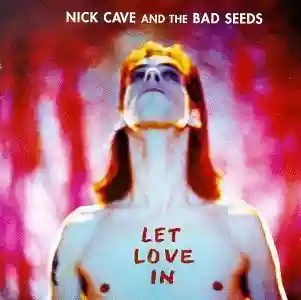
He succeeded to perfection with "Let Love In", the album that practically reconciles him with the jet set, there he is on the cover, after 14 years of a borderline career with the mask of Muerte from the Bergmanian Seventh Seal now ready to feature in tabloids, a little drug he still takes, but true heroin addiction is only a memory (according to his interviews, he might still be taking it, eh,) and he has much to say, having exceeded the art itself at the risk of life, such a man has much to ask, much to ponder: first question of the supreme post clamor: Do you love me? Heroin has not erased the noble desire of humanity: love.
The atmosphere is saturated with seaweed and Rio de Janeiro's mucilages, malodorous reminiscences of that "Good Son" that was, a swamp of sounds without resonance, rhythms without dance, Nicky Cave is addicted to love trinkets, "Nobody's Baby Now": Nick the Stripper can finally cradle a 17-year-old girl in his arms without stretching his hands too far, it's the birthday party of the girl and the whole family is gathered, only innocent caresses and no more Sigfriedian ecstasies that annul the antithesis life/art, Cave brandishes his tongue like an elastic dagger, imbued with unsettling joy, the fruit of his vibrant, razor-sharp blade, which only wants to hiss. No longer the shady figure from Tupelo, but an old gringo aroused just before slipping into the senility of the boatman's call.
The album is all a fiery red suspended between love-eros-o-scene (as indeed was his entire career), like the splashes of red on the cover, but someone like Cave doesn't fall in love, he exceeds in love, lets love in ("Let Love In") only to kill it and deliver it to the obscene (o-scené. Out of the scene, beyond the eros), the love Cave talks about is not ultra-bourgeois, that is the breath of the species, it's about starting a family, Cave is something else, his Let Love In is an arch of eyebrows under which the entire sky passes, a real sky of violence, of lava, of hurricane and rage, a deeply theological sky, like the trumpet of the abyss, like hemlock drunk in a dream, a sky collected in all the vials of death, a sky of suicidal lovers.
Don't be deceived by the nowadays Christian converted Cave, Christianity gave Eros the poison to drink, though it did not die, it corrupted into vice. The sonic tricks of Blixa and Harvey in "Red Right Hand" should make one reflect on the music of this album which for me is among the best ever written by the Bad Seeds, "Loverman" is perhaps the last apocalypse written by Cave along with the final murder ballads two years later: the word apocalyptic has interesting origins, coming from the Greek "apokalupsis", which means revelation, revelation in turn derives from the Greek "apokaluptein" which means to unveil, "apo" is a prefix that in Greek means "from", "kaluptein" on the other hand means "woman's veil", so apocalyptic is a term that describes what is revealed when the veil of a woman is lifted, or when a random Cave album is inserted from 1980 to 1996.
Loading comments slowly
Summary by Bot
Let Love In marks a pivotal moment in Nick Cave's career where artistic integrity meets broader appeal. The album explores themes of love, apocalypse, and theological depth through complex lyrics and haunting soundscapes. With standout tracks like 'Red Right Hand' and 'Loverman,' this 1994 release remains one of the Bad Seeds' best works. It reveals a mature Cave who balances darkness and human desire with raw emotion and poetic insight.Tracklist Lyrics Videos
Nick Cave & The Bad Seeds
Australian rock group led by singer-songwriter Nick Cave, formed in 1983; known for dark, literary songwriting that spans blues, post-punk, gospel and experimental sounds.44 Reviews
Other reviews
By 47
"‘Let Love In’ is the album of this inner conflict, of wanting to stay at the helm at all costs when the ship is sinking and the icy wind allows no breath."
"The album... is nothing but the exorcism... of the shadows of its author, which purify through writing like a liver."
