
 •
Rating:
•
Rating:
THE REVIEW
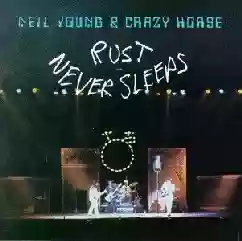
The year was 1979, when Neil Young and his Crazy Horse (Frank "Pancho" Sampedro on guitars, Billy Talbot on bass, and Ralph Molina on drums) recorded "Rust Never Sleeps", one of the masterpieces by the Canadian singer-songwriter. The decision to record the album live was probably made to achieve a more "alive" sound: any artist performing live gains much more spontaneity compared to a normal studio album, which, with few exceptions, is a "colder" work. The album exclusively contains new material; none of the songs here appeared on any of his previous LPs. The only flaw of the record, in my opinion, was the removal of the audience's background noise (applause, whistles, and various shouts), which wasn't even done properly: in some tracks (for example, the first one, My My Hey Hey) you can distinctly hear people applauding, towards the beginning. Note also the period when the album was released: right in those years, the Punk phenomenon literally "exploded" in England and the USA, making everyone believe that "rock was dead, and punk was In". Not many musicians or bands of the time, (except the old rock dinosaurs still active, like Pink Floyd) created rock absolutely devoid of punk influences (Dire Straits first and foremost, followed by the reggae-rock of the Police). An album, therefore, completely against the grain, out of fashion at the time. But Young doesn't care at all about the fashions and customs that are in vogue at that moment: courageously, he decides to release the LP. And success is immediate.
It is divided into two sides: one acoustic, with Neil on vocals, guitar, and harmonica (only here and there supported by Sampedro's rhythm guitar) and the other electric, almost garage-rock, composed of furious strumming and maximum distortion on Hey Hey My My.
Side A opens with My My Hey Hey, a nostalgic ballad that refuses to surrender, which still gives us hope in rock: "The King is gone but he's not forgotten" (referring to Elvis, of course). The following "Thrasher" is also very beautiful, melancholic but at the same time, it leaves a sense of hope to the listener's ears, as does the subsequent "Ride My Lama". "Pocahontas" talks about the famous Native American girl and denounces the abuses the settlers committed against these people: the music is beautiful, a touch of innocence shines through the notes. Closing the first part of the album is done by "Sail Away", where there is also a drum accompaniment, and joining Young is the talented vocalist Nicolette Larson.
Side B begins with the rocking "Powderfinger", rhythmic and very "garage" style: Neil's electric guitar refrain is beautiful, almost as if it were conversing with him. "Welfare Mothers" is another distorted and cheerful rock piece, with a catchy chorus, a statement that also applies to the penultimate "Sedan Delivery", the only difference being that the latter is much faster. To beautifully close the album, comes Hey Hey My My: the electric version of its sister My My Hey Hey is the hardest and roughest song of the entire work (I prefer it to the acoustic version: this electric one gives more emphasis to the lyrics, more emotional charge).
In short, an album with which Neil Young wants to give us a lesson: Rock'n'Roll Will Never Die...
Loading comments slowly
Summary by Bot
Neil Young's 1979 album 'Rust Never Sleeps' is celebrated as a bold statement against contemporary trends, blending acoustic and electric rock. Recorded live, it features new material that showcases Young's songwriting and musicianship. The album divides into two distinct sides with a strong emotional and political edge. Despite minor flaws in sound editing, it remains a timeless classic emphasizing that rock 'n' roll will endure.Tracklist Lyrics Videos
01 Opening: Star Spangled Banner ~ A Day In The Life (00:00)
02 Welfare Mothers (00:00)
04 Lotta Love (00:00)
06 I Am A Child (00:00)
08 After The Goldrush (00:00)
09 Thrasher (00:00)
10 My My, Hey Hey (Out Of The Blue) (00:00)
11 When You Dance I Can Really Love (00:00)
14 Powder Finger (00:00)
15 Cortez The Killer (00:00)
16 Cinnamon Girl (00:00)
18 Hey Hey, My My (Into The Black) (00:00)
19 Ending (School Days) (00:00)
20 Tonight's The Night (00:00)
Neil Young
Neil Young (born 1945) is a Canadian singer-songwriter and musician, active since the 1960s. He gained prominence with Buffalo Springfield, later collaborated with Crosby, Stills, Nash & Young, and has released influential solo albums and records with Crazy Horse across folk, country and electric rock.67 Reviews
