
 •
Rating:
•
Rating:
THE REVIEW
Portrait of the Artist as an Adult, Part One.
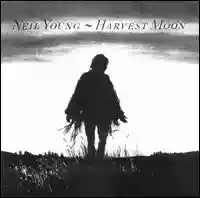
Paraphrasing Joyce, this might be the most fitting definition for “Harvest Moon.” Commonly defined as the successor—exactly twenty years later—of that “Harvest” which carved Neil Young's name into music history, this album is actually a much more complex work.
The first part, indeed, of a project aimed at addressing the myths that have dotted the Canadian’s career, and whose conclusion will be found in the subsequent, painful “Sleeps with Angels.” In this sense, “Harvest Moon” represents the sunny side of this quest. Young arrives there in 1992 by turning down the volume, bringing back steel guitar, poignant harmonicas, and sensual female backing vocals after “Ragged Glory” and “Weld” had closed another circle—the search for the perfect guitar sound, cacophonous and distorted, serving as a seal for the return of the most authentic rock to the center of contemporary music during the grunge season.
The return to the sounds of “Harvest” is also certified by the reunion with musicians who collaborated on that album, like James Taylor, Nicolette Larson, or Linda Ronstadt, and it’s no coincidence at all. Another account with the past to settle. Young has always had a love/hate relationship with his most famous album, fearing to be trapped in its clichés and which he repudiated at the time of “Tonight's the Night,” even going so far as to parody its styles. Even live, rare are the reprises of the sweet country-rock classics, except of course for “The Needle and the Damage Done,” which its author has always considered among his most personal compositions.
What are the myths that Neil unravels in this “journey through the past”? The myth of “Harvest,” certainly. “Old Man” cited in a bucolic “You and Me” that sends shivers, the creation of heavenly and dreamy melodies in scream-inducing folk ballads like “From Hank to Hendrix,” “Dreamin’ Man,” and “Unknown Legend,” or in a “Such a Woman” that seems like an ideal continuation of “A Man Needs a Maid.” The legend of “Harvest” as the seal of a season where the best minds in music collaborated with each other, putting the dream of a better world into music, before the '70s, with their load of drugs and oppressive despair, broke those magical threads.
In this sense, the dedication to those days in “One of These Days” is splendid, with Neil emotionally declaring “I never tried to burn any bridges / though I know I let some good things go”, a clear message to old friends Crosby and Stills, the same ones that were once “lost in a crystal canyon,” as once recited in “Thrasher.” The pinnacle of pathos, however, is reached in the closure, with the ethereal 10 minutes of “Natural Beauty.” Heir to the epic closings of Young’s albums such as “Ambulance Blues” or “My My, Hey Hey (Into the Black),” it doesn’t pale in comparison to those masterpieces. A shiver runs down the spine when listening to a Young as serene as never before, he who wrote the darkest pages in the entire history of rock. “Natural Beauty” is his acme of maturity, a divine ballad, where female voices provide a unique magical touch.
A disenchanted and poetic journey through life’s disillusions (We watched the moment of defeat / Played back over on the video screen / Somewhere deep inside / Of my soul) or (One more night to go One more sleep / upon your burning banks A greedy man never knows What he's done) and the perennial warning to combat the rust (Don't start yourself too short, my love / Or someday you might find / your soul endangered A natural beauty should be preserved / like a monument to nature).
Poet of Ontario, traveling among us.
Loading comments slowly
Summary by Bot
Harvest Moon stands as a mature, heartfelt continuation of Neil Young's legacy, revisiting and reframing themes from his seminal album Harvest. Featuring soothing folk ballads, country-rock sounds, and collaborations with former bandmates, the album explores personal and artistic mythologies. It showcases Young’s serene and poetic side, culminating in the epic closing track 'Natural Beauty'. This album is a warm, thoughtful journey into the artist’s past and present.Tracklist Lyrics Videos
Neil Young
Neil Young (born 1945) is a Canadian singer-songwriter and musician, active since the 1960s. He gained prominence with Buffalo Springfield, later collaborated with Crosby, Stills, Nash & Young, and has released influential solo albums and records with Crazy Horse across folk, country and electric rock.67 Reviews
