
 •
Rating:
•
Rating:
THE REVIEW
1978: the long wave of punk is devastating, it is about to forever change the musical landscape by merging into the new wave, and almost all rock stars now appear bombastic and jurassic. Except, of course, for Neil Young. He was one of the putative fathers of punk, and in the magma created by the revolution of '77, he happily swims, ready to let his inimitable style shine.
Said and done. Young hits the road again with the faithful Crazy Horse and stages one of the most legendary tours ever, extracting nine unreleased tracks from that series of concerts, which will be released on this record. "Rust Never Sleeps" is probably the Canadian's most significant work. Divided into an acoustic and an electric side, it perfectly encodes the two quintessential musical sides of Neil, between ghostly ballads and electrifying assaults. Conceived precisely in an unrepeatable period, it is the right opportunity to bring out the knots of Young's aesthetics, formally rearrange them into authentic and uncompromising music and finally render them as Art in its purest form.
"La ruggine non dorme mai": already the title perfectly encapsulates one of Neil's obsessions: success and decline, and the ability to exorcise even physical decay through music. "It’s easy to get buried in the past / when you try to make a good thing last," Neil had warned in one of the most significant verses of the masterpiece "On The Beach".
The first side of "Rust Never Sleeps" lucidly takes up and expands on this theme. The first track is "My My, Hey Hey (Into The Black)". Mythologized by Kurt Cobain, who quoted the verse "It’s better to burn out than to fade away" in his farewell message, it brilliantly synthesizes the vicious cycle of show business. Almost blasphemous in juxtaposing Elvis and the Sex Pistols ("The King is gone but he’s not forgotten / Is this the story of Johnny Rotten?"), Neil recognizes in punk the vital force that will carry the rock and roll script forward. The logical next step is "Thrasher". Over a crystal-clear melody, the man from Ontario forges his most intense text and describes in a poetic crescendo that gives chills the birth of artistic inspiration and its journey amidst the ruins of the Woodstock generation's dreams, synonymous with creative death ("where the vultures glides descending"). He pays homage to the fallen ("I searched out my companions / Who were lost in crystal canyons / When the aimless blade of science / slashed the pearly gates" or "I burned my credit card for fuel / heading out to where the pavement turns to sand / with a one-way ticket to the land of truth and a suitcase in my hand / how I lost my friends I still don’t understand"), he bitterly satires the now swollen protagonists of that epic ("They were lost in rock formations or became park bench mutations", dedicated to his former comrades Crosby, Stills, and Nash) to finally find salvation in music ("When the thrasher comes I’ll be stuck in the sun / like the dinosaurs in shrines / But I’ll know that time has come to give what’s mine").
"Ride My Llama" and "Pocahontas" then reprise another famous Young archetype, that of Native Americans. Especially "Pocahontas" touches almost literary shores, and it is perhaps the quintessential ballad in Neil's repertoire. A poignant and vivid portrait of an authentic and betrayed America, it confirms that the key to fighting the ghosts evoked by the album lies in imagination and its translation into Art. After the delightful "Sail Away", a crazy splinter from the world of "Harvest", comes the impetuous second side.
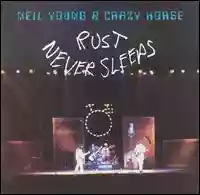
There are only 4 tracks, but so devastating as to justify the co-dedication of the album to Ralph Molina and his associates. The cover of "Rust Never Sleeps" is indeed eloquent, with those enormous amplifiers in the background. With the punk revolution underway, there could only be a feedback frenzy. It opens with "Powderfinger", and here Neil succeeds in surpassing his master Dylan, creating an epic more memorable than "Like a rolling stone". Sublime lyricism lays down the law, painting a scenario of youth violently torn away in a hysterical and sick society. Excellent are also "Welfare Mothers" and "Sedan Delivery", hallucinated and corrosive portraits of post-Vietnam America.
The closing is the infernal electric reprise of "Hey Hey, My My (Into The Black)".
It is probably the most influential track - via Sonic Youth and Dinosaur Jr - on the grunge generation. Molina and Talbot's rhythm section pounds as it is accustomed to, while Sampedro and Young's guitars relentlessly barrage to the cry of "Rock and Roll will never die".
Epochal is still today the right word to define "Rust never sleeps".
Loading comments slowly
Summary by Bot
Neil Young & Crazy Horse's "Rust Never Sleeps" stands as a seminal album merging punk's raw energy with classic rock craftsmanship. Divided into acoustic and electric sides, it captures themes of decline, creativity, and social commentary. The album’s iconic tracks, especially "My My, Hey Hey (Into The Black)," influenced generations, notably grunge artists like Kurt Cobain. Poetic lyricism and powerful instrumentation make it a timeless masterpiece.Tracklist Lyrics
Neil Young & Crazy Horse
Neil Young & Crazy Horse are the long-running collaboration between Canadian singer-songwriter Neil Young and the band Crazy Horse, known for loose, loud, distortion-heavy rock that can pivot into intimate acoustic songwriting.16 Reviews
