
 •
Rating:
•
Rating:
THE REVIEW
Napalm Death enjoyed a peak of notoriety especially after their debut (1987) and at least until the early '90s, when they were then absorbed by a trend they themselves had helped to create and in which, somehow, they physically dispersed. Members of Napalm, in fact, boast a significant curriculum of collaborations and side projects.
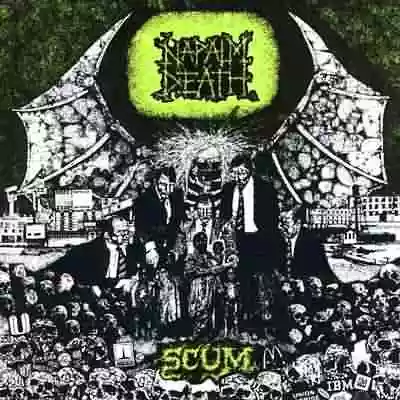
The album with which they revealed themselves to the entire world was "Scum" (literally scum meaning dregs). On the green cover of the vinyl, there was a sticker label that declared something like this: the undisputed fastest band in the world - 28 tracks of furious brutal grindcore.
A lot of furious and brutal music had already been heard around the mid-'80s. Starting from Slayer’s brilliant masterpiece "Reign in Blood," the empire of distorted guitars already seemed destined to have a massive influence on the generations to come and on the evolution of metal in a broad sense. But the bizarre and extreme novelty of Lee Dorrian and Mitch Harris's band was precisely the extremization of execution speed, which bordered on a sonic blend in the strict sense: drums hammered in a continuum of cymbals-snare-bass almost simultaneously, tormented guitars, distorted bass, and cavernous voice with a 10% comprehensibility rate of the words.
Except for some lyrical flashes of a more traditional imprint, appearing here and there, the tracks of "Scum" ran inexorably towards a funnel of magmatic madness, dragged by an anarchic spirit (which can only be inferred from the content by reading the lyrics) and by a destructive will that did honor to the band's very name.
Moments of pure divertissement in the screamed shouts, alternating with demonic grumblings worthy of a gargle with boiling pitch, lead to the ingenious paroxysm of pieces like "You Suffer", which lasts so briefly that it resolves itself in a single turn of the needle (on the old vinyl) and produces a kind of animal grunt: the only four words of the lyrics ("you suffer but why?") condense into a single second!
The extreme turn of Napalm Death, however, was a point of arrival from which it would have been difficult to unstick. Indeed, if Slayer at the time seemed unpleasantly noisy compared to metal standards and then in turn acquired a comprehensible and evolvable standard, the contemporary Napalm marked the ultimate boundary between noise and music, and to this day, the tracks of "Scum" continue to seem unpleasantly noisy! The fact is that even their more recent productions ("Smear Campaign" for example) do not deviate much from the parameters of "Scum".... indeed, if anything they have partially refined the style by sanding it down from certain approximations of the early days.
Intense and decisive, however, was the contribution of their ideological manifesto, in which the music seems more a physical expression than the central pivot of the message launched against multinationals and the exploitation of peoples. The skull-faced vampire on the cover protecting the feudal lords of the chemical industry and banks casts a sinister shadow over the emaciated faces of Third World people: Napalm Death expressed with all possible fury the contours of a concept that needs more inhuman screams than lyrics. Hence, we care little about the comprehensibility of the lyrics (moreover written in the insert): the anguish of poverty and slavery generates the thunderous eruption of the fastest band in the world.
Loading comments slowly
Summary by Bot
Napalm Death's debut album Scum set a new extreme standard in grindcore, pushing speed and noise to the limits. Known as the fastest band globally, their brutal sound combines chaotic drumming, distorted guitars, and raw vocals. The album delivers a fierce political message against exploitation, using music as a physical expression of rage. Despite its challenging sound, Scum remains influential and groundbreaking in metal history.Tracklist Lyrics Videos
Napalm Death
British grindcore band from Birmingham, pioneers of grindcore and active since the early 1980s.47 Reviews
Other reviews
By diamond_darrell
Napalm Death. Just the name says it all.
28 brief and explosive tracks of sonic violence and acoustic destruction, for an incredibly monstrous half-hour of music.
